How to Become an Automation Engineer: Degree, Skills, and Career Steps
Key takeaway: To become an automation engineer, earn a bachelor’s degree in electrical, mechanical, industrial, or computer engineering, build hands-on skills in programmable logic controllers (PLCs), control systems, and programming, gain experience through internships or technician roles, and consider a certification such as ISA’s Certified Automation Professional (CAP) to stand out.
Automation engineers design, program, test, and maintain the systems that let machines and processes run with minimal human intervention. They work in car plants, food-processing facilities, pharmaceutical factories, warehouses, and utilities — anywhere repeatable, precise work can be handed to machines.
What an automation engineer actually does
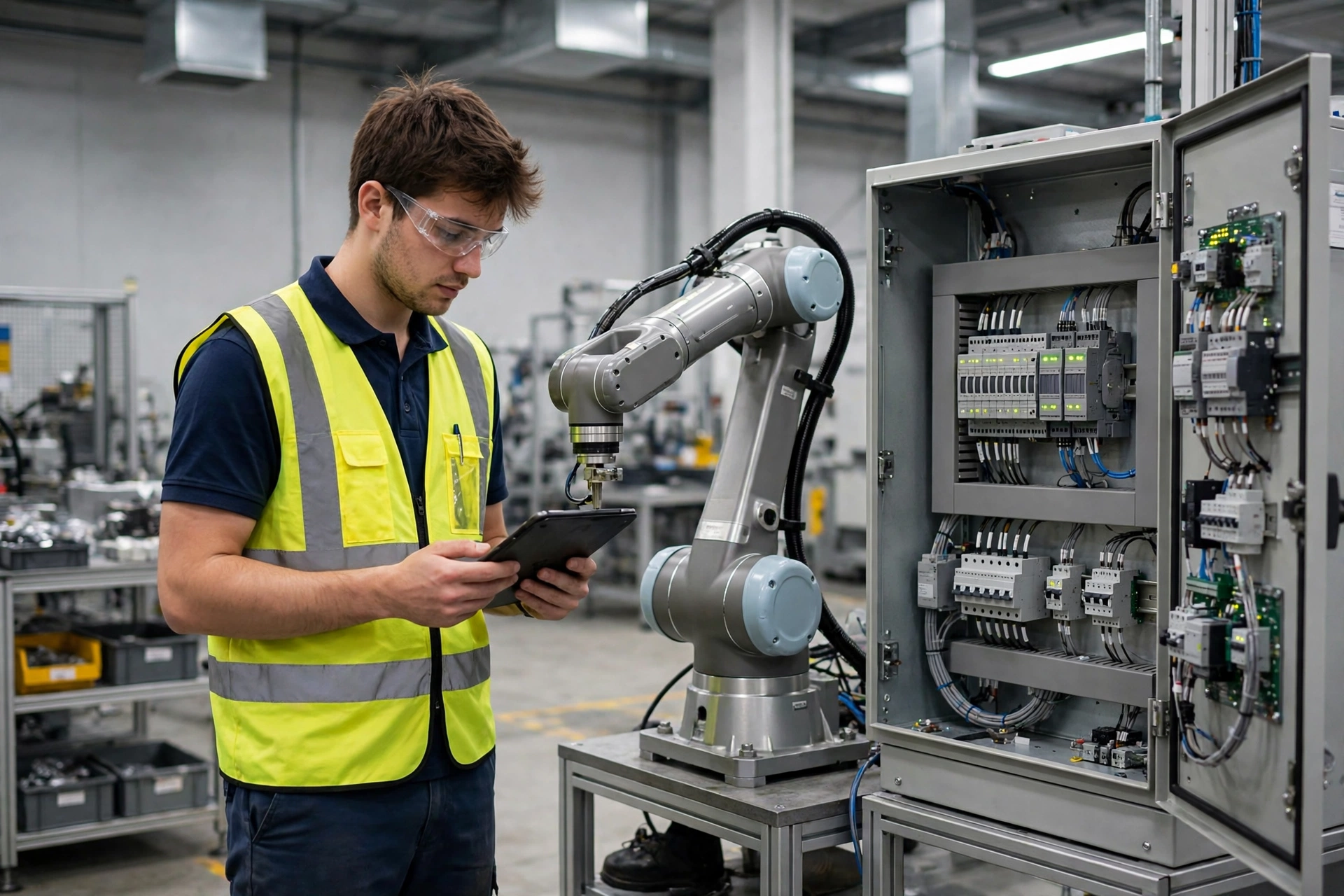
An automation engineer designs, programs, simulates, and tests automated machinery and processes, usually in manufacturing settings where machines do most of the high-precision work, according to Indeed’s career guide. That can mean programming a PLC that controls a packaging line, integrating a robot arm with a conveyor, troubleshooting a sensor fault, or documenting a system so the next shift can run it safely.
There are two branches of the title. Industrial automation engineers work with physical systems: PLCs, robots, sensors, and control networks. Software or QA automation engineers write code that tests software automatically. This guide covers the industrial route, which is what most employers mean by the title.
| Industrial automation engineer | Software / QA automation engineer | |
|---|---|---|
| Main work | PLCs, robots, control systems, factory lines | Automated software tests, CI/CD pipelines |
| Core tools | Siemens, Rockwell Automation, ABB systems | Selenium, Cypress, Playwright, Jenkins |
| Typical degree | Electrical, mechanical, or industrial engineering | Computer science or software engineering |
| Workplace | Plants, factories, utilities | Software companies, often remote-friendly |
How to become an automation engineer, step by step
Step 1: Earn a relevant bachelor’s degree
Most employers require at least a bachelor’s degree in engineering — electrical, mechanical, and computer engineering are the most common routes, TechTarget reports. Mechatronics, which blends mechanical, electrical, and software engineering, is another strong fit. A master’s degree is optional but can help for senior or specialist roles.
Step 2: Build the core technical skills
Beyond programming languages such as Python, C++, or Java, automation engineers must understand industrial control systems and their components — PLCs, supervisory control and data acquisition (SCADA) systems, and distributed control systems — plus computer-aided design software, according to TechTarget. In practice, employers also expect comfort with industrial automation software from Siemens, Rockwell Automation, and ABB. The hiring checklist usually includes PLC programming (ladder logic and structured text), robotics and motion control, industrial networking, and problem-solving under pressure — when a line stops, every minute costs money.
Step 3: Get hands-on experience early
Employers generally prefer candidates with several years of industry experience, and automation engineering is often treated as a senior position, Jobstreet notes. The way in is through internships during college, technician or junior engineer roles, and personal or academic automation projects, TechTarget advises. A home lab — a small PLC trainer kit or a simulated line — plus a documented project portfolio can carry real weight, because it proves you can make hardware do what you claim.
Step 4: Consider certification
Certifications signal proficiency and aid advancement. The best-known is the Certified Automation Professional (CAP) from the International Society of Automation (ISA), alongside ISA’s Certified Control Systems Technician and vendor-specific PLC certifications, TechTarget reports. Vendor certifications from Siemens or Rockwell are useful when you know which platform your target employers run.
What does an automation engineer earn?
Pay varies widely by country, industry, and experience, so treat any single figure as a guide, not a promise. Control Engineering’s 2026 Career and Salary Survey found automation professionals responding to its survey earned an average salary of $117,395, down 1.9% from $119,682 in 2025 but still above the 2024 figure of $114,771, with an average bonus of $16,315, according to the survey report. Note that this is a survey of the magazine’s subscribers, not a census of the whole profession. Regulated industries such as pharmaceuticals and semiconductors tend to pay premiums over general manufacturing, and senior engineers who lead commissioning or manage teams earn substantially more than entry-level engineers.
Cost, prerequisites, and risks
Cost: The main cost is the degree itself, which varies enormously by country and institution, plus optional certification and training fees. Vendor courses and PLC trainer kits cost far less than a degree and are the cheapest way to test whether you enjoy the work. Many employers fund certifications once you are hired, so ask about training budgets in interviews.
Prerequisites: Strong maths and physics, comfort with both hardware and code, and willingness to spend time on factory floors, not just at a desk. Safety awareness is non-negotiable around moving machinery, high voltages, and pressurised systems.
Risks: The job can involve on-call work, night shifts during commissioning, and travel to customer sites. The same survey that reported pay also found a lack of skilled workers was the leading challenge facing manufacturers, at 42% of respondents — good news for job security, but it also means small teams and heavy workloads are common.
Related USABite explainers cover machine automation solutions, low-cost intelligent automation for small teams, and how automation improves labour planning.
Analysis: The strongest route is not the fastest one. A degree plus a portfolio of working projects beats a stack of certificates with no hardware experience, because employers hire automation engineers to keep real lines running — and that trust is earned on the floor, not on paper.
Frequently asked questions
How long does it take to become an automation engineer?
Typically four years for a bachelor’s degree in engineering, plus one to three years of hands-on experience in technician, junior engineer, or internship roles before reaching a full automation engineer position. Certifications can be earned alongside work, so they rarely add extra years.
Do you need a degree to become an automation engineer?
Most industrial automation roles require at least a bachelor’s degree in electrical, mechanical, industrial, or computer engineering. Some technicians move into engineering roles with experience and certifications, but a degree remains the standard route employers ask for.
Which programming languages should an automation engineer learn?
Start with PLC languages such as ladder logic and structured text, then add Python for scripting and data work. C++ or Java helps for embedded and robotics work, while SQL and industrial networking knowledge round out the skill set.
What is the difference between an automation engineer and a controls engineer?
The titles overlap heavily, and many job postings use them interchangeably. As a rough guide, controls engineers focus more narrowly on control loops and system stability, while automation engineers cover the broader system: robots, PLCs, integration, and the full production process.
Is automation engineering a good career in 2026?
Demand looks solid: manufacturers cite a lack of skilled workers as their top challenge, and Control Engineering’s 2026 survey reports average pay of $117,395 for its automation-professional respondents. The trade-offs are on-call work, travel, and time on factory floors, so it suits people who like hands-on engineering.
Sources
- Indeed — How to Become an Automation Engineer
- TechTarget — What is an automation engineer and how do you become one?
- Control Engineering — Career and Salary Survey, 2026
- Jobstreet — How to become an Automation Engineer