Automated IT Operations: What It Is and How It Works in 2026
Key takeaway
Automated IT operations, better known as AIOps, applies artificial intelligence and machine learning to IT telemetry — logs, metrics, and alerts — to detect anomalies, correlate related signals, and trigger fixes with less human intervention. Gartner coined the term AIOps in 2016; in 2026, the field is shifting from “better alerts for humans” to platforms that close the loop with automated remediation, cutting downtime, alert noise, and on-call burnout.
What automated IT operations means
Automated IT operations is the practice of using software — increasingly AI — to run the routine work of keeping IT systems healthy: monitoring infrastructure, detecting problems, investigating incidents, and fixing them. The industry’s standard name for the AI-driven version is AIOps (AI for IT Operations), a term Gartner coined in 2016.
The need is straightforward. Modern systems are too complex for humans to watch manually. Cloud-native architectures generate millions of log lines, metrics, and alerts every day, and traditional monitoring tools rely on static thresholds: they page an engineer, and the engineer manually digs through logs, metrics, and traces to find the root cause. Automated IT operations inserts machine learning into that loop — learning what “normal” looks like for every signal and acting on deviations.
How automated IT operations works
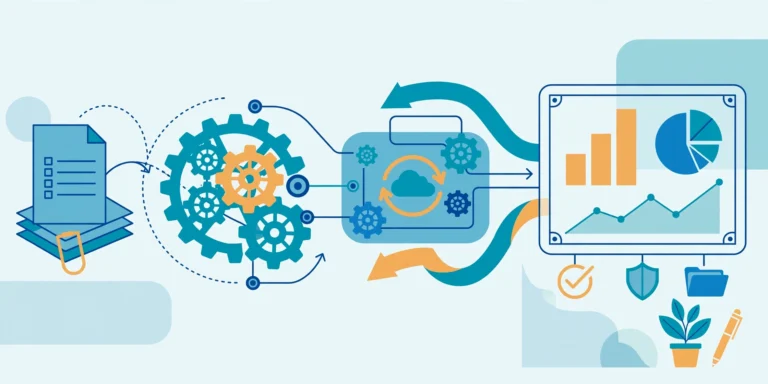
Most AIOps platforms share the same four capabilities: they ingest operational data from across the stack (logs, metrics, traces, events, tickets), detect anomalies using ML models rather than fixed thresholds, correlate related signals into a single incident instead of paging on every alert, and automate a response — running a remediation runbook or routing the ticket.
In practice, teams experience it as three stages. First, the platform monitors and discovers: it builds a baseline of normal behavior for each service. Then it engages: when something deviates, it adds context for the on-call engineer — probable root cause, similar past incidents, blast radius. Finally, it acts: for known failure patterns it executes the fix itself, from restarting a failed service to scaling capacity.
That last stage is where the industry is changing fastest. The concept is closely related to smart process automation applied to IT: first-generation AIOps largely stopped at correlation: it produced better-ranked alerts but still required a human to acknowledge, investigate, and fix the issue. Industry analysis describes this as the “better alerts for humans” ceiling — MTTR improved only modestly and on-call burnout persisted. The 2025–2026 shift is toward agentic AIOps, where AI agents carry an incident through triage, root-cause analysis, ticket routing, and remediation, with a human approving where needed.
What gets automated: the ten common use cases
Across platforms, automation targets a recurring set of tasks: anomaly detection, metric forecasting, alert clustering, event correlation, health scoring, correlated-metric root-cause analysis, similar-incident matching, entity recognition, assignment prediction, and incident classification. Grouped plainly: the system sees problems before users report them, understands which of the thousand alerts are actually one incident, and does something about it.
AIOps can be domain-centric — an AI feature inside one monitoring tool, like anomaly detection in an APM platform — or domain-agnostic, working across monitoring, logging, cloud, and infrastructure tools to correlate signals that no single tool can see alone.
The main platform options compared
The 2026 market splits into three lanes:
| Lane | Examples | Best fit |
|---|---|---|
| Correlation-focused AIOps suites | BigPanda, Moogsoft, Dynatrace Davis | Teams drowning in alert noise across many tools |
| APM platforms with built-in AIOps | Datadog, New Relic, Splunk ITSI | Teams wanting observability plus AI-assisted diagnosis in one place |
| Agent-native platforms | Newer autonomous-remediation tools | Teams ready to let AI execute runbooks with guardrails |
Price varies widely. Public entry points run around $15 per host per month (Datadog) or $21 per user per month (PagerDuty Professional), while enterprise correlation and ITSM-native suites are typically quoted in five or six figures annually. SaaS correlators that sit on top of existing tools can show value within weeks; full observability rollouts take weeks to months.
Why it matters
Dynatrace frames the payoff bluntly: automated root-cause analysis reduces mean time to resolution from hours to minutes, because the platform evaluates dependencies and pinpoints the source instead of leaving engineers to correlate manually. For businesses, that translates to shorter outages, less revenue at risk, and fewer wasted engineering hours on repetitive triage.
There is also a cost angle. Automated remediation often lets systems scale down when idle instead of over-provisioning capacity as insurance against instability — stability and cost efficiency are tightly linked. And engineers hired to build systems generally don’t want to babysit alerts, so reducing alert fatigue is a retention argument as much as an efficiency one.
Practical angle: don’t automate before you trust detection. Teams that enable automated remediation before the platform has proven its accuracy end up with a system that confidently executes the wrong runbook. The sensible adoption path is staged: start with anomaly detection and correlation in read-only mode, let the team validate its calls, then switch on automated remediation for known failure patterns with guardrails — approvals, rollback plans, and audit trails.
Analysis: where automation still needs humans
AIOps does not replace IT or SRE teams — this is consistent across every major platform’s own documentation. Current tools are strong at detection, correlation, and diagnosis, and improving at recommending actions, but novel failures and customer communication still need human judgment. The realistic outcome is fewer pages and faster triage, not empty on-call rotations. Organizations that invest early gain an edge in reliability and customer experience, but the winners will be the ones that treat automation as a junior operator to supervise, not a replacement to trust blindly.
Frequently asked questions
What is automated IT operations in simple terms?
Automated IT operations means using AI and software to monitor IT systems, detect problems, and fix common issues automatically instead of relying on engineers to do it all manually. The AI-driven version is called AIOps — “AI for IT operations” — a term Gartner coined in 2016. It learns what normal behavior looks like across your systems and acts when something deviates.
Does automated IT operations replace IT staff?
No. It removes repetitive operational work — alert triage, log digging, routine remediation — so IT and SRE teams can focus on architecture, reliability, and performance. Novel failures and customer-facing communication still require human judgment. The realistic outcome is fewer on-call pages and faster incident resolution, not smaller teams.
What is the difference between AIOps and observability?
Observability is the data layer: collecting logs, metrics, and traces so humans can investigate system state. AIOps is the intelligence layer on top: it applies machine learning to that telemetry to reduce noise, correlate related events, identify root causes, and drive automated action. You generally need observability data before AIOps can do anything useful.
How much do automated IT operations platforms cost?
It varies widely. Public entry points include around $15 per host per month for observability platforms and about $21 per user per month for incident-response tools, while enterprise AIOps and ITSM suites are typically quoted in five or six figures annually. SaaS tools that layer on existing monitoring can show value within weeks; full platform rollouts take weeks to months.
Sources
- Dynatrace — AIOps (AI for IT Operations)
- Fabrix.ai — What is AIOps? Top 10 AIOps Use Cases Explained (2026)
- Nova AI Ops — AIOps in 2026: The Definitive Guide
- Rankite — Best AIOps Platforms in 2026: 10 Tools Compared