Chatbots Got Voters’ Districts Wrong Nearly Half the Time, Washington Post Test Finds
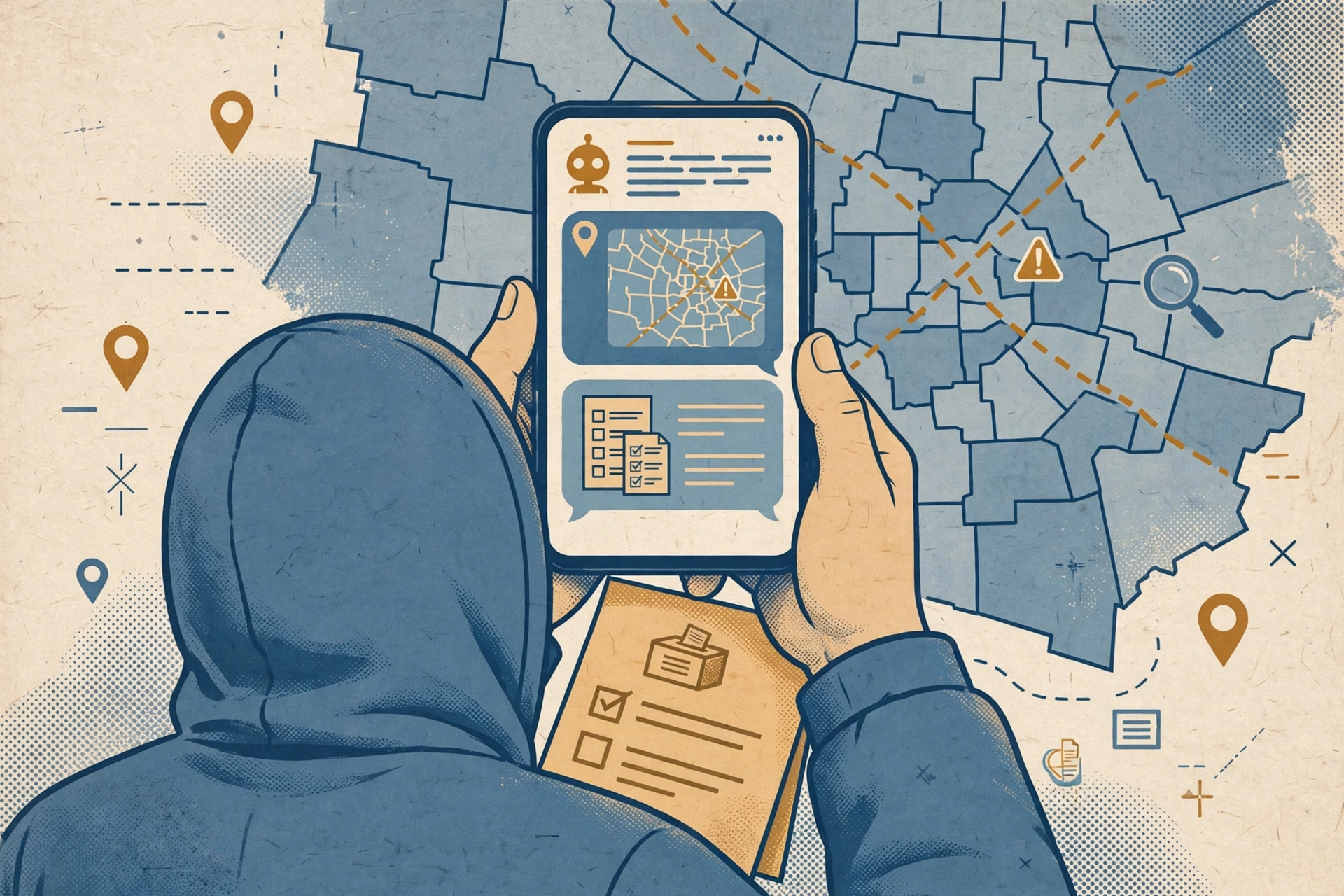
Key takeaway: The Washington Post asked six popular chatbots to build voter guides for an address in every US county. In 48% of the 3,000-plus guides, the chatbot failed to name the voter’s congressional district, and when it did name one, it was wrong 22% of the time — so voters were shown candidates they cannot vote for.
With the 2026 midterm elections days away, more Americans are asking chatbots — instead of search engines — who is on their ballot. A recent survey by the National Conference on Citizenship found that 2 in 5 Americans said they had used artificial intelligence to look up election information. The Washington Post’s test suggests that habit is risky: the guides were frequently wrong about the most basic fact on a ballot, which district a voter lives in.
What the Washington Post tested
On September 23, 2026, the Post, working with AI search analytics firm Promptwatch, sent the same request to six chatbots for a random address in every US county: a voter guide for November 2026 listing every race and what the candidates say about the biggest issues. The analysis covered more than 3,000 AI-generated voter guides, published on October 28, 2026. The Post checked each named district against the address’s actual boundaries, excluding Missouri, where court rulings left the proper district boundaries unresolved.
What the test found
The chatbots failed to say which congressional district an address was in 48% of the time, even though every voter has a House race on their midterm ballot. Of the guides that did specify a district, 22% got it wrong. Only about 41% of guides named the voter’s correct district, according to independent arithmetic on the Post’s figures.
The errors were not subtle. For a Missouri address, ChatGPT included a US Senate seat that is not on the ballot this year. For a Wyoming address, Anthropic’s Claude listed local politicians as running for federal office — one is running for state treasurer, the other for superintendent of public instruction. Google’s AI Mode placed a Maryland address in the state’s 5th District instead of the 4th, and said Rep. Steny Hoyer faced a Republican challenger; Hoyer is not running for reelection. Amazon’s Alexa erroneously listed the seat of Sen. Chuck Schumer of New York as up in 2026.
How the six chatbots compared
No chatbot came out clean, but they failed differently. Claude and Alexa+ were wrong most often, each incorrect for more than 1 in 5 addresses. ChatGPT, Google AI Mode and Perplexity were wrong least often — but only because they typically gave no district at all. Microsoft Copilot stood out for its sourcing: it cited the Ballot Brief, a largely AI-generated voter site, in 75% of its voter-guide tests, while ChatGPT cited it in 22%.
| Chatbot | What the Post found |
|---|---|
| Claude (Anthropic) | Wrong most often — incorrect for more than 1 in 5 addresses |
| Alexa+ (Amazon) | Wrong most often — incorrect for more than 1 in 5 addresses; Amazon has since paused its voter guides |
| ChatGPT, Google AI Mode, Perplexity | Wrong least often, but typically gave no district at all |
| Microsoft Copilot | Cited the Ballot Brief in 75% of voter-guide tests |
Why the chatbots got it wrong: AI citing AI
The Post traced many errors to the sources the chatbots leaned on — voter-guide websites that themselves appear to be largely AI-generated. The Ballot Brief, run by a former executive at Rumble, translates ZIP codes into districts, and the Post found multiple instances of it mapping ZIP codes to the wrong congressional districts. Chatbots then repeated those errors. The flaw is structural: political boundaries do not line up with postal codes, so a ZIP-code lookup is a rough guess dressed up as an answer.
For an address in Burke County, Georgia, ChatGPT cited myvotega.com, a small beta site that labels much of its content as AI-generated and had listed the county in the wrong district. Its operator told the Post he was surprised ChatGPT cited it — “I’m just a guy with a laptop” — and has since fixed the error. Jevin West, who co-founded the University of Washington’s Center for an Informed Public, told the Post the 2026 midterms will be the first election for which many people get information from chatbots, and “right now, they’re far from reliable.”
What the companies said, and what to do instead
Amazon said Alexa is designed to draw on established sources such as the Associated Press, RealClearPolitics and Ballotpedia, and that it has paused Alexa’s voter guides after identifying the cause of the errors. Microsoft said it is looking into the results; Anthropic and OpenAI pointed to new partnerships with Democracy Works for official voting information; Google said its systems corroborate AI Mode claims against trusted sources. Analysis: those partnerships did not prevent the errors in this test, and the Post found OpenAI and Amazon changed their chatbots’ voter-guide responses only after being contacted.
The practical fix is free and takes under a minute. Use your state or local election office’s official lookup, entering your full home address — not just your ZIP code — and confirm your congressional district, your polling place, and the full list of races on your ballot. A wrong guide costs no money, but it can cost you an informed vote: researching the wrong candidates wastes the time you meant to spend deciding. If a chatbot guide and the official lookup disagree, the official lookup wins, every time.
Knowns, unknowns, and what to watch
Known: six leading chatbots failed this test badly on district accuracy, and AI-generated voter sites fed several errors. Unknown: whether the companies’ fixes will measurably improve accuracy before Tuesday’s vote, since the Post’s requests were sent on September 23 and the fixes came after. What to watch: whether chatbot makers start refusing voter-guide requests outright or routing them to official sources first — and whether independent testers repeat the experiment after the election.
Risk to keep in mind: this is one test, not a permanent verdict. Chatbot answers change as models and sources update, so a chatbot that failed in September may answer better — or worse — in November. That variability is itself the point: for a ballot, you want a source that is stable and authoritative. Related USABite coverage: New York’s law on AI chatbots that pretend to be human for kids, and OpenAI’s tightened ChatGPT teen safety rules.
Sources
Verified facts in this article come from The Washington Post’s October 28, 2026 test, as syndicated in full by DNYUZ, cross-checked against independent summaries by FourWeekMBA and the U.S. Vote Foundation. If you found this useful, add USABite as a preferred source in Google Search so our coverage reaches you first.
Frequently asked questions
How often did chatbots get the congressional district wrong?
In The Washington Post’s test of more than 3,000 AI-generated voter guides, chatbots failed to name the voter’s congressional district 48% of the time. When they did name a district, they got it wrong 22% of the time. Only about 41% of guides named the correct district.
Which chatbots performed worst in the voter guide test?
Anthropic’s Claude and Amazon’s Alexa+ were wrong most often, each responding incorrectly for more than 1 in 5 addresses. ChatGPT, Google AI Mode and Perplexity were wrong least often, but mainly because they usually gave no district at all. Amazon has since paused Alexa’s voter guides.
Why did chatbots make so many voter guide mistakes?
The chatbots often cited voter-guide websites that were themselves largely AI-generated and wrong. The Ballot Brief, for example, translated some ZIP codes to the wrong congressional districts, and chatbots repeated those errors. Districts do not follow ZIP code boundaries, so ZIP-based lookups are unreliable.
Can I trust a chatbot voter guide before Tuesday’s election?
No, not on its own. Use a chatbot only as a starting point, then verify your district, races and polling place against your state or local election office’s official lookup. If the chatbot and the official source disagree, trust the official source.
Where should I check my ballot instead of a chatbot?
Use your state or local election office’s official voter lookup, entering your full home address rather than just your ZIP code. It will show your congressional district, your polling place and every race actually on your ballot, free of charge.