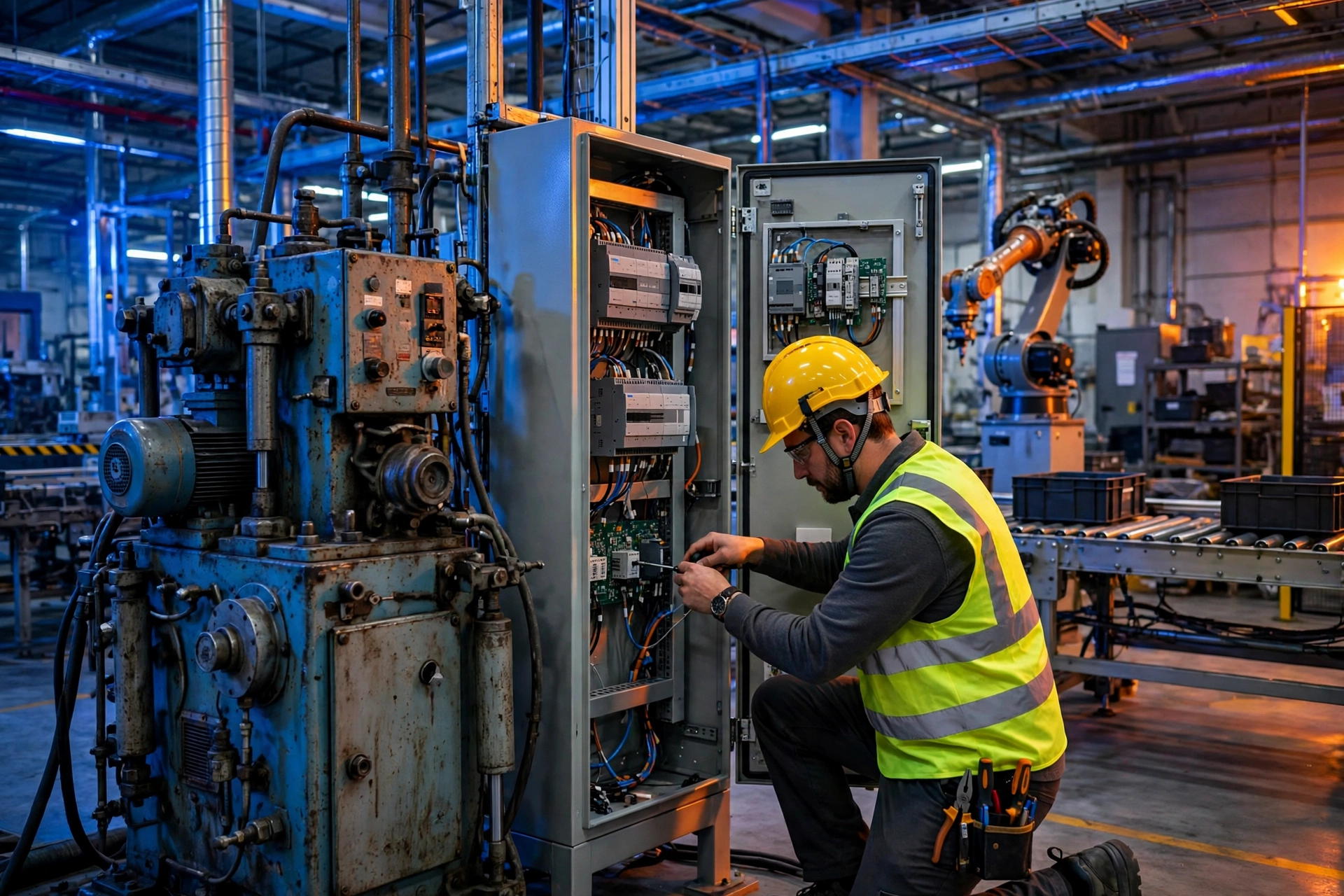
Industrial Automation Upgrades: What They Are, When to Upgrade, and What They Cost
Key takeaway: An industrial automation upgrade modernises the controls, sensors, or software on existing factory equipment — usually a PLC retrofit, new sensors, or a software layer — instead of replacing the whole line. The US PLC retrofit market is projected to grow from $3.15 billion in 2025 to $6.92 billion by 2032.
What industrial automation upgrades are
An industrial automation upgrade is any change that makes existing production equipment smarter, faster, or better connected without buying a whole new line. The machine itself — the press, the conveyor, the packaging line — usually stays. What changes is the control system around it: the programmable logic controller (PLC) that runs it, the sensors that watch it, the drives that power its motors, or the software that monitors it.
A full line replacement can run into millions of dollars and weeks of downtime. A targeted upgrade reuses the mechanical equipment that still works and replaces only what is obsolete, unsupported, or holding back performance. That is why brownfield modernisation — upgrading plants that already exist — has become the dominant path to Industry 4.0.
The main types of industrial automation upgrades
Most projects fall into one of five categories, and many plants combine two or three of them.
| Upgrade type | What changes | Best when |
|---|---|---|
| PLC upgrade | New CPU, I/O, or firmware on the same vendor platform (e.g. Siemens S7-300 to S7-1500) | Vendor still supports the platform; wiring can be reused |
| PLC migration | Full replacement with a different controller family or vendor; logic rewritten | Old platform is obsolete or unsupported |
| Sensor and IoT retrofit | Wireless temperature, vibration, pressure, and flow sensors plus a gateway | You need data without touching the control loop |
| Drive and motor upgrade | Variable frequency drives (VFDs) on older motors for precise speed control | Energy use or motor wear is the problem |
| Software and SCADA upgrade | New supervisory control, dashboards, and links to MES or ERP | Machines run fine but nobody can see what they do |
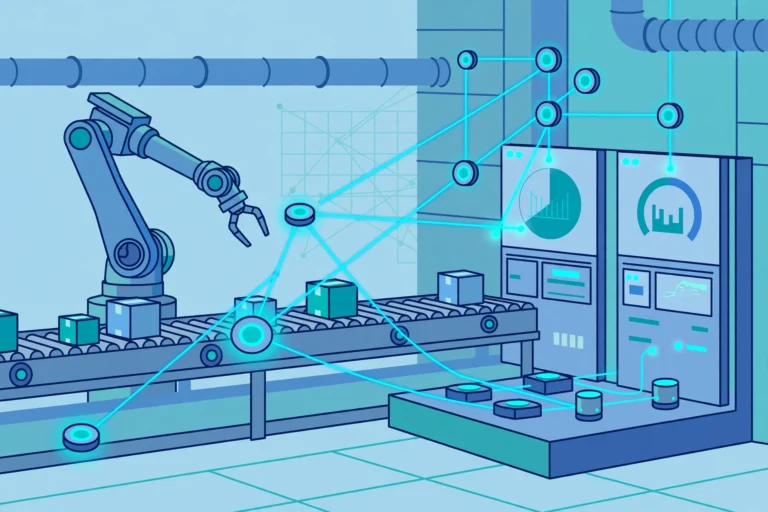
The cheapest option is often the sensor retrofit: a gateway reads data from a legacy PLC and passes it to modern systems through OPC UA, leaving the proven controller in charge of the machine. Replace the controller only when obsolescence, safety, or performance force the issue.
When to upgrade — and when to wait
Four triggers justify an upgrade. First, the vendor ends support: no spare parts, no firmware patches, no one to call when the controller fails. Second, unplanned downtime is rising — industry surveys put the average cost of unplanned downtime in discrete manufacturing at roughly $260,000 per hour in 2026, so one bad failure can pay for a retrofit. Third, the plant cannot get the data it needs: no energy figures, no Overall Equipment Effectiveness (OEE), no traceability for customers who demand it. Fourth, energy costs are climbing — the International Energy Agency counts motor system optimisation, including VFDs, among the most cost-effective efficiency measures available to industry.
Waiting is right when the process is stable, the controller still meets its scan-time, I/O, and safety needs, and spares are available. A working controller isolated from the network is not a problem that needs solving this quarter.
What industrial automation upgrades cost
Costs vary widely by scope. Published benchmarks from automation builder AMD Machines, based on its delivered projects, put a simple custom machine at around $100,000 and an average project at roughly $500,000 — but a PLC-only retrofit on one line is far cheaper than either. Materials are typically 50–60% of project value; the rest is engineering, integration, commissioning, and trials. Payback runs 2–3 years for individual machines, about 5 years for very large lines, and 12–24 months for cobot cells in the same benchmarks. Budget for integration, not just hardware: programming, testing, and commissioning are usually where projects overrun. For context, North American robot orders grew 6.6% in 2025 to $2.25 billion, per the Association for Advancing Automation.
How to plan an upgrade without stopping production
Plan in phases, and never change the control loop and the information path at the same time: audit first, then add the data layer, then change the controller.
- Audit everything. List each PLC, firmware version, HMI, drives, and safety controller. Note what is already obsolete and what has spares on the shelf.
- Add monitoring first. Fit sensors and a gateway, and segment the controls network behind a firewall. The US National Institute of Standards and Technology (NIST) publishes frameworks for securing industrial control systems — use them before connecting anything new.
- Test offline, cut over in stages. Build the new control program offline, prove it in a planned shutdown, then migrate one cell at a time, keeping the old system ready to roll back until the new one has run a full production cycle.
This is where project management discipline pays off: a written scope, a test plan, and a named owner for the cutover decision. Equipment automation projects fail most often on integration — the new controller talking to the old drives — not on the hardware.
Risks and limits
The biggest risk is scope creep: a PLC swap becomes a line rebuild because “while we are in there” keeps growing — freeze the scope before ordering hardware. The second is undocumented logic: old programs with no comments and no backup. Budget time to reverse-engineer them, or the cutover will find the gaps for you. Third is cybersecurity: a retrofit that links a 1990s controller to the cloud without network segmentation creates an attack path that did not exist before. And upgrades do not fix a bad process — automating a bottleneck just moves it. Fix the workflow first, then upgrade the controls around it. Industrial automation examples from real factories show the same lesson: the process comes before the hardware.
Analysis: the upgrade wave is a retrofit wave
Manufacturers are modernising what they own rather than replacing it. A retrofit market growing at a projected 11.9% a year to 2032, robot orders still climbing, and over 4.28 million industrial robots already in operation worldwide (per the International Federation of Robotics) all describe the same pattern — incremental, brownfield investment.
Our take: for most plants, the highest-return upgrade is the smallest one that removes a real constraint — usually sensors and visibility first, then the controller when support ends. The plants that overspend treat an upgrade as a technology purchase instead of a production decision. Start from the constraint, not the catalogue.
Frequently asked questions
What is an industrial automation upgrade?
An industrial automation upgrade modernises the controls, sensors, drives, or software of existing factory equipment instead of replacing the whole line. Common projects include PLC upgrades or migrations, IoT sensor retrofits, variable frequency drive installations, and SCADA software upgrades. The goal is better reliability, visibility, or efficiency from equipment the plant already owns.
How much does an industrial automation upgrade cost?
It depends on scope. A single-line PLC retrofit can cost tens of thousands of dollars, while a plant-wide modernisation runs into hundreds of thousands — published builder benchmarks put an average custom automation project at roughly $500,000. Materials are typically 50–60% of the total; engineering, integration, and commissioning make up the rest.
What is the difference between a PLC upgrade and a PLC migration?
A PLC upgrade stays within the same vendor platform, moving to a newer version — for example, Siemens S7-300 to S7-1500 — and reuses existing wiring. A PLC migration replaces the controller with a different family or vendor and requires the control logic to be rewritten. Upgrades are cheaper and faster; migration is the answer when the old platform is obsolete or unsupported.
How long does an industrial automation upgrade take?
A single-machine retrofit can be completed in a planned shutdown of days, while a line-wide migration typically takes weeks of preparation plus a staged cutover. Published benchmarks for custom machines range from about 6 weeks for simple builds to 24–26 weeks for complex systems. Phased cutovers — one cell at a time — keep production running while the work proceeds.
Can you upgrade automation without stopping production?
Mostly, yes. Sensors, gateways, and software can usually be added while machines run, and the new control program can be built and tested offline. Only the final cutover needs a stop, and that can be scheduled into a planned shutdown. Keep the old system ready to roll back until the new one has completed a full production cycle.
Sources: Mobility Foresights — USA PLC Automation Retrofit Market; Automation Electric — Retrofitting Legacy Equipment for Smart Automation; UMA Technology — Industry 4.0 Without Replacing Legacy PLCs; Manufacturing.co — AI in Manufacturing ROI; AMD Machines — Custom Automation Benchmarks: 2026 Report.
If you read USABite in Google Search, you can add us as a preferred source so our explainers show up more often in your results.