Trust Layer for AI Explained: How It Keeps Enterprise AI Safe, Private, and Auditable
Key takeaway: A trust layer for AI is the safety and governance layer that sits between your data and a large language model. It masks sensitive information, grounds answers in data the user is allowed to see, checks outputs for harmful content, and logs every interaction — so teams can use AI without handing raw company data to a model unchecked.
Every time an employee asks an AI assistant a question about a customer, a contract, or a patient record, something risky can happen in the background: private data can travel to an outside model, the model can invent an answer, and nobody can later prove what was sent or returned. A trust layer for AI exists to stop that chain of problems before it starts. It is not a single product or a single model setting. It is a set of controls that wrap each AI request and each AI response. The official Salesforce Trust Layer documentation is a good reference point for how one major platform builds it — see the official Salesforce Trust Layer guide for the vendor’s own description.
What is a trust layer for AI?
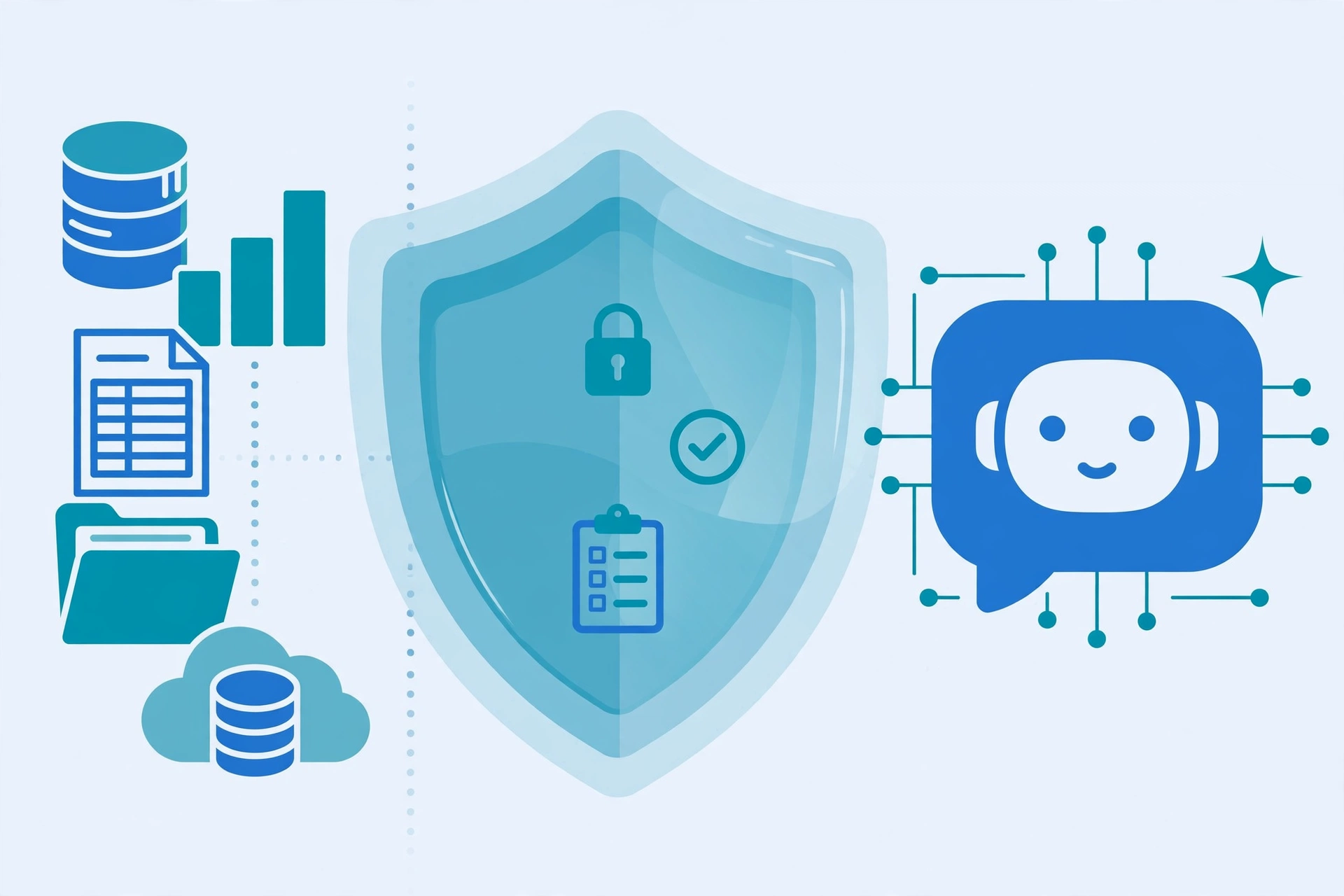
A trust layer for AI is a control layer placed between an application and a large language model (LLM). When a user makes a request, the layer inspects and prepares the prompt before it reaches the model. When the model replies, the layer inspects the response before it reaches the user. The goal is simple: the model should only see what it needs, only answer from approved information, and leave a record of what happened.
That distinction matters most in regulated work — healthcare, finance, government, and customer service — where a leaked phone number or an invented policy answer can become a real compliance problem.
How a trust layer for AI works, step by step
Although vendors package the steps differently, the flow is broadly the same:
- Retrieve and ground. The system pulls relevant, permission-aware records — for example, the customer’s actual order — and adds them to the prompt, so the model answers from real data rather than guessing.
- Mask sensitive data. Names, social security numbers, account details, and other sensitive fields are replaced with tokens before the prompt leaves the company’s boundary.
- Defend the prompt. System instructions tell the model to stay on topic, use only the supplied context, and not reveal sensitive or inappropriate content.
- Send through a gateway. The masked prompt travels through a controlled gateway to the model provider, under the vendor’s data-retention agreement.
- Check the response. The reply is scored for toxicity and harmful content before delivery.
- Demask and log. Placeholders are swapped back to real data for authorised users, and the full interaction — prompt, response, masking, and scores — is written to an audit trail.
Salesforce describes this sequence for its Einstein Trust Layer — secure retrieval and dynamic grounding, masking, prompt defence, zero data retention, toxicity scoring, and an audit trail in Data Cloud — in Salesforce’s own Trust Layer help page. Grounding respects the user’s role-based controls and field-level security, so a user cannot get an AI answer built from records they could not normally see.
Trust layer for AI: the core components compared
| Component | What it does | What breaks without it |
|---|---|---|
| Dynamic grounding | Anchors answers in retrieved, permission-aware data | Confident hallucinations and answers about the wrong record |
| Data masking | Replaces sensitive data with tokens before it reaches the model | Private data exposed to an outside provider |
| Zero data retention | Contractually bars the provider from storing or training on the data | Company data reused for future model training |
| Prompt defence | Guards against manipulation and off-topic or harmful instructions | Prompt injection and jailbreak-style misuse |
| Toxicity scoring | Scores outputs for harmful content categories | Offensive or biased replies reaching customers |
| Audit trail | Logs prompts, responses, masks, and scores for review | No way to investigate, explain, or prove what happened |
Trust layer for AI vs guardrails: are they the same thing?
The terms overlap, and vendors use them differently — that is worth stating plainly, because it confuses buyers. A “trust layer” is usually a platform’s full package: grounding, masking, retention, scoring, and audit in one architecture, as Salesforce presents it. “Guardrails” is often the narrower, configurable policy set inside that package: which topics to block, which content categories to filter, and which sensitive-data patterns to mask.
Amazon Bedrock Guardrails illustrates the guardrail side well. According to AWS’s Bedrock Guardrails documentation, a guardrail can combine content filters (including hate, insults, sexual content, violence, misconduct, and prompt attack), denied topics, word filters, sensitive-information filters that block or mask PII, and contextual grounding checks that flag responses not grounded in the source material. In other words, Bedrock gives teams the dials; a trust layer is the whole console those dials sit in, plus the retention contracts and audit storage around them.
What does a trust layer for AI cost?
There is no single price. On a platform such as Salesforce, the Trust Layer is built into the Agentforce and Einstein generative AI experience, but the audit and grounding storage behind it can depend on Data Cloud entitlements. On a cloud platform such as AWS, guardrails are priced as a service layer on top of model usage, so the bill scales with filtered prompts and responses. For a small team, the real starting cost is the platform subscription you already pay, plus staff time to configure policies, test them, and review audit logs.
What do you need before you switch one on?
A trust layer cannot fix data it cannot classify. Before deployment, teams need three prerequisites. First, a list of what counts as sensitive — not just regulated PII, but internal pricing, unreleased product details, and customer health or financial notes. Second, clean permission rules: grounding only works if roles and field-level security are already right, because the AI inherits the user’s access. Third, a review owner who reads blocked-response reports and audit samples each week and decides when a human must check an answer before it reaches a customer.
What are the risks and limits of a trust layer for AI?
A trust layer reduces risk; it does not remove it. Masking can miss a novel identifier format or a name hidden in free text. Grounding depends on retrieval: if the search returns the wrong record, the model will confidently answer from the wrong record. Toxicity scoring is probabilistic, and retention guarantees are contractual — only as strong as the provider agreement and audit rights behind them. Analysis: the practical risk is over-trust — treating the layer as a stamp of safety rather than a control that needs tuning, testing with realistic messy prompts, and human oversight.
How to choose a trust layer for AI: a practical checklist
- Confirm which fields it masks out of the box, and whether you can add your own patterns.
- Check that grounding respects your existing permissions, not just a separate AI permission set.
- Ask for the retention terms in writing: stored, used for training, or reviewed by humans — and under what exceptions.
- Test denied topics and prompt-injection attempts before launch, and record the results.
- Decide who reviews audit logs, how often, and what triggers a human review of an AI answer.
- Start narrow — one use case, one team — then widen once blocked-response and audit reports look sane.
Related USABite reads: Google AI Mode and SEO strategy, Conversational AI for the enterprise, and AI in medical records retrieval.
Sources
- Salesforce Developers — Trust Layer (Agentforce guide)
- Salesforce Help — Einstein Trust Layer
- AWS Documentation — Amazon Bedrock Guardrails (CreateGuardrail)
Frequently asked questions
What is a trust layer for AI in simple terms?
A trust layer for AI is a safety layer between your application and a language model. It hides sensitive data before the prompt is sent, grounds the answer in records the user is allowed to see, checks the reply for harmful content, and logs the whole exchange so it can be audited later.
Is a trust layer for AI the same as AI guardrails?
Not exactly. Guardrails are usually the configurable rules — blocked topics, content filters, and PII masking. A trust layer is the wider architecture around them, including grounding, data-retention agreements with model providers, and audit storage.
Does a trust layer for AI stop the model from training on my data?
It can, but only through the provider agreement behind it. Salesforce, for example, describes zero data retention agreements under which third-party LLMs do not store, train on, or have humans review the data, with narrow exceptions. Always confirm the written terms rather than assuming a feature name guarantees this.
Can a trust layer for AI prevent hallucinations completely?
No. Grounding makes hallucinations less likely by anchoring answers in retrieved records, and grounding checks can flag ungrounded replies, but retrieval can still return the wrong record and scoring is probabilistic. Human review remains important for high-stakes answers.
Do small teams need a trust layer for AI?
Yes, if they send customer or employee data to an outside model. The controls can start simple — mask obvious identifiers, ground answers in one approved source, block a few topics, and keep an audit log — and grow as usage grows. The risk scales with the sensitivity of the data, not the size of the team.