Smart Science Lab: What It Is and How AI Is Changing Research
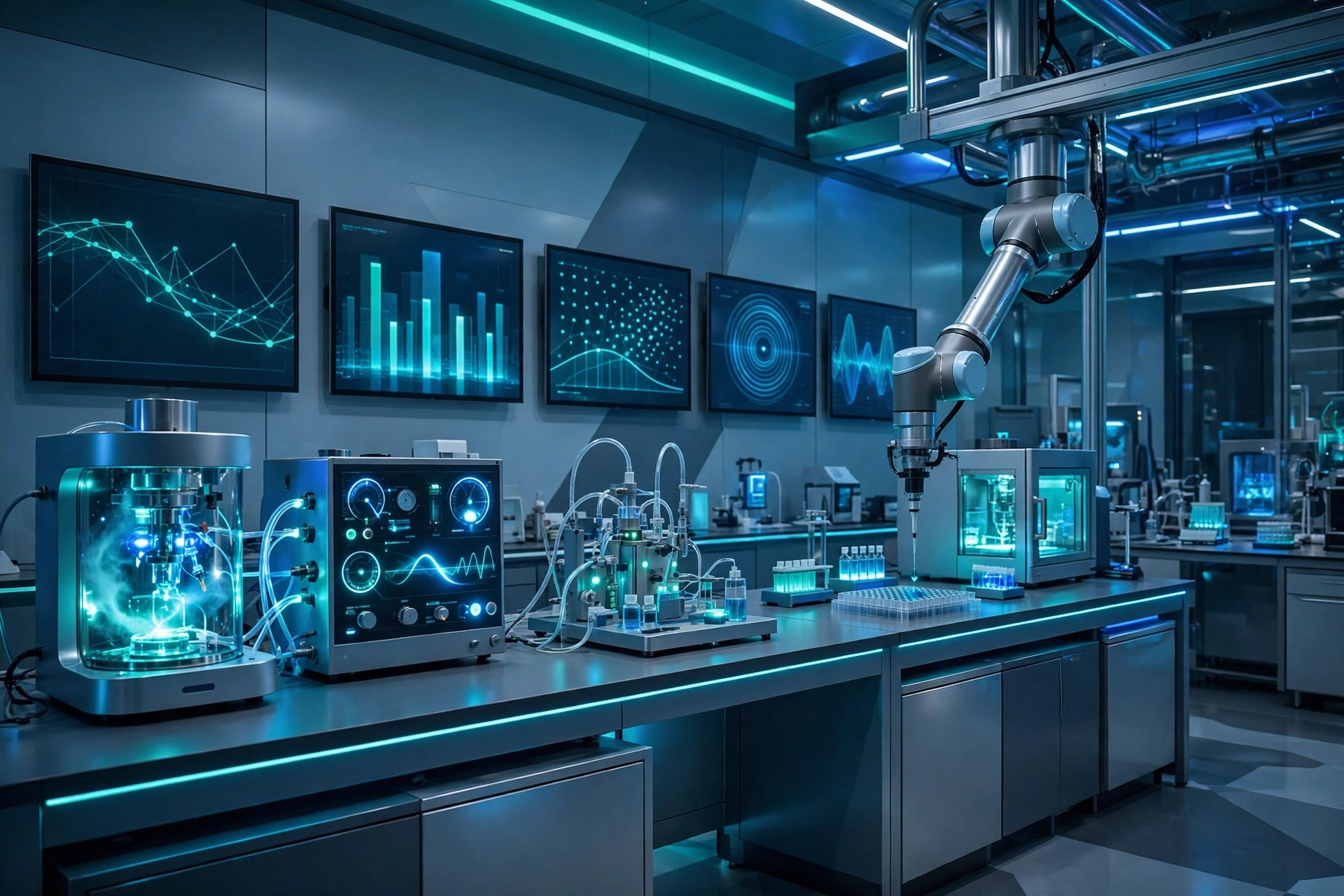
A smart science lab is a research facility where robotics, Internet of Things (IoT) sensors, and artificial intelligence work together as one connected system. Instead of standalone instruments operated by hand, everything — sample handling, data collection, experiment planning — is coordinated, and in the most advanced cases the lab runs experiments on its own.
Key Takeaway
A smart science lab connects robotics, IoT sensors, and AI into a single coordinated research environment. The most advanced form — self-driving laboratories — uses AI to plan experiments, robots to run them, and results to choose the next experiment in a continuous loop. Real facilities are already accelerating discovery in chemistry, materials science, and biology.
What Is a Smart Science Lab?
The term covers a spectrum. At the basic end, a smart lab connects existing instruments with software so data flows automatically and workflows are orchestrated rather than manually handed off. According to Biosero, a smart lab is “a connected ecosystem that combines automation, software, data, and human expertise” — the key difference isn’t how much equipment a lab owns, but how well it works together.
At the advanced end are self-driving laboratories (SDLs), also called autonomous laboratories. The U.S. National Institute of Standards and Technology (NIST) defines them as labs where AI algorithms select which samples to make and how to characterize them, running in a closed feedback loop that maximizes what is learned with each experimental iteration — needing little human interaction.
The Technology Behind a Smart Science Lab
Four technologies converge to make a lab “smart”:
- Robotics and automation handle sample preparation, pipetting, synthesis, and data collection — cutting human error and enabling round-the-clock operation.
- IoT sensors monitor equipment performance, environmental conditions, and experiment progress in real time.
- AI and machine learning analyze results, detect patterns, and decide which experiment to run next. AI assistants can also find relevant literature and suggest protocols.
- Workflow orchestration software ties it all together, coordinating instruments, schedules, and data into one system instead of isolated tools.
When AI planning and robotic execution form a continuous cycle — results feeding back to choose the next experiment automatically — the lab becomes truly self-driving.
Real Smart Labs Already in Operation
This isn’t a future scenario. Verified examples include:
- Carnegie Mellon’s Coscientist, driven by the large language model GPT-4, plans and executes real chemistry experiments — including palladium-catalysed organic reactions — from a plain-language prompt. It runs on the CMU Cloud Lab, built with Emerald Cloud Lab, which can run more than 100 experiments simultaneously and continuously, according to Nature.
- Japan’s Robotics Innovation Center at the Institute of Science Tokyo opened in April 2026 with 10 robots — including the humanoid Maholo LabDroid — and no human staff. The university plans to expand to around 2,000 robots by 2040, aiming to automate nearly the entire research process, from generating hypotheses to experimental verification, The Mainichi reports.
- Berkeley’s A-Lab ran 17 days of hands-off operation, choosing and synthesizing novel inorganic compounds using active learning.
- Hong Kong Polytechnic University’s self-driving system ran 50,764 perovskite solar-cell experiments and produced a cell certified at 26.5% efficiency, Frontier Signal reports based on the January 2026 paper in the journal Engineering.
- Industry scale: Eli Lilly’s autonomous “Science Studio” coordinates over 100 instruments and more than 5 million compounds in a closed loop where AI controls robots that researchers access via the cloud.
The payoff is real: R&D World cites McKinsey’s estimate that automation in pharma could bring medicines to market 500 days faster and reduce development costs by 25%.
Why It Matters: The Practical Angle
For most people, smart labs mean faster science: new drugs, better batteries, and cheaper solar cells reaching the real world sooner. For researchers and students, the skill set is shifting — routine bench work is being automated while demand grows for people who can supervise AI systems, validate results, and engineer robotic workflows. Labs facing staff shortages and rising costs, like Japan’s research institutions, see automation as essential to staying competitive.
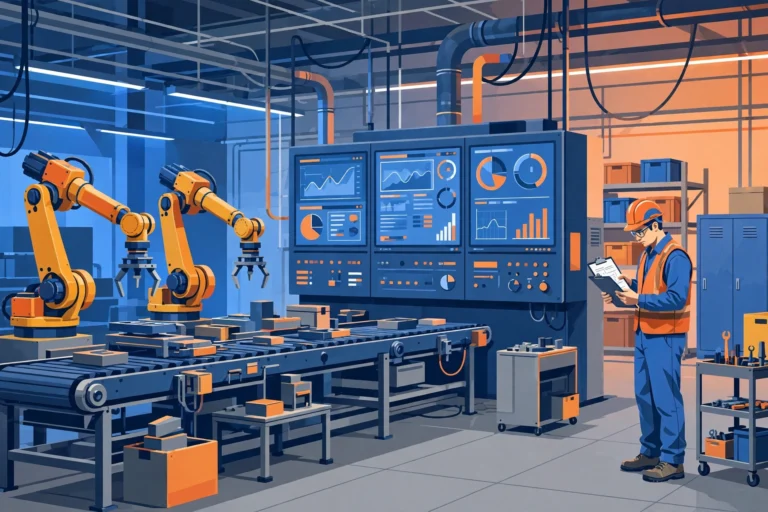
The same convergence of AI and automation is already reshaping physical work beyond the lab — see how AI is cutting manufacturing setup times and delivering real energy savings in factories.
Analysis: The Limits Are Real Too
The following is analysis, not a verified claim. Smart labs work best when the goal, the tools, and the success signal are tightly bounded. Independent analysis later questioned some of the A-Lab’s novelty claims — a reminder that a closed loop still needs human verification. Fully open-ended discovery — deciding which question is worth asking — remains human. Safety and regulatory frameworks are also still evolving; letting robots run experiments autonomously without robust safety mechanisms risks both scientific integrity and occupational safety. For most labs, the realistic near-term target is a “self-driving bench” for specific workflows, not a lights-out megalab.
Frequently Asked Questions
What is a smart science lab?
A smart science lab is a research facility where robotics, IoT sensors, and AI are connected into one coordinated system. Instead of scientists operating standalone instruments by hand, software orchestrates instruments, data, and workflows — and in self-driving labs, AI even decides which experiments to run next.
What is the difference between a smart lab and a self-driving laboratory?
A smart lab is the broader category: any lab where connected instruments, data, and automation work together. A self-driving laboratory (SDL) is the most advanced form, where AI plans experiments, robots execute them, and results feed back to the AI automatically in a closed loop with minimal human input.
Are self-driving labs replacing scientists?
Not today, and not fully. Current systems excel at bounded, repetitive experimental work but still need humans for open-ended questions, result validation, and judgment. The emerging pattern is role change: technicians shift toward supervision and validation while demand grows for AI and robotics specialists.
Can an existing lab become a smart lab?
Yes — labs don’t have to replace every instrument. Interoperability and workflow-orchestration software can connect existing equipment into coordinated workflows, so labs can modernize on top of their current investments rather than starting from scratch.
Sources
- NIST — Autonomous Laboratories
- Nature — Inside the ‘self-driving’ lab revolution
- The Mainichi (Kyodo) — Unmanned lab opens with robots at work
- Oxford Global — Smart Labs for Smart Research
- Biosero — Future of Smart Labs: Connected Workflows Drive Better Science
- R&D World — Is your lab up next for automation?