
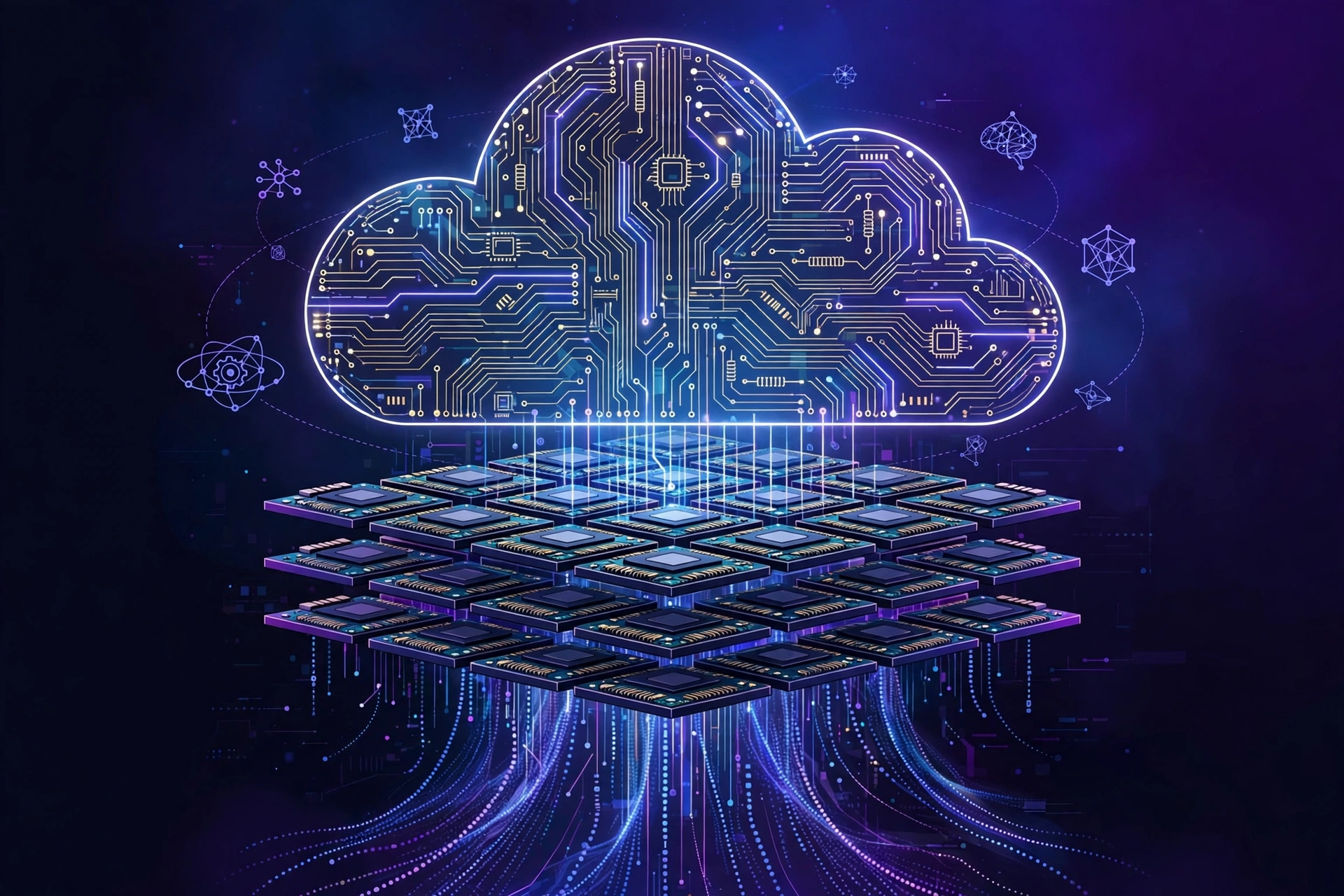
AI PaaS Explained: What AI Platform-as-a-Service Is and When to Use It
Key takeaway
AI PaaS (AI Platform-as-a-Service) is a cloud platform that gives teams everything needed to build, train, and deploy AI models — GPU compute, data pipelines, pre-built models, and monitoring — without managing servers. It sits between raw AI infrastructure (IaaS) and ready-made AI tools (SaaS), and it’s the layer teams reach for when they want custom AI built on their own data.
You’ve probably heard “AI as a service” used for everything from chatbots to cloud GPUs. That looseness causes real confusion: a non-technical founder asking for “an AI platform” might mean something very different from what a data scientist means. AI PaaS is the specific middle layer — a managed platform for building AI, not just using it.
What AI PaaS actually is
An AI Platform-as-a-Service is a specialized cloud platform for artificial intelligence and machine learning workloads. It bundles cloud computing resources, AI frameworks, data pipelines, and deployment tools into one managed environment, so teams can develop, train, deploy, and manage AI applications without worrying about the underlying infrastructure (Btech; GeeksforGeeks).
A typical AI PaaS handles GPU compute with autoscaling, pre-built models you can fine-tune, automated training and tuning (AutoML), data pipelines for ingestion and labeling, managed deployment endpoints, and monitoring — usually on a pay-per-use basis, so customers rent capacity instead of buying infrastructure (Northflank; Dataversity).
AI IaaS vs AI PaaS vs AI SaaS: the stack in one table
The clearest way to understand AI PaaS is by comparing it with the two layers around it (Signity Solutions):
| AI IaaS | AI PaaS | AI SaaS | |
|---|---|---|---|
| You get | Raw virtualized compute (GPUs, storage, networking) | A managed platform to build, train, and deploy models | Ready-to-use AI software |
| You manage | OS, middleware, frameworks, deployment | Your data, models, and code | Almost nothing — just configuration |
| Customization | Total | High — train on your own data | Low — vendor controls the model |
| Examples | AWS EC2 GPU instances, Google Compute Engine | AWS SageMaker, Google Vertex AI, Azure Machine Learning | Chatbots, AI writing tools, image-recognition APIs |
| Best for | Teams needing full infrastructure control | Teams building custom AI on proprietary data | Teams that want AI features immediately |
The big cloud vendors each run a flagship AI PaaS: Amazon SageMaker, Google Vertex AI, and Azure Machine Learning — each a managed, end-to-end platform for data preparation, training, deployment, and MLOps (Microsoft Learn). Names keep shifting: Google has been folding Vertex AI into its Gemini Enterprise Agent Platform since April 2026, and Microsoft rebranded Azure AI Foundry to Microsoft Foundry — so check current docs when choosing (Sphere Inc.).
Why AI PaaS matters in 2026
Building AI from scratch remains complex and expensive — scarce data-science talent, GPU procurement, deployment pipelines, monitoring. AI PaaS abstracts most of that away, which is why it’s become the default route for enterprises moving AI from experiment to production: pre-configured environments and ready-to-use models can shrink that path from months to weeks (Btech).
Choose AI PaaS when you need custom models trained on your own data or control over model behavior. Choose AI SaaS instead when a ready-made tool solves the problem — building from scratch adds cost without benefit.
Analysis: what to watch
The AI PaaS layer is consolidating fast: hyperscalers are bundling generative-AI tooling, agent frameworks, and governance into their platforms, while open-source stacks (open-weight models with servers like vLLM) let teams self-host to avoid vendor lock-in. Practical advice from platform comparisons: shortlist two platforms, test both on the same workload, and pick the one closest to your data and identity systems (Sphere Inc.).
If AI & tech explained in plain English is your thing, add USABite as a preferred source in Google Search so our explainers keep showing up for you.
Frequently asked questions
What is AI PaaS in simple terms?
AI PaaS (AI Platform-as-a-Service) is a cloud service that provides a ready-made platform for building, training, and deploying AI models. It handles servers, GPU provisioning, scaling, and monitoring, so developers focus on their models and data instead of infrastructure.
What is the difference between AI PaaS and AI SaaS?
AI SaaS is ready-to-use AI software (like a chatbot or AI writing tool) with little customization. AI PaaS is a development platform that lets you build, train, and deploy your own custom AI models on your own data, with far more control over the result (Signity Solutions).
What are examples of AI PaaS platforms?
The three leading examples are Amazon SageMaker, Google Vertex AI (now evolving into Google’s Gemini Enterprise Agent Platform), and Azure Machine Learning, now under the Microsoft Foundry brand. They all cover the full ML lifecycle from data preparation to deployment and monitoring (Microsoft Learn).
Is AI PaaS the same as MLaaS?
Mostly yes — MLaaS (Machine Learning as a Service) is the older term for essentially the same idea: managed cloud platforms for building and running ML models. AI PaaS has become the more common label as platforms expanded beyond classic ML to cover generative AI, agents, and RAG pipelines.
Who should use AI PaaS?
Teams that need custom AI built on proprietary data — product teams adding AI features, enterprises automating with their own workflows (see how industry actually uses automation), or startups that want ML capability without hiring a full infrastructure team. If you just need an off-the-shelf tool, AI SaaS is cheaper and faster.
Sources
- Northflank — “What is AI Platform as a Service (PaaS)?”
- Btech — “AI Platform as a Service (AI PaaS): The Smartest Way for Enterprises to Scale AI Innovation”
- Signity Solutions — “What is AI PaaS and Why It’s the Foundation of Smarter, Scalable AI”
- GeeksforGeeks — “Platform as a Service (PaaS) and its Types”
- Dataversity — “Fundamentals of AIaaS and AIPaaS”
- Microsoft Learn — “Compare AWS and Azure AI and machine learning services”
- Sphere Inc. — “AI Development Platforms Compared for Enterprise Builds”



One Comment
Comments are closed.