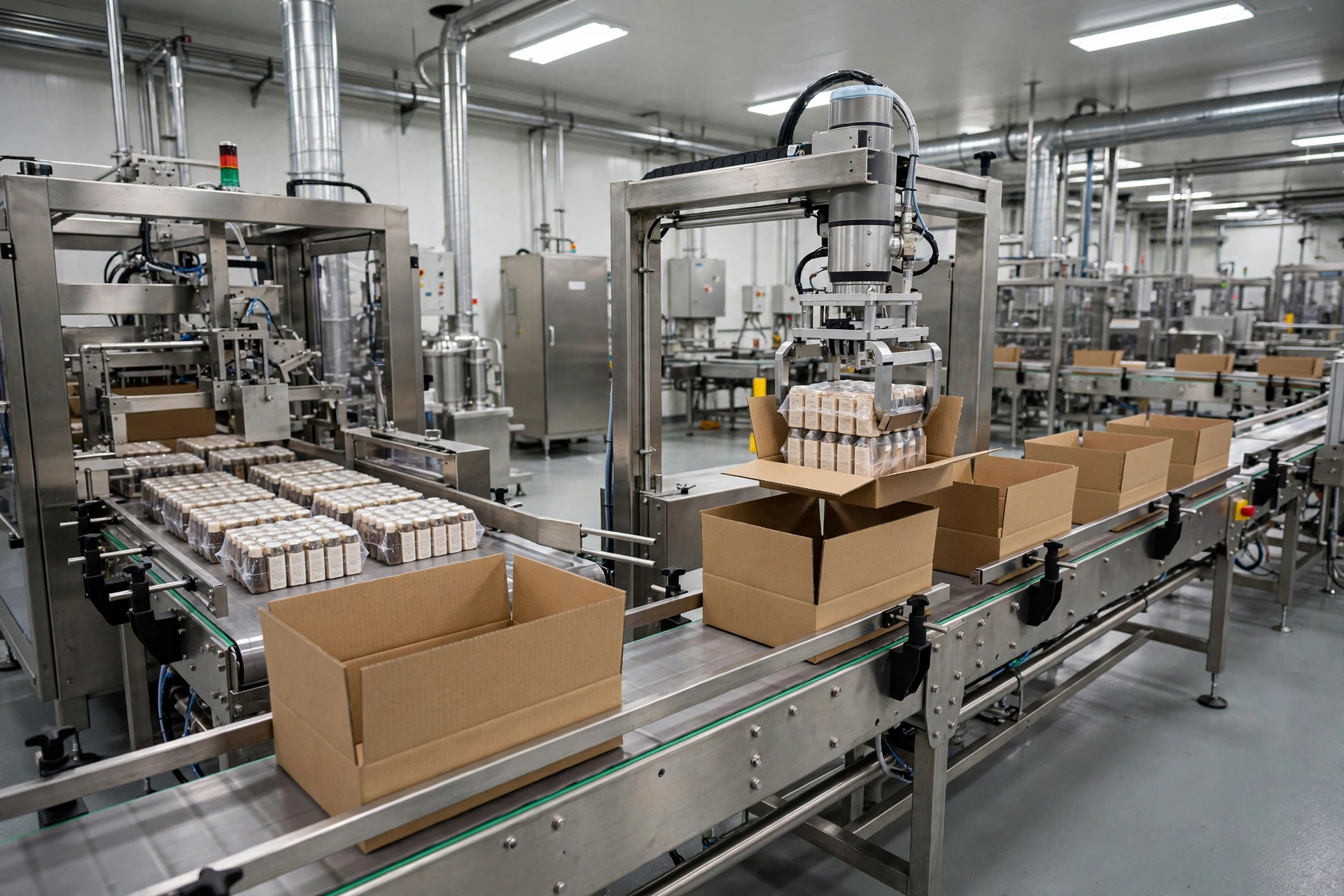
Automated Case Loader: What It Is and How It Works in 2026
Key takeaway: An automated case loader is an end-of-line packaging machine that groups individual products into sets and loads them into corrugated cases automatically. Most machines follow four steps — case infeed, product collation, loading, and discharge to sealing — and designs range from robotic top-load systems to high-speed side-load and wrap-around packers.
At the end of almost every production line, there is a quiet bottleneck: getting finished products into the cardboard cases that ship to warehouses and stores. Manual packing is slow, inconsistent, and hard on workers’ backs. An automated case loader — usually called a case packer — removes that bottleneck by grouping products into precise pack patterns and loading them into cases with no human hands involved.
What an Automated Case Loader Does
An automated case loader sits near the end of a packaging line. It takes individual products or secondary packs (like cartons of cans or pouches of snacks) arriving on a conveyor and loads them into corrugated cases or trays in a controlled, repeatable way. Compared to manual packing, automatic case loading delivers higher speed, consistent pack patterns, and better ergonomics for the operators who remain on the line.
Loading is one stage in a larger end-of-line system. A case erector usually feeds the loader with pre-formed cases, and once a case is full it travels onward to a case sealer — which tapes or glue-seals the flaps — and then to a palletizer. When you read about “end-to-end” factory automation, this is exactly the kind of stage being connected: see our explainers on end-to-end process automation and automation examples in industry for the bigger picture.
How an Automated Case Loader Works: The Four Core Steps
Although designs vary by manufacturer, most automated case loaders follow the same four-step sequence, described in packaging-industry guides from suppliers such as Foshan Soontrue and Massman Automation:
- Case infeed. Empty cases or trays arrive from a case erector. They can be open-top RSC (regular slotted container) cases, wrap-around blanks, or trays with or without lids. The loader positions each case at the loading station.
- Product infeed and collation. Products arrive from upstream equipment such as flow wrappers, cartoners, or pouch machines. Conveyors, lane dividers, and accumulation systems organize the flow and group products into the target pack pattern — for example 3×4, 4×6, layered, or mixed patterns.
- Loading. Depending on the machine’s design, grouped products are pushed in from the side, lowered in from the top, wrapped together with the case blank, or placed by a robot into the open case.
- Discharge to sealing and palletizing. Filled cases leave the loading station and move to a case sealer for tape or hot-melt glue sealing, then continue to palletizing.
The whole cycle is typically run by a PLC controller with a touchscreen HMI, and modern machines use servo-driven motion for the precise, repeatable movements that high-speed packing requires.
Main Types of Automated Case Loaders
Choosing the right type is one of the most important decisions in secondary packaging automation, according to The Packaging Edge’s side-load guide. The three common architectures differ in how products enter the case:
| Type | How it loads | Best for | Trade-off |
|---|---|---|---|
| Top-load | Products picked and placed from above by servo gantries or robots | Mixed or irregular products; flexible SKU changes | Slower than side-load for identical, high-volume SKUs |
| Side-load | Product groups pushed horizontally into the case | Rigid containers (bottles, cans, jars); retail-ready packs | Less flexible for varied or fragile product shapes |
| Wrap-around | Corrugated blank formed tightly around the grouped product | Reducing cardboard use; strong square cases | Best suited to stable, consistent product shapes |
Side-load machines excel where product orientation and protection matter most, while top-load machines — especially robotic ones — win on flexibility and simpler changeovers when the factory runs many different products. Wrap-around packers reduce corrugate usage because they form the case directly around the product instead of using a pre-glued box, which also improves pallet stability.
Why It Matters: Speed, Consistency, and Labor
The practical payoff is throughput. A classic example is the TL-10 robotic top-loading case packer covered by Machine Design, which processed 90 bags per minute into 24-count cases — or up to 10 finished cases per minute on lower-count formats. Suction-cup grippers handle delicate products, and a six-axis robot synchronized to the loading conveyors means product changes need programming, not mechanical rebuilds.
Beyond raw speed, automation removes the most injury-prone jobs on the packing line. Repetitive lifting of 15–25 kg cases is exactly the kind of work that drives musculoskeletal injuries and turnover; loading it onto a machine keeps output predictable and workers on higher-value tasks like quality monitoring and changeovers.
Our analysis: automated case loading is one of the clearest ROI stories in factory automation because the costs it attacks — labor, damage, and inconsistent pack patterns — are easy to measure before and after installation. The current trend is toward more robotic pick-and-place loaders, since their flexibility lets one machine cover many SKUs, though high-volume single-product lines still favor purpose-built side-load systems. For manufacturers weighing automation broadly, the numbers keep improving as servo hardware and machine vision get cheaper.
Frequently Asked Questions
What does an automated case loader do?
An automated case loader groups individual products or secondary packs into preset patterns and loads them into corrugated shipping cases automatically. It sits between the case erector (which forms the empty boxes) and the case sealer (which tapes them shut) at the end of a packaging line, replacing manual packing with faster, repeatable machine packing.
What is the difference between a case loader and a case packer?
There is no real difference — the two terms describe the same machine. “Case packer” is the more common industry term, while “automated case loader” or “case loader” is used by some suppliers and buyers. Both refer to equipment that loads grouped products into corrugated cases.
How fast can an automated case loader run?
Speed depends on the design and product. Robotic top-load systems like the TL-10 documented by Machine Design handle around 90 bags per minute into 24-count cases, or up to 10 cases per minute on lower-count formats. High-speed side-load machines running simple, consistent SKUs can go faster, since every motion is optimized for one product.
What products can an automated case loader handle?
Nearly anything that ships in a case: bottles, cans, jars, rigid cartons, tubs, pouches, bags, and flow-wrapped products. Top-load machines with robotic pickers handle the widest range of product shapes, while side-load machines are preferred for rigid containers where keeping orientation matters, such as retail-ready display packs.
How is a case loader different from a case erector or case sealer?
They perform three different jobs in sequence. The case erector folds flat cardboard blanks into open cases, the case loader fills those cases with products, and the case sealer folds and tapes or glue-seals the filled case. Fully automated end-of-line cells often integrate all three into one continuous system.