Google’s AI Chip Just Answered From Space: What Project Suncatcher’s First Haiku Really Proves
Key takeaway: Google’s Project Suncatcher satellite has returned the first AI response from a data-center-class TPU in orbit: a haiku written by its onboard Gemma 4 model. Announced October 30, 2026, the test proves the chip can boot, run, and reply from space — but it does not yet prove orbital AI data centers are practical, affordable, or durable.
Google’s experimental satellite did not do anything flashy. It answered a prompt. But the fact that the answer came from orbit, from a data-center-class AI chip rather than a ground server, is why the company is calling it a milestone.
What happened: a haiku from orbit
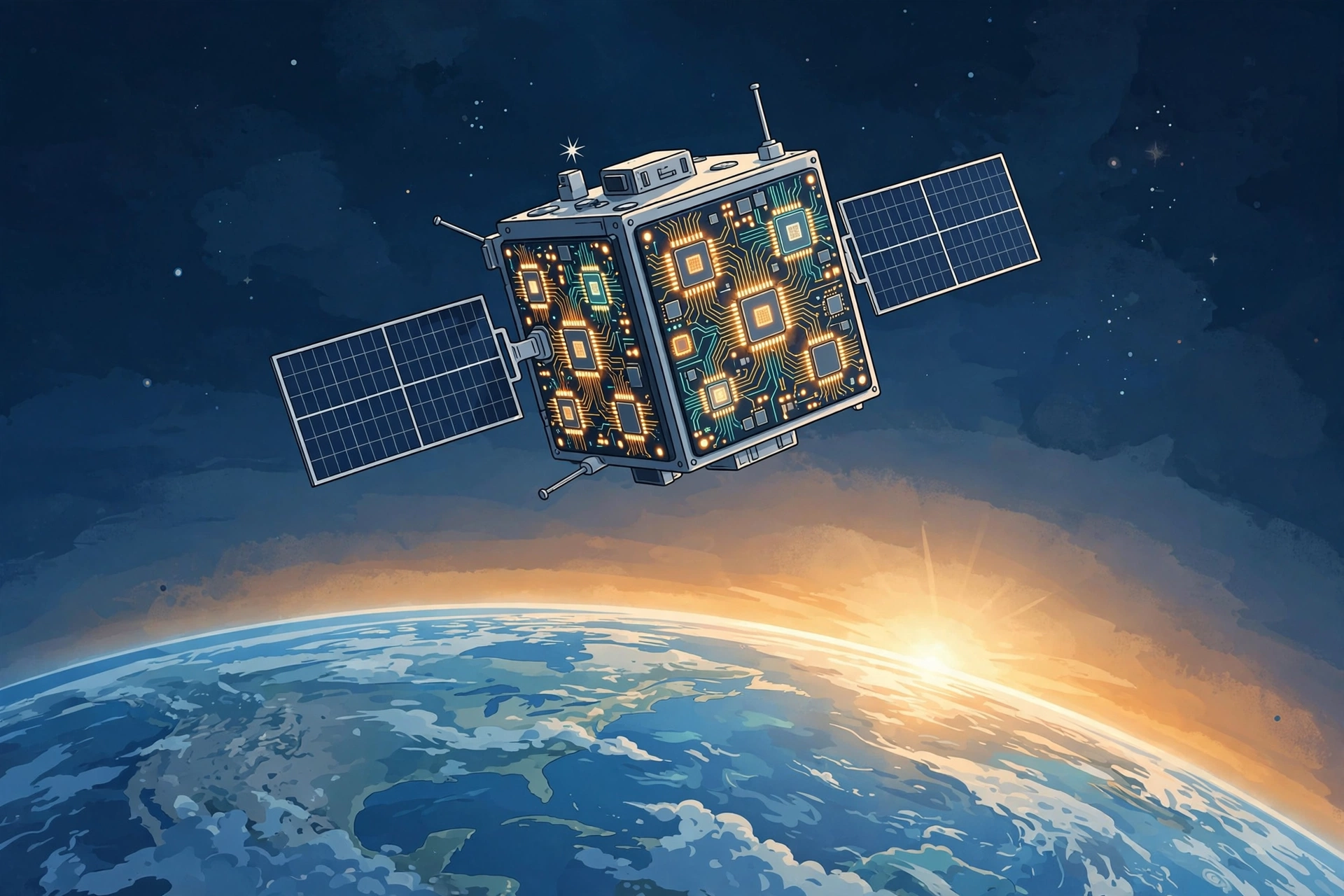
Google announced the result on October 30, 2026, in a Google Research post by Travis Beals, Senior Director of Paradigms of Intelligence. The Project Suncatcher prototype satellite launched on October 1, 2026, aboard SpaceX’s Transporter-18 rideshare mission, and was built in partnership with satellite-imaging company Planet. After weeks of commissioning — powering up the host computer and TPU trays and running early machine-learning tests — engineers sent their first prompt during a ground-station pass.
The prompt asked the satellite’s onboard Gemma 4 open model to write a haiku about being in space. As the spacecraft passed over Svalbard, Norway, the reply came back down:
Blue marble below
Data streams in silent grace
Starlight feeds my core.
Google calls this the project’s “Hello World” milestone and describes it as the first-ever AI response from a data-center-class TPU in orbit. Google CEO Sundar Pichai echoed the framing in a post on X the same day. The team then tested space-themed limericks and prompts asking the model to report the technical status of the payload systems. The Economic Times and The Register both reported the milestone on October 31, 2026, drawing on Google’s post and Pichai’s announcement.
Knowns, unknowns, and what to watch
Known: A Gemma 4 model ran on a TPU aboard the satellite, took a prompt from the ground, and returned a complete response. The satellite is operating normally, according to a Google spokesperson quoted by TechCrunch. Unknown: How fast the chip runs in orbit, how it degrades over time, and what any of this costs — Google’s post publishes no performance data or cost figures. What to watch: The thermal-stress and radiation tests Google says come next, and whether the planned twin interconnected satellites actually launch in 2027.
Space data centers vs. ground data centers: the comparison
Orbital computing is not competing with ground data centers on speed today. It is competing on a single idea: sunlight. Google’s case is that satellites in low Earth orbit get near-constant sunlight and can generate up to eight times more solar power than comparable systems on Earth, which could one day make space an attractive place to run energy-hungry AI workloads.
| Ground data center | Project Suncatcher prototype | |
|---|---|---|
| Power | Grid power, effectively continuous | Up to 1 kW generated on board, so only one TPU runs at a time (TechCrunch reporting) |
| Run time | Continuous operation | About 20 minutes per session, per TechCrunch’s reporting |
| Cooling | Water and air cooling at scale | Untested at scale; thermal-stress tests still to come |
| Radiation risk | Negligible | Real: particle strikes can flip stored bits and corrupt data silently |
| Status | Proven at massive scale | One prototype, a handful of test prompts |
The table makes the gap plain: this is a boot test, not a benchmark. The haiku shows the hardware survived launch, powered up, and talked to Earth. It shows nothing yet about speed, cost, or longevity.
What it costs — and what Google has not said
Google has published no cost figures for Project Suncatcher, and no price for orbital AI compute. That absence matters, because the economics are the hardest part of the idea: launching hardware, operating it remotely, and replacing it when radiation or heat takes its toll are all expensive in ways ground data centers are not. Until Google publishes performance-per-watt or cost-per-inference figures from orbit, any claim that space AI is cheaper or greener is speculation, not fact.
What has to be true before orbital AI scales
Three things have to be proven before a single satellite becomes a constellation. First, the chips must survive months of radiation and temperature swings without silent data corruption. Second, satellites must talk to each other reliably — the optical links between spacecraft that Google says the 2027 twin satellites will test. Third, the whole system must beat ground data centers on total cost and energy, not just on sunlight availability. Google’s own roadmap reflects that order: durability tests first, interconnected satellites second, scale only after that.
The risks and limits
Radiation is the sharpest risk. A particle strike can flip a bit in memory, corrupting a result without tripping ordinary error checks — a failure mode ground data centers barely face. Heat is the second limit: in vacuum there is no air to carry heat away, which is part of why each TPU can only run for short sessions. And Google’s post gives no TPU generation, orbit details, or mission cost, so independent experts cannot yet verify much beyond the fact that the exchange happened.
What this means for you
Nothing changes yet for anyone who uses Google’s Gemini or other AI products — this is research hardware, not a product launch. The practical angle is different: Project Suncatcher is a signal about where AI infrastructure could go if energy, not chips, becomes the binding constraint. Google announced the project on November 4, 2025, as a long-term research moonshot, and the October 30 result is its first proof that the hardware works at all in orbit. If the durability tests pass and the 2027 twin satellites link up, expect a serious debate about orbital data centers.
For context on Google’s wider AI moves this month, see USABite’s coverage of Google DeepMind’s Genie 4 world model and the reported deal putting OpenAI’s models on Google’s TPU-powered cloud. And for the other side of the AI-infrastructure debate — who controls the data that trains these models — see the new shared opt-out signal from OpenAI, Google, Microsoft, and Anthropic.
Analysis: why a poem was the right first test
Analysis, not a reported fact: A haiku is a deliberately tiny workload — a few dozen tokens, easy to verify end to end, and impossible to mistake for a partial result. If the reply had been garbled, Google would have known immediately. That is exactly what a “Hello World” test is for: proving the full chain (uplink, chip, model, downlink) works before risking anything larger. The poetry is the point only in the sense that its smallness is the proof.
Frequently asked questions
What is Google’s Project Suncatcher?
Project Suncatcher is Google’s long-term research effort to test whether AI computing can run on satellites in orbit instead of only in ground data centers. It was announced on November 4, 2025, and its first prototype satellite launched on October 1, 2026, aboard SpaceX’s Transporter-18 rideshare mission, built in partnership with Planet.
What did the satellite actually do in space?
During a ground-station pass, engineers sent a prompt to the onboard Gemma 4 open model asking it to write a haiku about being in space. As the satellite passed over Svalbard, Norway, it downlinked the poem, which Google calls the first-ever AI response from a data-center-class TPU in orbit. The team then tested limericks and prompts reporting the payload’s technical status.
Why does Google want AI data centers in space?
Google’s argument is energy: satellites in low Earth orbit receive near-constant sunlight and can generate up to eight times more solar power than comparable systems on Earth. If that energy can be harnessed reliably, connected satellite groups could one day handle large AI workloads without the grid and cooling constraints of ground data centers.
What are the limits of the current test?
The prototype carries four TPUs but generates only up to 1 kW of power, so only one TPU runs at a time for about 20 minutes per session, according to TechCrunch’s reporting. Google has published no performance or cost figures, and the chips have not yet faced the thermal-stress and radiation tests that come next.
What happens next for Project Suncatcher?
Google says the next phase tests how the TPUs perform under thermal stress and radiation exposure in orbit. If those tests go well, the next milestone is two interconnected satellites in 2027, which would test the satellite-to-satellite links a future orbital AI network would need.
Sources: The Economic Times; The Register; Unite.AI; ETV Bharat. Google’s October 30, 2026 Research post by Travis Beals, Senior Director of Paradigms of Intelligence, is the primary announcement.