Industrial Automation Examples Explained: Robots, PLCs, and Real Factory Systems
Key takeaway: Industrial automation examples range from robotic welding arms and PLC-controlled packaging lines to SCADA-supervised utilities and DCS-run chemical plants. Each system replaces repetitive, dangerous or highly precise manual work with sensors, controllers and software — but the right choice depends on whether production is discrete, batch or continuous, and how often products change.
Industrial automation is the use of control systems, machines and information technology to run industrial processes with minimal human intervention. The goal is to make production faster, more consistent and safer, while people move to supervision and maintenance.
Industrial automation examples at a glance
| Example | What it does | Where it is used |
|---|---|---|
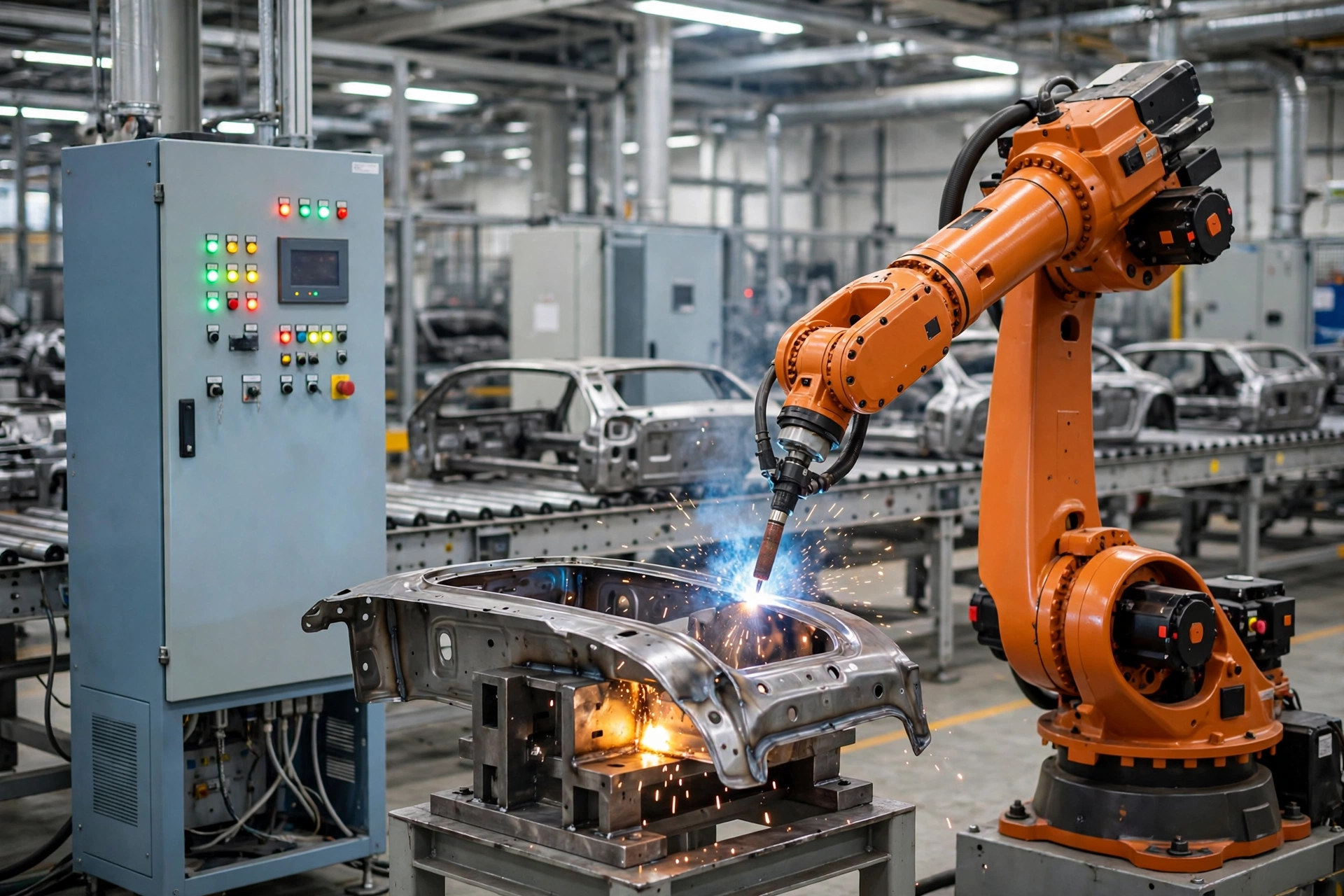
| Robotic welding and painting lines | Articulated robots weld, paint or assemble with high speed and repeatability | Automotive assembly |
| CNC cells with robot loading | A robot loads parts while a CNC machine cuts them to programmed paths | Metalworking |
| Automated packaging lines | Sensors detect products; PLCs run conveyors and fillers that fill, cap and label | Food and beverage |
| Machine-vision inspection | Cameras and software check parts for defects consistently | Electronics and pharmaceuticals |
| Batch process control | Controllers run recipes step by step, with records for quality and traceability | Pharmaceuticals and chemicals |
| SCADA-supervised utilities | Operators monitor pumps, pipelines or plants spread over a wide area | Water, energy and pipelines |
| AGVs and mobile robots | Driverless vehicles move materials without fixed conveyors | Warehousing and logistics |
| Collaborative robot cells | Smaller robots work beside people on packing or light assembly | Small-batch production |
The scale is now mainstream. The International Federation of Robotics (IFR) reported in its World Robotics 2025 report that 542,000 industrial robots were installed in 2024 — more than double the number installed ten years earlier — and that the total stock in use worldwide reached 4,664,000 units, with Asia accounting for 74% of new deployments in 2024. Source: IFR.
How the pieces fit: the automation pyramid
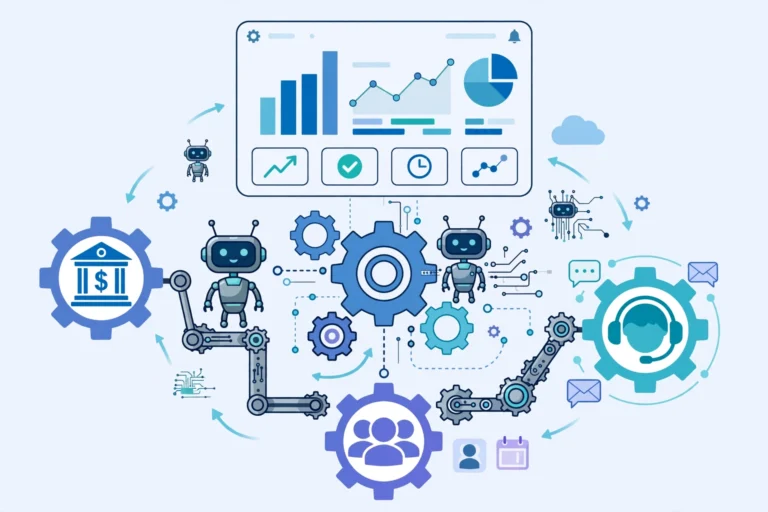
Most plants are organised in layers, often described by the ISA-95 model. At the field level sit sensors, actuators, motors and drives. Above them, the control level runs programmable logic controllers (PLCs) and distributed control system (DCS) controllers that make real-time decisions. The supervisory level — SCADA systems and human-machine interfaces (HMIs) — gives operators a view across machines, with alarms and historical data. Operations systems such as manufacturing execution systems (MES) link the shop floor to orders and quality records, and enterprise systems handle planning. Source: eindustrify on ISA-95.
Three types of industrial automation
Fixed automation is built for one product at high volume — bottling plants and dedicated transfer lines are classic examples. It is efficient at scale, but changing the product usually means changing the equipment. Programmable automation can be reprogrammed for different batches: PLCs, CNC machines and robotic work cells can make a family of similar products, though changeovers take time. Flexible automation handles low volumes and many variations with quick, often automatic changeovers, using modular robot cells and mobile robots. Source: Wevolver.
PLC vs SCADA vs DCS
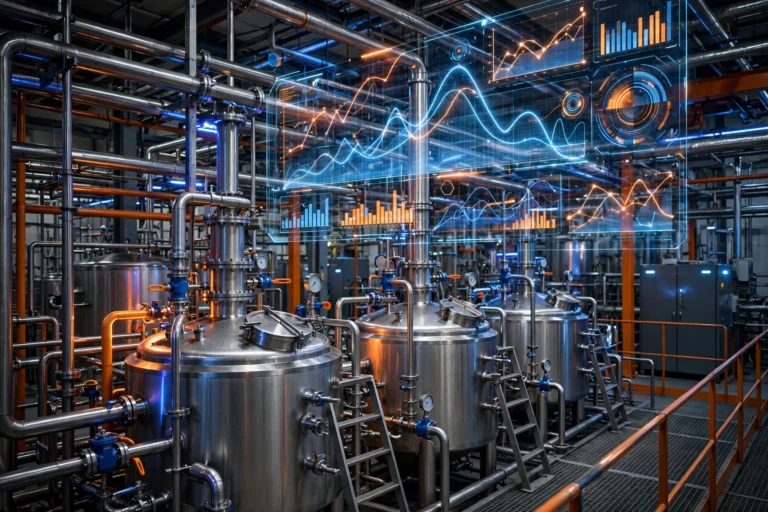
A PLC is a rugged industrial computer that runs fast, discrete machine control — reading sensors, executing logic and driving motors and valves. SCADA is supervisory software: it visualises many machines or sites, manages alarms and stores historical data, but does not usually replace the local controller. A DCS spreads control across many controllers for large continuous processes such as refining, with built-in redundancy so the plant keeps running. In practice the lines blur, and one plant may use all three — for example, a PLC for bottling mechanics and a DCS for fermentation vessels.
Cost, prerequisites and risks
There is no single price for automation, because cost follows scope: one cobot cell and a plant-wide DCS are different projects. Main drivers are equipment, integration and programming, safety systems, installation downtime, and maintenance and training. As a rule, a PLC-based cell is cheaper than a full DCS, which carries the highest initial cost. See also our guide to automation standards.
Automation works best where the process is already stable. Prerequisites include a repeatable process, reliable power and networks, safety assessments for every robot cell, and staff trained to run and maintain the system. Measure the baseline first — cycle time, defect rate and downtime — because, as our guide to automation velocity notes, faster is not automatically better if it just produces defects sooner.
Risks change rather than disappear. Networked controllers need segmentation, patching and access control under standards such as IEC 62443, and safety systems such as light curtains and emergency stops must be designed in. Every system also needs spares and a plan for mid-shift failures.
Analysis: start from the product, not the robot
Analysis: The common mistake is buying the most visible technology — usually a robot — before asking how many variants the line will make, how often they will change, and what happens when the system stops. High-volume single products justify fixed automation; families of batches point to programmable cells; frequent change points to flexible systems. The IFR figures show robots are now ordinary factory equipment, so the choice of system, not the decision to automate at all, is the real decision.
Frequently asked questions
What are examples of industrial automation?
Common examples include robotic welding and painting lines, CNC machines with robot loading, automated filling and packaging lines, machine-vision inspection, SCADA-supervised utilities, batch process control in pharmaceuticals, and mobile robots moving materials in warehouses.
What is the difference between fixed, programmable and flexible automation?
Fixed automation makes one product at high volume with little reconfiguration. Programmable automation can be reprogrammed for different batches, such as CNC and PLC-controlled cells. Flexible automation handles many variations with quick, often automatic changeovers, such as flexible manufacturing systems and modular robot cells.
What is the difference between a PLC, SCADA and a DCS?
A PLC controls individual machines or processes in real time. SCADA supervises and visualises many machines or sites, with alarms and historical data. A DCS distributes control across many controllers for large continuous processes, with built-in redundancy for plants that must run without interruption.
How much does industrial automation cost?
Cost varies widely with scope, from a single cobot cell to a plant-wide system. Key drivers are equipment, integration and programming, safety systems, installation downtime, and maintenance and training. PLC-based cells are generally cheaper than a full DCS, which is the most expensive to engineer and install.
Is industrial automation only for large factories?
No. Collaborative robots, modular cells and cloud-connected controllers have lowered the entry point for smaller plants. Small-batch production can start with one cell — such as packing, inspection or machine loading — and expand once the first cell proves its reliability and return.
Sources
International Federation of Robotics — World Robotics 2025; oTechWorld — Industrial Automation Systems: Types and Real Examples; Wevolver — Types of Automation; eindustrify — Manufacturing Control Systems: SCADA, DCS, PLC and ISA-95.