Smart Universities Explained: What They Are, How They Work, and What Students Get
Key takeaway: A smart university is a campus where connected systems — Wi-Fi, sensors, learning platforms and AI tools — share data to improve teaching, safety and operations. It is not just new gadgets in classrooms: the defining feature is coordination between people, buildings and digital services, so rooms, timetables and support services can respond to actual conditions, not fixed routines.
The phrase “smart universities” is often used to mean a campus with good Wi-Fi and a few screens. That misses the point. Researchers at the University of Oxford describe a smart university as a place where infrastructure, digital services, intelligent systems and academic processes are integrated through data-driven technologies — much like a smart city connects its own services.
What smart universities actually are
An early definition still holds up. Writing for EDUCAUSE in 2008, Prince Sultan University’s Eltayeb Salih Abuelyaman argued that a smart campus requires three things together: smart teachers, smart technology, and smart pedagogical centres that support teaching staff. Classrooms full of equipment alone, he warned, do not make a campus smart.
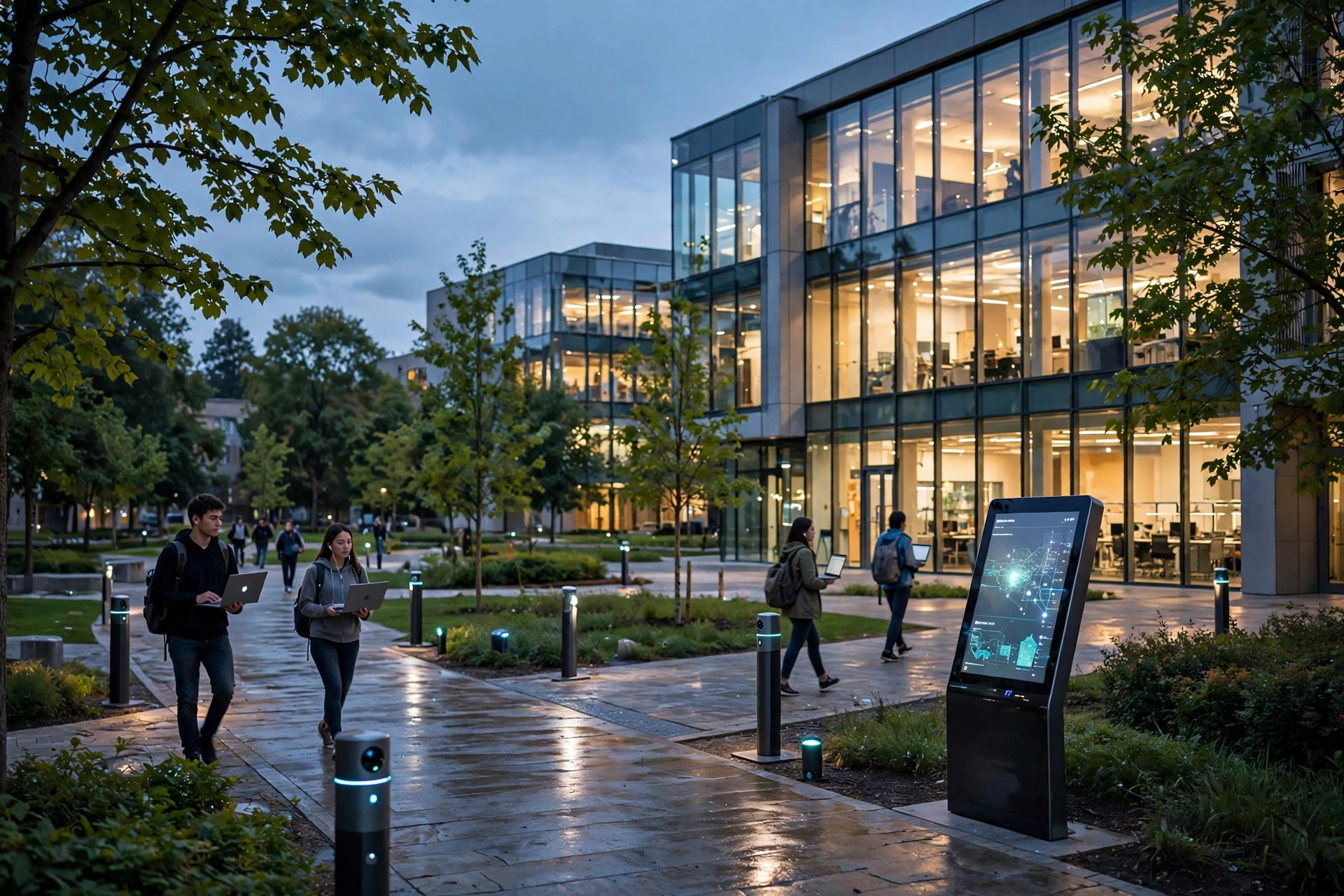
Joined-up systems are what make the difference. When a learning platform, a building system and a timetable share data, the campus can adjust heating and lighting to occupancy, flag a room that is always overbooked, or alert support staff when a student stops engaging. EDUCAUSE notes that connected campuses can monitor attendance, security, lighting and classroom usage to operate more efficiently and safely.
The five building blocks of a smart university
The Oxford review identifies five dimensions — a useful checklist for judging whether a campus is genuinely smart or simply well equipped:
| Dimension | What it covers |
|---|---|
| Intelligent learning environments | Classrooms and online tools that adapt to learners |
| Smart physical infrastructure | Buildings run on live occupancy and energy data |
| Data-driven governance | Decisions based on combined institutional data |
| Sustainability and resource optimisation | Less waste in energy, water and space |
| Integrated digital campus services | One joined-up experience for learning, library and support |
The review also warns that a campus with thousands of sensors is not automatically smart: transformation needs interoperability, cybersecurity, privacy protection, AI governance, digital skills and strategy too.
Smart universities vs traditional universities
| Area | Traditional university | Smart university |
|---|---|---|
| Teaching | Fixed timetable, one pace for all | Adaptive materials alongside live teaching |
| Buildings | Heating and lighting on fixed schedules | Systems respond to occupancy |
| Student support | Help found by the student, often late | Engagement data can trigger early, human support |
| Decisions | Based on end-of-term reports | Based on live usage and learning data |
Why smart universities matter, and what they cost
For students, the benefit is practical: fewer wasted trips to a full library, clearer routes to help, and materials that fit around work and commuting. For universities, the case is operational. A survey cited by EdTech Magazine, from the Center for Digital Education and CenturyLink, found 50 percent of higher-education officials agreed smart campus technology could cut costs, and 43 percent said it could help boost retention. Those are expectations, not measured outcomes — but they explain continued investment despite tight budgets.
Costs come in three layers: network and sensors, software platforms, and ongoing staff time for maintenance, training and data governance. The third layer usually decides whether a project survives. Retrofitting older buildings costs more than wiring a new campus, and subscriptions recur yearly — which is why phased rollouts, one use case at a time, are the norm.
Prerequisites, risks and limits
Before buying hardware, a university needs four prerequisites: reliable connectivity, systems that can exchange data, staff training and support, and clear data rules covering what is collected, who sees it, and how long it is kept. Skipping the data rules will cost student trust, however good the technology is.
Privacy and cybersecurity are the largest risks, since smart campuses collect more data on movement, attendance and engagement than traditional ones — and poorly explained monitoring can feel like surveillance. Vendor lock-in is another limit, and there is an equity risk: students without reliable devices benefit least from a campus that assumes everyone is always connected, a gap that mirrors the questions in purpose-built AI and technological fluency.
Analysis: the test is coordination, not gadgets
Analysis — our judgement from the sources above, not a verified fact. The label is most useful as a test: do the campus’s systems talk to each other, are staff supported to use them, and can students see and challenge how their data is used? A university that passes those three tests is smart in the sense that matters. One that merely installs screens and sensors is a traditional university with a higher electricity bill.
Frequently asked questions
What is a smart university in simple terms?
A smart university is a university where connected technology — sensors, Wi-Fi, learning platforms and data systems — works together to improve teaching, safety and campus services. The key idea is coordination: buildings, timetables and support services respond to real usage instead of fixed routines.
How is a smart university different from a university with online classes?
Online classes are only one part of the picture. A smart university also connects its physical campus — rooms, energy, security and student services — through shared data. A university can offer online learning without being smart, and a smart campus still runs in-person teaching.
What technologies do smart universities use?
The core technologies are Internet of Things sensors, campus-wide Wi-Fi, cloud and edge computing, learning management systems, learning analytics and AI tools, plus intelligent building controls for lighting, heating and security. Digital twins — virtual models of campus buildings — are an emerging addition for planning and maintenance.
Are smart universities better for students?
They can be, when the technology is used well: easier access to materials, faster support when engagement drops, and less wasted time. The benefit is not automatic — it depends on staff training, reliable systems and clear data rules, so judge a campus by those outcomes rather than its marketing.
What are the privacy risks of a smart university?
Smart campuses can collect data on attendance, movement, device use and engagement, creating risks around surveillance, data breaches and unclear consent. Check what data is collected, who can access it, how long it is kept, and whether you can opt out of non-essential tracking.
Sources
EDUCAUSE, “Making a Smart Campus in Saudi Arabia” (2008): er.educause.edu. Markham, Wallom and Wright, “Smart Universities and Smart Campuses” (University of Oxford): journal.kernelxos.com. EDUCAUSE, “Achieving the Smart Campus of Tomorrow Today”: er.educause.edu. EdTech Magazine, “AI and Smart Campuses Are Among Higher Ed Tech to Watch in 2020”: edtechmagazine.com.