How Is Agentic AI Different From Earlier Forms of AI? Explained in Plain English
How Is Agentic AI Different From Earlier Forms of AI? Explained in Plain English
Key takeaway: Agentic AI is different from earlier forms of AI because it acts instead of only answering. Rule-based systems followed fixed scripts, predictive AI spotted patterns, and generative AI created content on request. Agentic AI takes a goal, plans the steps, uses tools and other software, and keeps working until the job is done — with a person setting the limits.
Ask a chatbot a question and you get an answer. Give an AI agent a goal — “sort out this disputed invoice” — and it checks the records, emails the supplier, updates the ledger, and reports back. That shift, from answering to acting, is what “agentic AI” means. This article explains how agentic AI is different from earlier forms of AI, in plain English, and what that difference means in practice.
How is agentic AI different from earlier forms of AI?
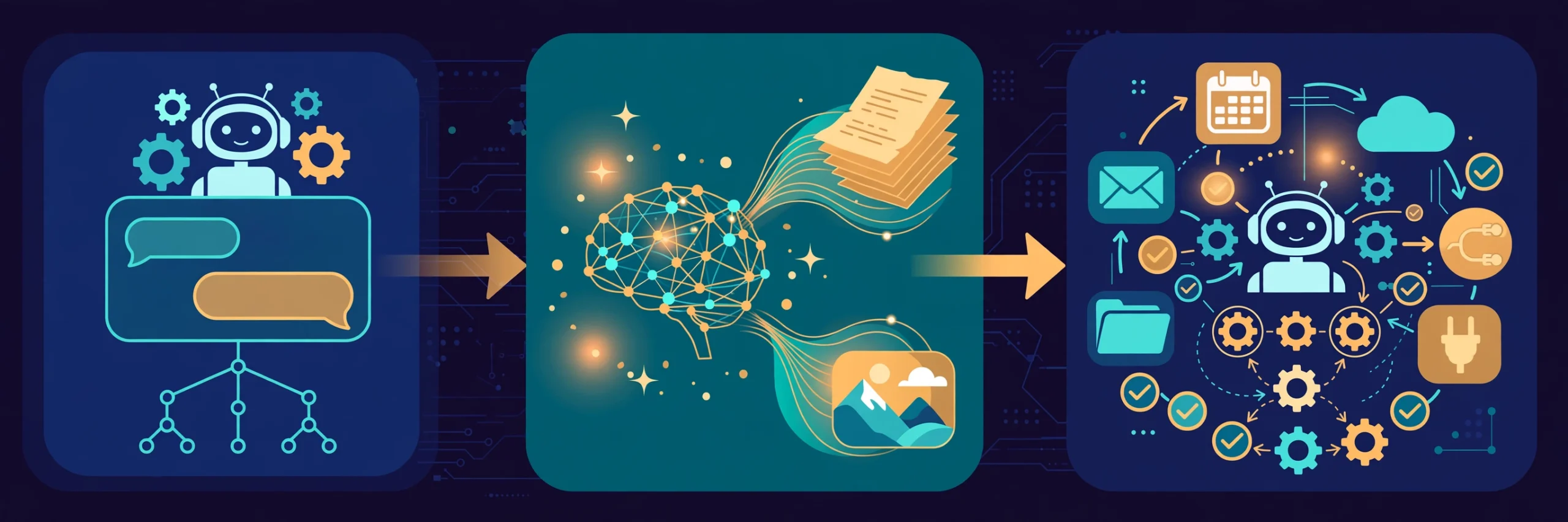
The short answer: earlier forms of AI produced an output for a person to use. Agentic AI produces an outcome. IBM puts the split in one sentence: “While traditional AI was designed to recognize patterns and make predictions, generative AI creates new content such as text, images, video, audio and software code. Agentic AI focuses on achieving goals by planning, making decisions and carrying out multi-step workflows with varying levels of autonomy.” The model underneath is often the same large language model. What changes is the system wrapped around it: a planning loop, memory, tool access, and permission to change things outside the chat window. Gartner expects the shift to spread fast: by 2028, 33% of enterprise software applications will include agentic AI, up from under 1% in 2024.
The four earlier forms of AI, and what each one did
Rule-based systems (the 2010s and before). Early chatbots and expert systems followed scripts written by people: if the user types X, reply Y. They were predictable and cheap, but they broke the moment a question fell outside the script.
Predictive and machine-learning AI. These systems learned patterns from data: flagging fraud, forecasting demand, ranking search results. They could make a prediction or a classification, but they waited for an input and returned a single output. A person still had to act on it.
Generative AI (from late 2022). When ChatGPT launched in November 2022, AI learned to create: drafts, summaries, code, images. But the first versions were stateless — they answered a prompt and stopped. They could write the email; they could not send it or follow up. For more on what generative models are built to do, see our explainer on the primary goal of a generative AI model.
Agentic AI (2024 onward). An agent takes a goal, breaks it into steps, calls tools and APIs, reads the results, and adjusts its plan. IBM describes an AI agent as a program that can “design its own workflow and use available tools” to accomplish a goal on a user’s behalf. Anthropic’s widely cited guide “Building effective agents”, published in December 2024, drew the same line: the agent is defined by the loop — decide, act, observe, decide again — not by the model inside it.
Agentic AI vs earlier AI: the comparison
| Form of AI | Triggered by | What it produces | Who decides the next step | Typical failure |
|---|---|---|---|---|
| Rule-based systems | A matching input | A scripted reply | The script’s author | Breaks on anything unexpected |
| Predictive / ML AI | New data | A prediction or score | A person reading it | A wrong forecast |
| Generative AI | A prompt | Content: text, images, code | A person, after reading it | A wrong or invented answer |
| Agentic AI | A goal | Actions across tools and systems | The software, inside limits you set | A wrong action, or a half-finished task |
What changes when AI starts acting instead of answering
The practical difference shows up in workflows, not demos. A generative AI assistant can draft a refund reply. An agent can check the order, verify the return policy, issue the refund inside the limits you set, and log the case — or stop and ask a human when the amount exceeds its authority. That is why governments are already testing agents for real services: our report on AI agents for government covers where they are live and the rules that govern them.
Adoption is moving fast, but it is still early. McKinsey’s 2025 survey of 1,993 participants across 105 countries found 23% of organisations were scaling an agentic AI system somewhere in the business and another 39% had begun experimenting. Deloitte’s January 2026 survey of 3,235 senior leaders found only 21% of companies had a mature model for governing autonomous agents — the guardrails are lagging the deployments.
What agentic AI costs, and what it needs before it works
Agents cost more per task than a chatbot, because they run many model calls, tool calls, and checks instead of one. One industry estimate puts an orchestrated agent interaction at roughly $1.20 against about $0.04 for a simple 2023 chatbot call — around 30 times more — and the bill varies with how many steps a task takes, which makes budgeting harder than per-prompt pricing.
Before an agent can work safely it needs four things: clear goals and limits, permission to use specific tools, persistent memory of the task, and an audit trail showing what it did and why. This is the same ground covered in our guide to AI workflow layer optimisation. IBM’s own AskHR tool, an agentic system powered by generative AI, handles more than 2.1 million employee conversations a year — proof the scale is real when the workflow is well defined.
The risks and limits nobody should skip
The biggest risk is also the biggest difference: when generative AI is wrong, you get a wrong sentence. When agentic AI is wrong, you get a wrong action — money moved, a record changed, a customer wrongly refused. Gartner predicted in June 2025 that more than 40% of agentic AI projects will be cancelled by the end of 2027, citing escalating costs, unclear business value, and inadequate risk controls. Its January 2025 poll of 3,412 webinar attendees found only 19% called their agentic investment significant, while 31% were still waiting to see.
Agents also struggle with long, ambiguous tasks, they can loop or stall, and they need human approval for consequential decisions. The US National Institute of Standards and Technology (NIST) launched an AI Agent Standards Initiative in February 2026 to build industry-led standards for agent security and identity — a sign that the rules are still being written. Unattended automation faces the same governance questions; see our explainer on unattended automation for how teams handle bots that run on their own.
Analysis: the difference is a system, not a smarter model
Analysis: The honest way to judge any “agentic” product is to ask what happens after the first answer. If the system cannot plan a second step, call a tool, remember the result, and change its plan, it is a chatbot with a new label — and Gartner’s warning suggests thousands of vendors are selling exactly that. The real shift is architectural: the same language model, given memory, tools, and permission, becomes a worker instead of a writer. For buyers, the winning move is to start with one narrow, well-measured workflow and an approval gate on every consequential action, not to chase full autonomy on day one.
Frequently asked questions
Is agentic AI the same as generative AI?
No. Generative AI creates content in response to a prompt and then stops. Agentic AI uses a generative model as its reasoning engine, then plans steps, calls tools, and acts on other systems until a goal is met. IBM says agentic AI “builds on generative AI techniques by using large language models” — it is a layer on top, not a replacement.
How is agentic AI different from a chatbot?
A chatbot waits for a message, generates a reply, and stops. An agent works toward a goal across many steps: it can search records, update a database, send messages, and check results. A chatbot handles a conversation; an agent handles a case.
How is agentic AI different from RPA and traditional automation?
Traditional automation and robotic process automation repeat fixed, recorded steps and break when anything changes. Agentic AI plans its own steps, adapts when results differ from expectations, and handles exceptions. The trade-off is cost and unpredictability: fixed automation is cheaper and more predictable for stable, repetitive work.
Will agentic AI replace generative AI?
No. Agents call generative models to do their thinking and writing, so generative AI is a component inside every agent. The two will keep being sold together: generative AI for one-shot content, agentic AI for multi-step outcomes.
Should a small business use agentic AI in 2026?
Start small and measured. Pick one narrow workflow with clear success criteria, give the agent limited permissions, and require human approval for anything that moves money or changes customer records. Gartner’s forecast that over 40% of agentic projects will be cancelled by 2027 is a warning against buying full autonomy before the workflow is proven.
Sources
- IBM — Agentic AI vs. Generative AI
- IBM — Generative AI Use Cases (AskHR: 2.1 million conversations a year)
- Metorial — Why 40% of agentic AI projects get canceled (Gartner, June 25, 2025)
- SmartMindAI — Agentic Era (McKinsey 2025 survey; NIST AI Agent Standards Initiative, February 2026)