IoT and Automation Explained: How Connected Devices Run Factories, Homes, and Cities
Key takeaway: IoT and automation work as a team: IoT devices sense what is happening in the physical world, and automation software acts on that information without waiting for a person. Statista counts 19.8 billion IoT devices worldwide in 2025, a number forecast to more than double to 40.6 billion by 2034.
What IoT and automation actually are
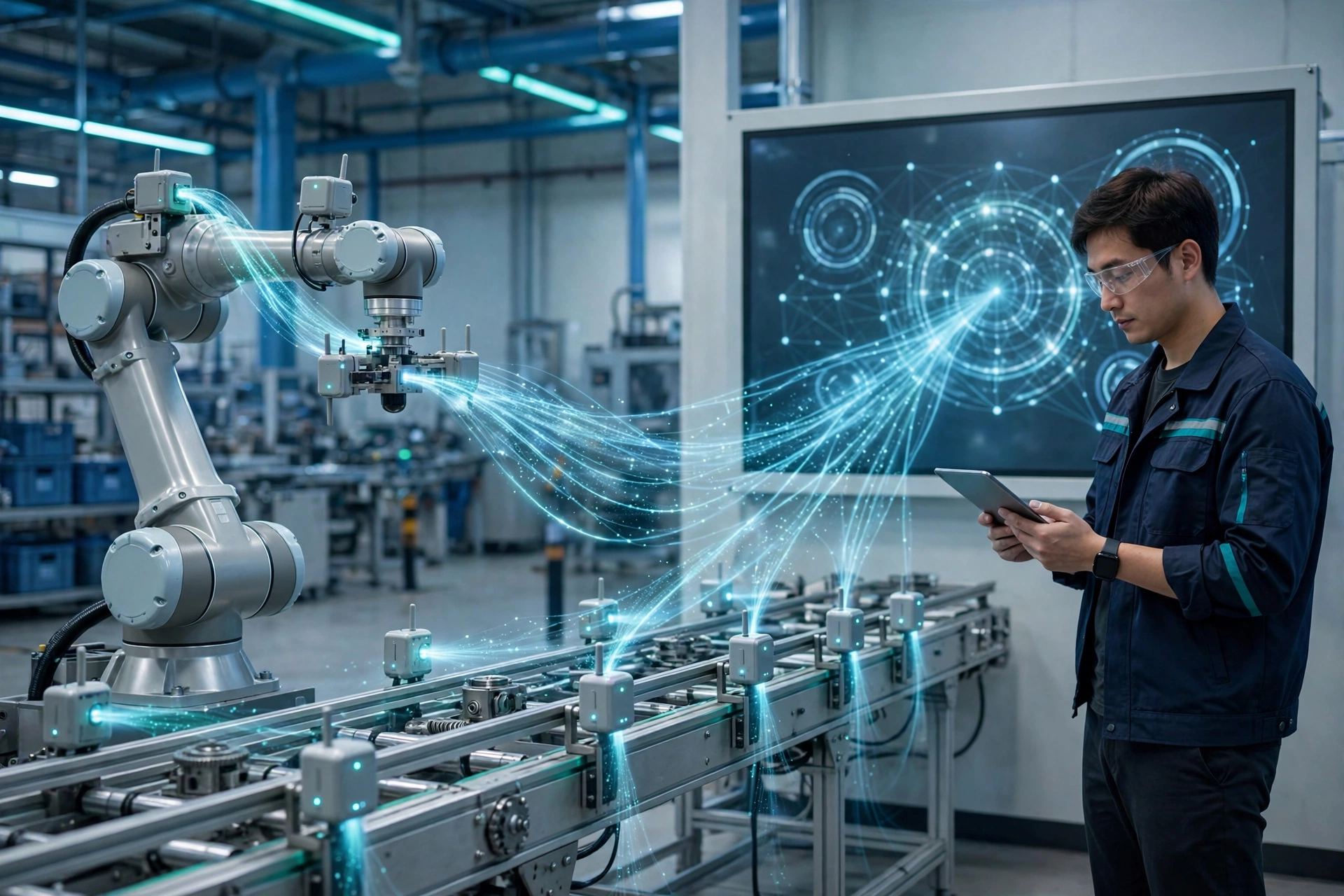
The Internet of Things (IoT) is the network of physical objects — sensors, machines, appliances, vehicles — fitted with connectivity so they can send and receive data. Automation is software and machinery carrying out tasks with little or no human input. A sensor that reports a temperature is IoT. A machine that switches itself off at a set time is automation. IoT and automation become powerful when combined: the sensor’s live data tells the machine when to act, and the machine acts immediately.
Think of a cold-storage warehouse: temperature sensors report readings every few seconds, and when one drifts above a safe limit the system raises cooling and alerts a manager — no one watches a gauge. That loop — sense, decide, act — is the core idea behind almost every IoT and automation deployment.
How IoT and automation work together
Most systems follow the same four steps:
- Sense. Sensors measure vibration, temperature, pressure, location, or energy use and send readings over Wi-Fi, Bluetooth, cellular, or industrial wireless links.
- Connect. Gateways collect the data and forward it to an edge computer nearby or to the cloud.
- Decide. Software compares the data against rules or an AI model — a rule might say “if vibration exceeds X, slow the machine,” while a model might predict a bearing will fail within a week.
- Act. The system adjusts a valve, reroutes a delivery, schedules maintenance, or sends an alert — automatically.
Processing data close to the machine — edge computing — cuts delay, so a safety shutdown can happen in milliseconds instead of waiting on a round trip to the cloud.
IoT-driven automation vs traditional automation
Traditional automation follows fixed programs: a robot repeats the same weld, a timer switches lights on at 6 p.m. IoT-driven automation reacts to live conditions instead. The differences are practical, not just technical:
| Traditional automation | IoT-driven automation | |
|---|---|---|
| Trigger | Fixed schedule or program | Live sensor data and rules |
| Visibility | Local, on the machine | Remote dashboards, anywhere |
| Maintenance | Fixed intervals | Predictive, based on actual wear |
| Flexibility | Reprogramming needed | Rules updated remotely |
Predictive maintenance is the clearest example of the upgrade. Instead of servicing a motor every six months, sensors track vibration and heat continuously, and analytics flag the motor only when the data shows real wear. IBM and National Instruments built one of the early public testbeds for exactly this: streaming sensor data from industrial gear to the cloud so failures could be predicted before they caused downtime.
Where IoT and automation show up today
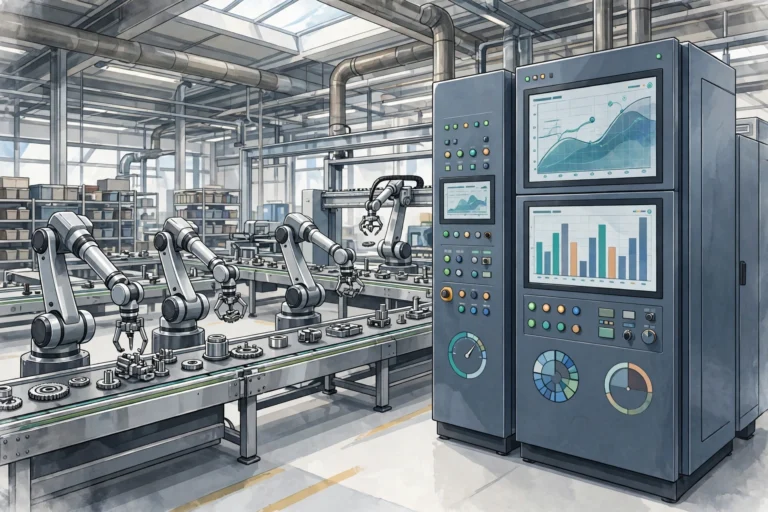
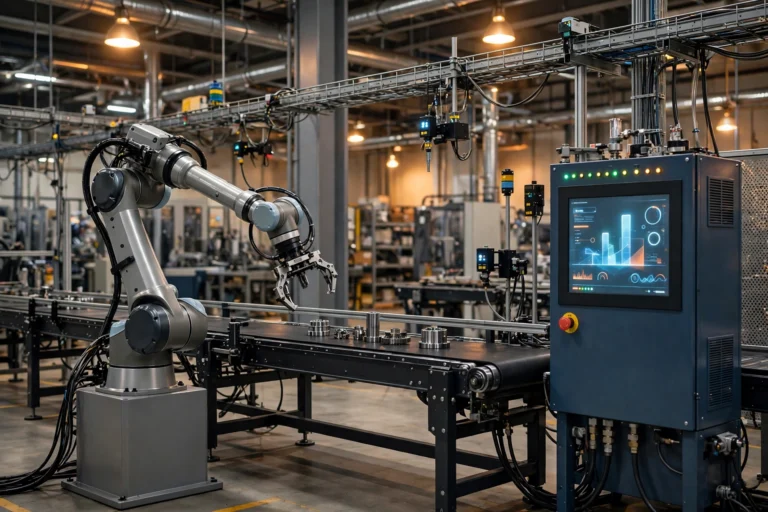
In factories, connected sensors monitor production lines, track energy use, and trigger maintenance. Berg Insight found annual shipments of wireless devices for industrial automation reached 5.8 million units worldwide in 2025, growing at 8.1% a year to 8.5 million by 2030. The industrial IoT automation market was valued at $134.64 billion in 2025 and is forecast to reach $301.38 billion by 2032, according to Stratistics MRC.
At home, thermostats learn routines, leak sensors shut off water mains, and lighting adjusts to occupancy — the consumer segment is around 60% of all IoT devices, per Statista. In cities, connected traffic lights adapt to congestion and smart meters report energy use in real time, while in healthcare, remote monitors alert clinicians when a patient’s readings move outside safe ranges. For more on the factory side, see our explainers on industrial automation and IoT and industrial automation in IoT, and for the IT side, automating IT operations.
What does IoT and automation cost?
Costs vary widely by scale. A home setup can start under $100 with a smart thermostat and a few sensors. A small business automating one process — say, sensor-based inventory tracking — typically spends a few thousand dollars on hardware, connectivity, and a platform subscription. A factory deployment runs into tens or hundreds of thousands. The recurring costs matter more than the hardware: connectivity plans, cloud subscriptions, and maintenance.
What you need before you start
Three prerequisites decide whether a project works. First, reliable connectivity that actually reaches every sensor location, including basements and metal-heavy factory floors. Second, a clear decision rule: know in advance what the system should do when a sensor reports a value — automate the decision, not just the data collection. Third, security from day one: every connected device is a potential entry point, so devices need unique credentials, encrypted connections, and regular firmware updates. Start small: one sensor, one automated action, one measurable result.
The risks and limits
IoT and automation carry real risks. Security is the biggest: Berg Insight notes that as operational technology and IT converge, the attack surface of industrial systems grows, and suppliers now treat cyber security as a design principle rather than an add-on. A compromised sensor network can feed false data to automated systems, so the automation is only as trustworthy as its inputs. Connectivity is a second limit: if the network drops, cloud-dependent automation stalls, which is why safety-critical actions usually run at the edge.
Analysis: the combination matters more than either part alone
Analysis: IoT without automation is a dashboard nobody watches, and automation without IoT is a machine running blind. The value sits in the loop between them — live data triggering a useful action in seconds. That is also why the market numbers keep climbing: the industrial IoT automation market is forecast to more than double by 2032. But most failures in this space are not technology failures. They are projects that collected data without deciding what to do with it, or automated a process nobody had measured first. The teams getting results start from a specific, expensive problem — unplanned downtime, wasted energy, a manual check that happens a thousand times a day — and let the sensors serve that problem. For the growing role of software agents in this loop, see AI agents for business automation.
What is the difference between IoT and automation?
IoT connects physical devices so they can share data; automation uses software and machines to perform tasks without human input. IoT supplies the live information, automation supplies the action. Together they form systems that sense conditions and respond on their own.
What is an example of IoT and automation working together?
A factory vibration sensor detects a motor running hotter than normal and the system automatically slows the line and books a maintenance slot before the motor fails. At home, a leak sensor detects water and shuts off the main valve within seconds. Both follow the same loop: sense, decide, act.
How many IoT devices are there in the world?
Statista counts 19.8 billion IoT devices worldwide in 2025 and forecasts more than 40.6 billion by 2034, with the consumer segment making up around 60% of devices. IoT Analytics, using a different counting method, reported connected IoT devices growing 14% to 21.1 billion in its State of IoT 2025 report.
Is IoT and automation safe?
It can be, but security must be built in from the start: unique device credentials, encrypted connections, regular firmware updates, and network segmentation so a compromised sensor cannot reach critical systems. As industrial systems connect more widely, suppliers increasingly treat cyber security as a core design requirement rather than an add-on.
How much does it cost to start with IoT and automation?
A home setup can start under $100. A small-business pilot usually costs a few thousand dollars for sensors, connectivity, and a platform subscription. Factory deployments cost far more, and the ongoing platform and maintenance fees matter more than the initial hardware. The strongest projects start with one sensor, one automated action, and one measurable saving.
Sources
- Statista — IoT connections worldwide
- IoT Analytics — State of IoT 2025 market data
- Computer Weekly — Wireless industrial automation IoT device shipments rise sharply (Berg Insight)
- Stratistics MRC — Industrial IoT Automation Market Forecasts to 2032
- CIO — Industrial IoT testbed for equipment monitoring and predictive maintenance