Custom Manufacturing Automation Explained: What It Is, the Main Types, and How to Choose One
Key takeaway: Custom manufacturing automation is machinery built for one specific product or process, not bought off the shelf. It combines robots, sensors, and control software into one system tuned to a single job. Simple machines start around $100,000, but they cut defects, run around the clock, and typically pay for themselves in two to three years.
What Is Custom Manufacturing Automation?
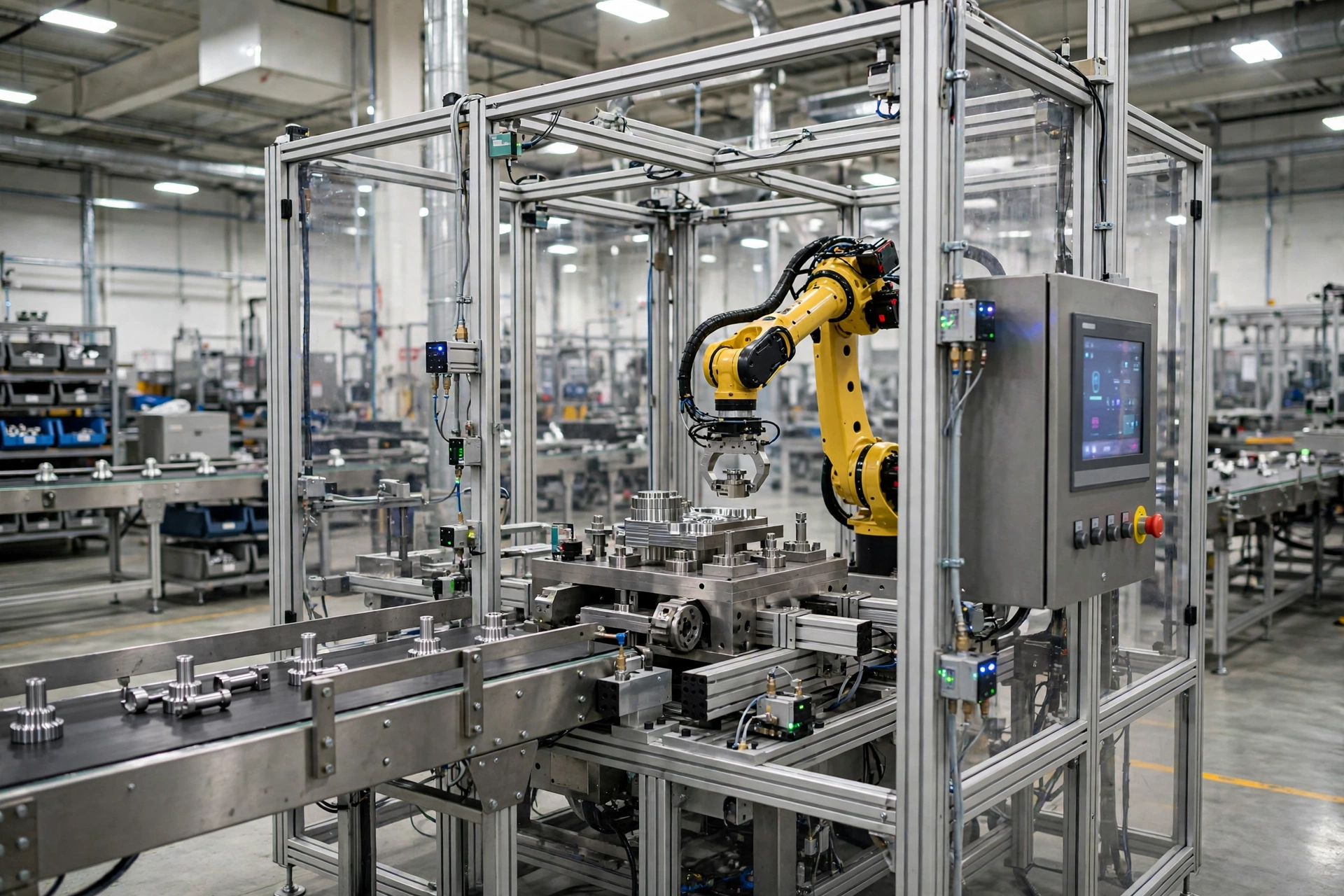
Custom manufacturing automation is a machine or integrated system engineered to perform a specific manufacturing task for a specific product. Unlike a general-purpose robot or a catalog machine, it is built around one job: one part, one process, one production rate. It typically combines a machine frame, feeding devices, a process station, sensors, and a control cabinet into one coordinated production asset.
The difference from off-the-shelf equipment is intent. A standard machine does a generic job well enough for many buyers; a custom system does one job exactly the way one factory needs it — the right cycle time, the right tolerances, the right inspection steps built in. That is why custom systems show up where tolerances are tight or a process cannot be done by hand. For background, see our guide to machine automation solutions.
Custom vs. Off-the-Shelf Automation
| Factor | Custom automation | Off-the-shelf automation |
|---|---|---|
| Fit | Built for one product and process | Built for many buyers and uses |
| Upfront cost | Higher; simple machines start around $100,000 | Lower; catalog pricing |
| Lead time | 6 weeks (simple) to 24–26 weeks (complex) | Days to weeks, often in stock |
| Flexibility | Low unless designed in from the start | Higher; redeployable to other tasks |
| Best for | High-volume, stable, product-specific work | Common tasks, pilots, changing mixes |
The trade-off is simple: custom buys precision and speed for one job; standard buys flexibility and a lower starting price. If your product will change within a year, custom is usually the wrong call.
The 4 Main Types of Custom Manufacturing Automation
Engineers group automation by how easily it changes to a new product. Most plants run more than one type, and custom systems usually sit in the programmable or flexible rows, because one station often handles many part numbers.
| Type | How it works | Best for |
|---|---|---|
| Fixed (hard) automation | The sequence is built into the machine’s mechanics | One product at very high volume for years |
| Programmable automation | Equipment is reprogrammed and retooled between batches | Batch production at medium volume |
| Flexible (soft) automation | Switches between product variants with little or no downtime | High mix at medium volume |
| Integrated automation | Machines, data, and business systems linked under computer control | Whole lines or plants |
Fixed automation is the classic transfer line: fast and painful to change. Programmable automation — CNC machines, PLC-sequenced cells — trades some speed for switching between batches. Flexible automation uses robots and machine vision to change products with a recipe or software change. Integrated automation links machines to MES and ERP systems so the whole plant runs as one operation. The framework is laid out in Sciotex’s industrial automation guide.
What Custom Manufacturing Automation Costs
Real cost data is scarce because most builders quote per project. A 2026 benchmark report from AMD Machines, drawn from more than 2,500 delivered custom machines, gives usable bands: simple custom machines start at around $100,000, a complex machine with several processes (servo pressing, robot handling, quality checks) costs about $300,000, and the average project is about $500,000. Materials are typically 50–60% of a project’s value; the rest is engineering, integration, commissioning, and trials.
Payback follows the same pattern. According to the same benchmarks, an individual custom machine typically pays back in 2–3 years and a very large line in about 5 years, while the best case on record — three-shift operation with a difficult manual process and a high scrap rate — paid back in 6 months. An independent ROI guide puts complex custom automation at 30–48 months, which lines up with the 2–3 year band. For comparison, the average industrial robot payback has fallen from 5.3 years in 2019 to about 1.3 years in 2024, according to McKinsey figures cited in that guide. Lead time matters too: simple machines can arrive in as little as 6 weeks, complex systems in 24–26 weeks.
When Custom Automation Pays Off
The market is moving this way. Market Research Future values the global industrial automation market at $251.06 billion in 2026, growing to $459.97 billion by 2035 at a 6.96% annual rate. The International Federation of Robotics’ World Robotics 2026 report recorded a record 603,000 industrial robots installed in 2025 — up 11% — with the global operational stock reaching 5.079 million units and installations forecast to rise to about 655,000 in 2026. A 2024 McKinsey report found that 70% of manufacturers worldwide planned to increase automation spending over the next two years.
The practical payoffs are throughput, consistency, and quality. A machine built for one product runs at a rate manual stations cannot match and repeats it hour after hour without fatigue. Every cycle applies the same force, position, and timing, which cuts scrap and rework, and inspection built into the process catches defects where they occur rather than at final test. Some processes, like precision servo pressing and certain welds, cannot be performed by an operator at all. Connected systems add a further layer: see how industrial automation works with IoT and how AI is used in fabrication.
The Risks and Limits to Plan For
Custom automation has real downsides. Vendor quotes typically cover equipment and basic integration only — actual project costs commonly run 25–35% higher once installation, guarding, programming, and commissioning are included. A system built for one product is hard to repurpose if that product changes or is discontinued, and validation cycles run longer in regulated industries such as medical devices and aerospace. The project also needs in-house skill to run and maintain: operators, maintenance technicians, and someone who owns the control software. If you are building that team, our guide on how to become an automation engineer covers the skills involved.
Prerequisites before you buy: a stable product design, enough volume to justify the investment, documented processes, and a maintenance plan. If the product design is still changing, fix that first — a custom machine built around a moving target is the most expensive mistake in automation.
How to Choose the Right System
Follow these steps in order, and do not skip the first one:
- Define the job in numbers. Cycle time, tolerance, defect rate today, and the volume you must hit. If you cannot state these, you are not ready to buy.
- Decide custom vs. standard. If a catalog machine or a collaborative robot cell meets the numbers, buy that first — it is cheaper, faster, and redeployable.
- Get three quotes from builders with delivered machines in your industry. Ask for reference customers and actual payback data, not brochure figures.
- Model the full cost. Include integration, installation, programming, training, and maintenance — equipment is typically only 50–60% of the project.
- Run the worst case. If the payback still works when savings are 30% lower and costs 30% higher, proceed. If not, shrink the scope.
Analysis: Buy Custom Only When the Job Demands It
Our take: custom manufacturing automation is the right answer when a job is stable, high-volume, and hard to do by hand — and the wrong answer when the product is still changing or the volume is uncertain. The benchmark data supports that: the fastest paybacks come from three-shift, high-scrap, hard-to-do-manually work, while the slowest come from large, complex lines with long validation cycles. Start with the smallest system that solves the worst bottleneck, prove the payback, and then expand.
Frequently Asked Questions
What is custom manufacturing automation?
Custom manufacturing automation is machinery designed and built for one specific product or process, rather than bought from a standard catalog. It combines mechanical structures, actuators, sensors, controllers, and software into a single system engineered around one job, such as assembling, testing, or packaging a particular part.
How much does custom manufacturing automation cost?
Based on 2026 benchmark data from more than 2,500 delivered machines, simple custom machines start at around $100,000, a complex machine with several processes costs about $300,000, and the average project is around $500,000. Materials are typically 50–60% of the project value, with engineering, integration, and commissioning making up the rest.
How long does it take to build a custom automation system?
Simple custom machines can be delivered in as little as 6 weeks, while complex systems typically take 24–26 weeks. That is faster than the 40–42 weeks typical for overseas builders, but you should still budget the lead time into your production plan alongside the price.
What is the difference between custom and standard automation?
Custom automation is built for one product and process, so it fits exactly and runs fast, but it costs more, takes longer to build, and is hard to repurpose. Standard automation is bought from a catalog, so it is cheaper, faster to install, and redeployable, but it may not match your tolerances or cycle time.
When is custom automation worth it?
Custom automation is worth it when the product design is stable, volumes are high enough to justify the investment, and the process is repetitive, precise, or impossible to do by hand. Typical payback is 2–3 years for an individual machine. If the product is still changing or volumes are uncertain, a standard machine or collaborative robot is usually the safer first step.
Sources
- Frand Machine — Custom Automation Equipment guide (definition, components, types, benefits)
- Sciotex — Industrial Automation: A Manufacturing Automation Guide (four automation types, components)
- AMD Machines — Custom Automation Benchmarks: 2026 Report (cost bands, lead times, payback from 2,500+ machines)
- OxMaint — Manufacturing Automation ROI Guide (payback by type, McKinsey robot payback figures)
- Market Research Future — Industrial Automation Market report (market size $251.06B in 2026, $459.97B by 2035)
- Wissen Research via PR Newswire — Global Industrial Automation Market (IFR World Robotics 2026: 603,000 robots installed in 2025, 5.079M stock, ~655,000 forecast for 2026)
- Ekotek — Manufacturing Process Automation guide (McKinsey 2024: 70% of manufacturers plan to increase automation spending)