What Are the Two Types of Industrial Automation? Fixed vs Programmable Explained
Key takeaway: The two types of industrial automation most textbooks name first are fixed automation and programmable automation. Fixed automation runs one unchanging sequence at very high volume; programmable automation can be reprogrammed to make different products in batches. Most modern classifications add a third type, flexible automation, which switches between products with little or no changeover time.
So if you searched “what are the two types of industrial automation,” the honest answer is that the question is slightly out of date: there are two foundational types, but the standard classification used today has three — and some frameworks count a fourth, integrated automation. Here is what each one does, where it fits, and how to pick between them.
What Are the Two Types of Industrial Automation?
Industrial automation is commonly classified by how easily a production system can change what it makes. Britannica distinguishes three types of automation in production: fixed, programmable, and flexible. The first two — fixed and programmable — are the pair the question refers to, and they represent opposite ends of a trade-off between speed and adaptability.
Fixed automation is built for one product, made in huge quantities, for a long time. Programmable automation is built for many products, made in batches, where the equipment is reprogrammed between runs. Flexible automation sits between them: it handles product variety like programmable automation, but changes over almost instantly.
Fixed Automation: One Product, Maximum Speed
Fixed automation, also called hard automation, uses dedicated equipment that performs a fixed sequence of operations. The sequence is built into the machine itself — cams, gears, wiring, and fixtures — so changing the product usually means rebuilding or replacing the line.
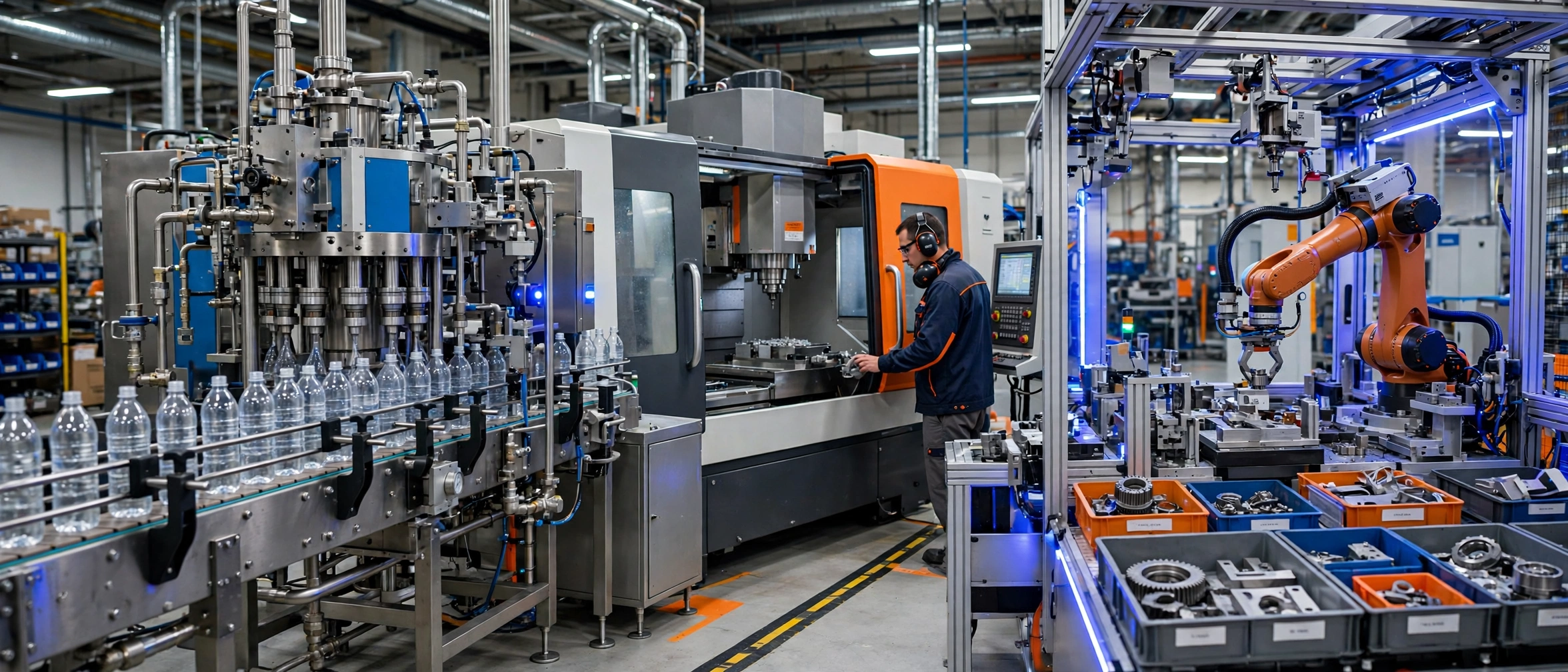
Typical examples include automated bottling lines, transfer lines in metalworking, mechanised assembly lines for a single car model, and continuous chemical processing. According to the Universal Technical Institute, fixed automation is widely used in automobiles, chemicals, and food processing, where the product barely changes.
Advantages: the highest production rates of any automation type, very low cost per unit at high volumes, and consistent quality once the line is running. Disadvantages: it is inflexible, expensive to set up, and a poor fit the moment product design or demand changes.
Programmable Automation: Batch Production With Reprogramming
Programmable automation uses computer-controlled equipment whose sequence of operations can be changed by loading a new program. Britannica notes that products are made in batches ranging from several dozen to several thousand units, and for each new batch the equipment must be reprogrammed and changed over to the new product style.
The classic examples are CNC machines, industrial robots in batch manufacturing, and batch process systems. UTI lists PLCs, industrial robots, and CNC machines as the core equipment, and names electronics, aerospace, and custom manufacturing as the industries that benefit most.
Advantages: one line can make many different products, setup costs are lower than fixed automation, and it suits medium-volume production. Disadvantages: production rates are slower than fixed automation, every new batch costs reprogramming and changeover downtime, and the systems need skilled programmers and more complex maintenance. For a closer look at how these systems are applied on real factory floors, see our guide to automating manufacturing systems.
Flexible Automation: The Third Type
Flexible automation, also called soft automation, is an extension of programmable automation. The equipment can switch between different product styles with little or no lost production time, because the changeover is handled by software rather than by physically retooling the machine.
The usual example is a flexible manufacturing system (FMS): several computer-controlled machine tools linked by an automated material-handling system and coordinated by a central computer. A robot cell that welds one car body and then, minutes later, a different one without stopping the line is flexible automation in action. It costs more than programmable automation up front, but it pays off where product variety is high and batch sizes keep shrinking.
Fixed vs Programmable vs Flexible: A Comparison
| Type | Best for | Production volume | Changeover | Relative cost |
|---|---|---|---|---|
| Fixed (hard) | One product, stable design | Very high | Rebuild the line | High setup, lowest unit cost |
| Programmable | Many products in batches | Medium | Reprogram + retool, hours | Moderate |
| Flexible (soft) | Many products, small batches | Medium | Minutes or automatic | High setup |
| Integrated | Whole-factory coordination | Varies | Software-driven | Highest |
Some frameworks add a fourth type, integrated automation, in which fixed, programmable, and flexible systems are coordinated by software from design through production and logistics — sometimes called computer-integrated manufacturing. oTechWorld describes it as many systems coordinated by software across the whole operation. It is less a machine type than a way of joining the other three together.
How to Choose the Right Type
Choose fixed automation when one product will sell in very high volumes for years with almost no design changes — think beverage bottling or a single car model. Choose programmable automation when you make several products in batches of dozens to thousands, and you can afford the changeover time between them. Choose flexible automation when variety is the business: small batches, frequent design changes, and customers who expect customisation. If you are weighing a custom build, our explainer on custom manufacturing automation covers the costs and payback in more detail.
Three practical checks before deciding: first, how many different products will the line make in a year; second, how long you can afford the line to sit idle during a changeover; and third, whether you have — or can hire — the programmers and maintenance staff a reprogrammable system needs.
Analysis: Why the “Two Types” Question Persists
The two-type framing survives because fixed and programmable automation are the two poles every engineer learns first: maximum speed versus maximum adaptability. Flexible automation was added to the classification later, as computer control made near-instant changeovers possible, and integrated automation later still, as factories began linking whole plants with software. The practical lesson is not the count — it is the trade-off. Every automation decision is a bet on how stable your product mix will be, and the most expensive mistake in factory automation is buying fixed equipment for a product that changes, or flexible equipment for a product that never will.
Frequently Asked Questions
What are the two types of industrial automation?
The two foundational types are fixed automation and programmable automation. Fixed automation runs one unchanging sequence at very high volume, while programmable automation can be reprogrammed to make different products in batches. Most modern classifications add flexible automation as a third type, and some add integrated automation as a fourth.
What is fixed automation best for?
Fixed automation is best for making one standardised product in very high volumes over a long period, such as bottling, continuous chemical processing, or a single car model’s assembly line. It gives the highest production rates and the lowest cost per unit, but it is expensive to set up and very hard to change.
What is programmable automation best for?
Programmable automation is best for batch production, where several different products are made in runs of dozens to thousands of units. CNC machines, industrial robots, and PLC-controlled lines are typical examples. It is widely used in electronics, aerospace, and custom manufacturing, where flexibility matters more than raw speed.
What is the difference between programmable and flexible automation?
Both handle product variety, but programmable automation needs significant downtime to reprogram and retool between batches, while flexible automation switches between products with little or no lost production time. Flexible systems, such as flexible manufacturing systems, handle changeovers through software, which makes them better for small batches and frequent design changes but more expensive to build.
Which type of industrial automation should a small factory choose?
Most small factories should start with programmable automation, usually built around CNC machines or a small robot cell, because it handles varied orders without the cost of a dedicated fixed line. Consider flexible automation only when changeovers are eating a large share of your working day, and fixed automation only when one product dominates your output for years.
Sources
- Britannica — Automation: Manufacturing applications of automation and robotics
- Universal Technical Institute — Types of Automation
- oTechWorld — Industrial Automation Systems: Types & Real Examples
- Electrical Technology — What is Industrial Automation? Types, Hierarchy and Benefits