

AI IoT Companies Explained: What They Do, the Leaders, and How to Choose One
Key takeaway: AI IoT companies combine artificial intelligence with connected devices, so sensors and machines analyse data and act on it — not just collect it. The leaders are Microsoft, Amazon Web Services, Google, IBM, Intel, Siemens, Cisco, and NVIDIA. Market-size estimates for 2026 range from about $17 billion to $120 billion, so judge vendors on your devices and use case, not on hype.
What Is an AI IoT Company?
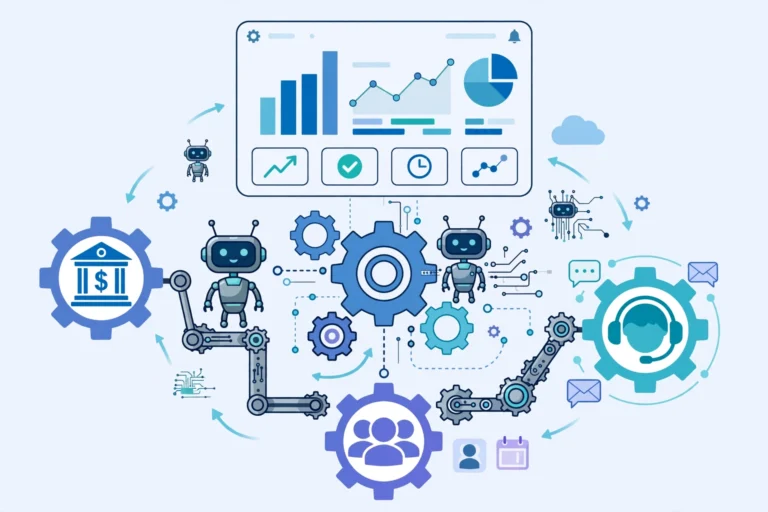
An AI IoT company builds products or platforms that connect physical devices to the internet and then use artificial intelligence to make sense of what those devices report. The combination is often called AIoT — the Internet of Things plus AI. A plain IoT system collects sensor data and shows it on a dashboard. An AIoT system goes further: it spots patterns, predicts failures, and triggers actions without a person watching the screen.
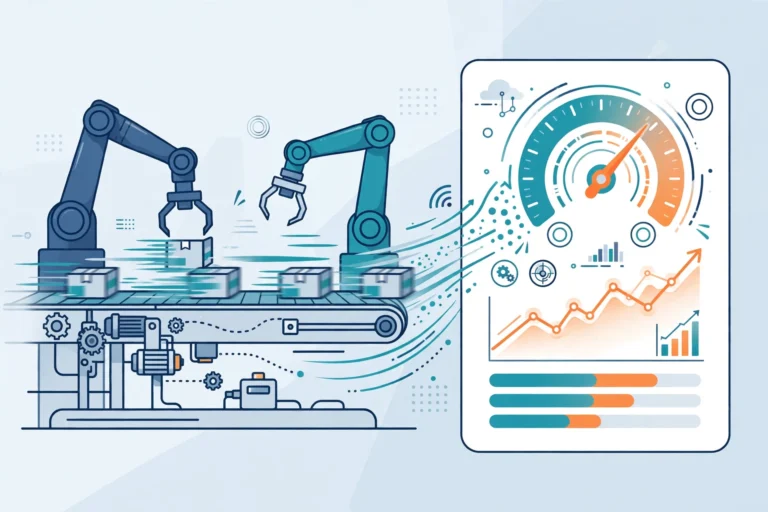
A factory sensor that reports vibration is IoT. The same sensor feeding a model that predicts a bearing will fail in three days, and automatically schedules maintenance, is AIoT. The same pattern shows up in smart buildings, hospitals, and farms, where connected devices adjust heating, flag patient deterioration, or decide when to irrigate.
Most AI IoT companies fall into one of three groups. Cloud platforms — Microsoft Azure, Amazon Web Services, Google Cloud — provide the plumbing: device connectivity, data storage, and AI services. Industrial vendors — Siemens, PTC, GE, Hitachi — build AIoT into machines and factory systems. Chip and edge companies — NVIDIA, Intel, Qualcomm — supply the hardware that runs AI models on the device itself, so decisions happen in milliseconds without a round trip to the cloud.
The Leading AI IoT Companies
No single ranking is authoritative, but the same names appear across every major market report. Here is what each one actually offers:
| Company | What it offers in AIoT | Best for | Watch out for |
|---|---|---|---|
| Microsoft | Azure IoT Hub plus Azure AI services for analytics and prediction | Businesses already on Microsoft 365 or Azure | Usage-based pricing can be hard to forecast |
| Amazon Web Services (AWS) | AWS IoT Core plus SageMaker and Bedrock for machine learning | Large device fleets at global scale | The service catalogue is huge; small teams can get lost in it |
| Vertex AI and analytics on Google Cloud, delivered with IoT partners | Teams that want Google’s AI models on device data | Google retired its Cloud IoT Core service in August 2023; device management now comes from partners | |
| IBM | Maximo Application Suite: AI for asset monitoring and predictive maintenance | Asset-heavy industries such as energy and transport | Strongest in asset management, narrower elsewhere |
| Siemens | Insights Hub (formerly MindSphere) and Industrial Edge for factory data and on-site AI | Manufacturing and industrial automation | Industrial focus means less for consumer or office use |
| NVIDIA | Jetson edge-AI modules and the Metropolis platform for video and sensor analytics | Computer vision on cameras, robots, and edge devices | Hardware-led: you still need software and cloud around it |
Smaller specialists also matter. Intel and Cisco play large supporting roles — Intel in edge AI processors, Cisco in IoT networking and industrial security — while PTC’s ThingWorx is widely used in manufacturing, and firms such as Uptake and C3 AI focus on predictive maintenance for specific industries. For a broader view of how AI products are chosen, see our explainer on AI business solutions, and for the factory end of the market, our guide to custom manufacturing automation.
AI IoT Companies vs Plain IoT Providers
An AI IoT company is not the same as a company that sells connected devices. A plain IoT provider answers the question “what is happening?” — a sensor reading, a location, a status light. An AI IoT company answers “what will happen, and what should we do about it?” — a failure forecast, a quality warning, an automatic adjustment.
Market research firm Straits Research puts the AI in IoT market at $74.32 billion in 2026, growing to $360.47 billion by 2034, while Market Research Future estimates $120.3 billion in 2026 and $833.9 billion by 2035. The Business Research Company is far more conservative, at $24.56 billion in 2026. All three agree on fast growth but disagree by a factor of five on size, because they draw the boundary of “AI in IoT” differently — so treat any single market figure with caution and compare vendors on features, not hype.
What Does Working With an AI IoT Company Cost?
There is no standard price, and vendors rarely publish rates. Most charge in some combination of three ways: a per-device monthly fee for connectivity and management, usage-based charges for data processed and AI predictions made, and professional services for setup and custom models. Cloud platforms are usually cheapest to start — a pilot with a few dozen devices can cost a few hundred dollars a month — but costs scale with data volume, and the bill for a large fleet can surprise buyers who did not model it.
The line item buyers most often forget is the edge hardware. If AI must run on the device — a camera that counts defects, a sensor that must respond in milliseconds — each device needs a capable chip, such as NVIDIA’s Jetson or Intel’s edge processors, plus installation and maintenance. A small paid pilot with a defined success metric, such as “cut unplanned downtime by 20% in 90 days,” is the cheapest way to learn the real cost before committing.
What a Business Needs Before Choosing One
AI IoT projects fail most often on unprepared ground, not on bad technology. Before choosing a vendor, a business needs a clear use case with a measurable outcome — “reduce energy use” is not a use case; “cut HVAC energy by 15% in one building within six months” is. It needs to know its devices: how many, what protocols they speak, and whether they can run AI on-device or must send data to the cloud. It needs someone who owns the data — who checks that sensors stay calibrated and models stay accurate. And it needs to check security and the exit: how devices are authenticated and updated, and whether data and models can be exported if you switch vendors. For the automation side of this decision, see our guide to the two types of industrial automation and our explainer on AI agents for business automation.
The Risks and Limits
The biggest risk is a pilot that never reaches production. A demonstration with ten sensors in a lab is easy; rolling out to thousands of devices across sites, with patchy connectivity and legacy equipment, is not. Projects also stall when a model works in testing but drifts in the real world — a vibration model trained on one machine type can misread another, and nobody notices until a failure it should have caught. Connectivity matters more than vendors admit: a cloud-dependent system is useless where networks drop, which is why edge AI is the fastest-growing part of the market, with Market Research Future projecting a 27.5% annual growth rate for intelligent edge computing through 2035. And a model is only as good as its training data — if sensors are miscalibrated, AI copies the error at machine speed.
Analysis: Buy the Use Case, Not the Leaderboard
Analysis: The most useful fact in this market is not who leads it — it is how wildly the market-size estimates disagree. Straits Research, Market Research Future, and The Business Research Company all project rapid growth, yet their 2026 figures span $17 billion to $120 billion. That gap means “AI IoT” has no settled definition, and any vendor claiming leadership is really claiming leadership in its own slice of the market. The right choice is therefore practical: name one measurable outcome, count your devices, check whether the AI must run on-device or in the cloud, and pick the vendor whose strength matches that job. A manufacturer should start with Siemens or PTC, a cloud-native team with Microsoft or AWS, and a computer-vision project with NVIDIA — each with a small paid pilot before signing anything bigger.
Frequently Asked Questions
What is an AI IoT company?
It is a company that combines artificial intelligence with Internet of Things devices. Its products connect sensors and machines to the internet, then use AI to analyse the data they produce — spotting patterns, predicting failures, and triggering actions automatically, instead of just displaying readings on a dashboard.
Which companies lead in AI IoT?
The names that appear across every major market report are Microsoft, Amazon Web Services, Google, IBM, Intel, Siemens, Cisco, and NVIDIA, with specialists such as PTC, Oracle, and SAP also prominent. The best choice depends on the use case: Siemens and PTC suit factories, Microsoft and AWS suit cloud-native teams, and NVIDIA suits computer vision at the edge.
How big is the AI IoT market?
It depends on who is counting. Straits Research estimates $74.32 billion in 2026, Market Research Future estimates $120.3 billion, and The Business Research Company estimates $24.56 billion. All three project fast growth of roughly 22% to 27% a year, but the five-fold gap in size shows that analysts define the market differently, so treat any single figure with caution.
What is the difference between IoT and AIoT?
IoT connects devices and collects their data, answering “what is happening?” AIoT adds artificial intelligence, answering “what will happen, and what should we do?” A temperature sensor reporting a reading is IoT; the same sensor feeding a model that predicts equipment failure and schedules maintenance is AIoT.
How do I choose an AI IoT company?
Start with one measurable outcome, such as cutting unplanned downtime by 20% in 90 days. Then check whether the AI must run on the device or in the cloud, count your devices and their protocols, and shortlist vendors whose strength matches that job. Run a small paid pilot against the agreed metric before committing, and check data export and exit terms to avoid lock-in.
Sources
- Straits Research — AI in IoT Market Size, Share & Trends, 2026–2034 ($61.01B in 2025; $74.32B in 2026; $360.47B by 2034; 21.82% CAGR; North America 38.5% share)
- Market Research Future — AI in IoT Market Forecast, 2026–2035 ($97.0B in 2025; $120.3B in 2026; $833.9B by 2035; 24.0% CAGR; edge computing 27.5% CAGR)
- The Business Research Company via GII Research — Artificial Intelligence (AI) in IoT Global Market Report 2026 ($19.38B in 2025; $24.56B in 2026; $63.64B by 2030; 26.7% CAGR)
- ET BrandEquity — Google Cloud to disband IoT Core Service from Aug 2023 (service discontinued August 16, 2023)




One Comment
Comments are closed.