Emerging Technologies in Engineering Explained: AI, Digital Twins, and What’s Next in 2026
Key takeaway: Emerging technologies in engineering — AI-assisted design, digital twins, additive manufacturing, collaborative robots, and advanced simulation — are moving from pilots to everyday engineering work in 2026. The winners are the tools with a proven return: a 3D-printed jet engine part that replaced 20 pieces with one, or a digital twin that lifted factory throughput by 20%.
These technologies reinforce each other. AI designs the part, a digital twin tests it before it exists, additive manufacturing prints it, and a collaborative robot assembles it. Here is what each one does, what it costs, and where it falls short.
What are emerging technologies in engineering?
Emerging technologies in engineering are the tools changing how engineers design, test, and build things — right now, not in some distant future. The five that matter most in 2026 are AI-assisted design, digital twins, additive manufacturing (industrial 3D printing), collaborative robots (cobots), and simulation-driven engineering. They share one trait: they close the gap between a digital idea and a physical product, so design flaws are found when fixes are still cheap.
The five technologies reshaping engineering in 2026
| Technology | What it does | Best-known example |
|---|---|---|
| AI-assisted design | Generates and optimises designs from constraints you set | Autodesk generative design |
| Digital twins | A live virtual copy of a product or factory, updated with real data | Siemens Digital Twin Composer with NVIDIA Omniverse |
| Additive manufacturing | Prints functional parts layer by layer, including metal | GE Aviation LEAP fuel nozzle |
| Collaborative robots | Robots that safely share a workspace with people | Assembly and machine-tending cobots |
| Simulation-driven engineering | Tests designs virtually across their whole lifecycle | Siemens Xcelerator, NVIDIA Omniverse |
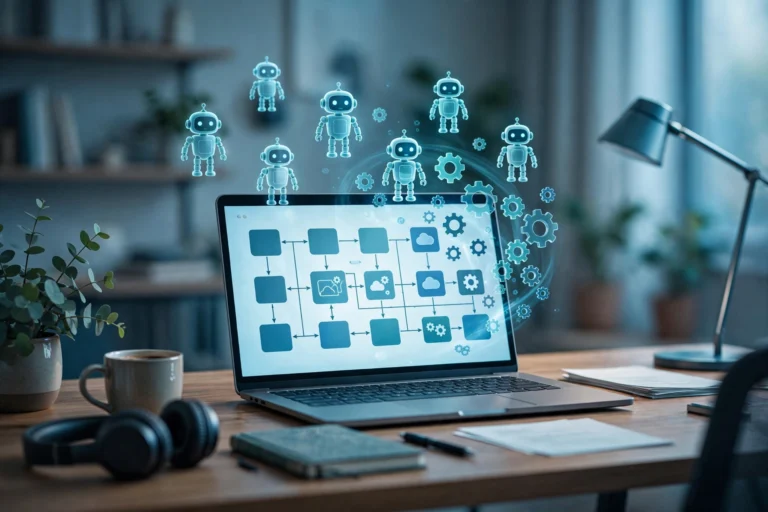
AI-assisted design. AI-powered CAD tools such as Autodesk generative design let engineers enter constraints — load, material, manufacturing method — and generate multiple optimised design options automatically. The engineer still decides; the AI explores far more options than a human could sketch. Machine design trends for 2026 rank AI-assisted design first among the forces reshaping the field.
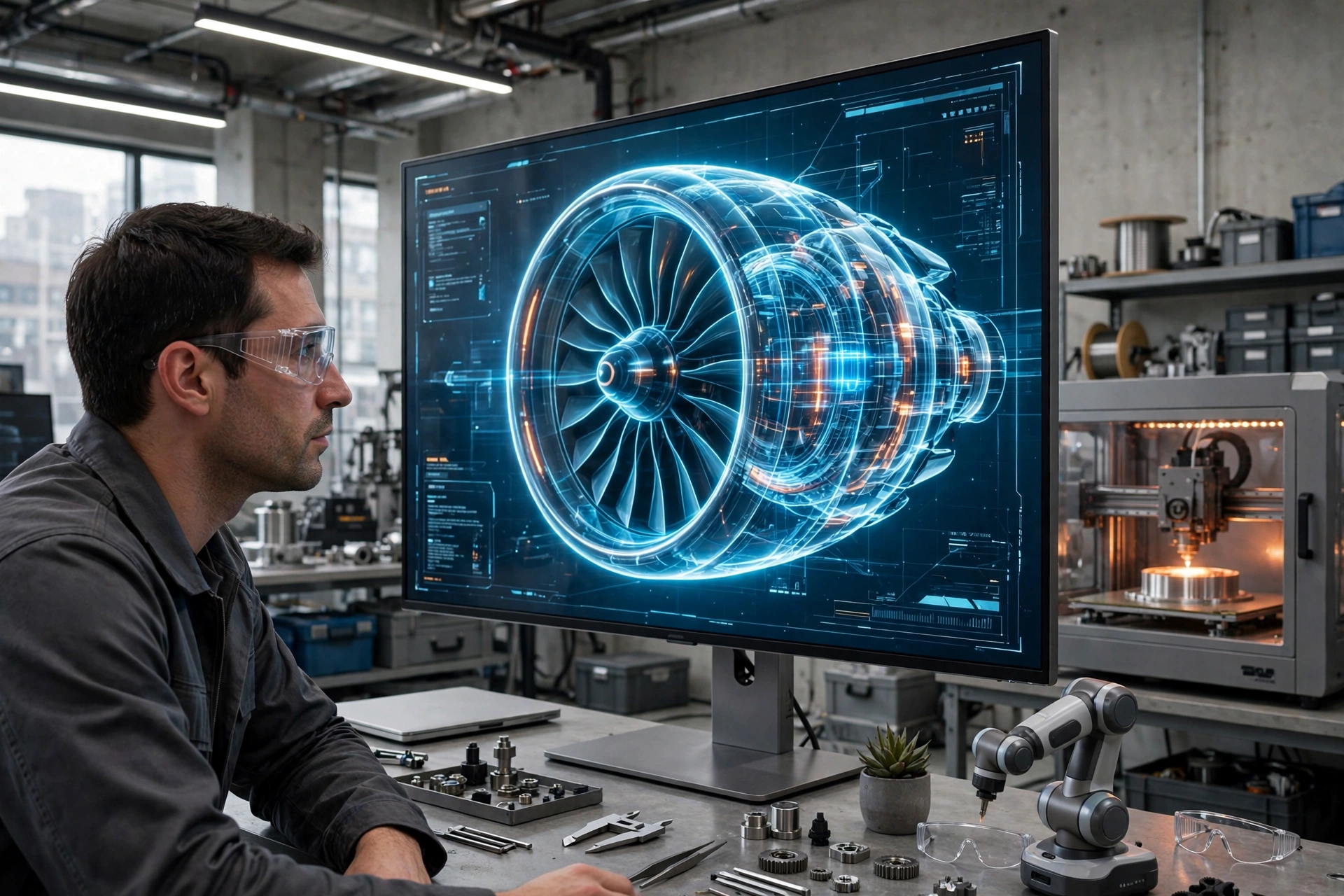
Digital twins. A digital twin is a real-time virtual replica of a physical system, continuously updated with operational data. Siemens launched its Digital Twin Composer in January 2026, integrated with NVIDIA Omniverse. PepsiCo used it and reported a 20% increase in throughput and nearly 100% design validation before building. Forecasts vary — IMARC Group puts the market at about $37 billion in 2026, growing past $220 billion by 2034 — but all agree the direction is steep.
Additive manufacturing. 3D printing has moved past prototypes into functional production parts. The classic proof is GE Aviation’s fuel nozzle for the CFM LEAP jet engine: the 3D-printed version combined 20 welded parts into a single piece that weighs 25% less, is five times more durable, and is 30% more cost-efficient. GE’s Auburn plant has shipped more than 100,000 of them, and the LEAP engine burns about 15% less fuel than the engine it replaced, according to GE. It is also embedded in the other breakthrough industries of 2026 — AI hardware, data centres, automation — because it lets engineers iterate physical hardware almost as fast as software, as Fabbaloo reports.
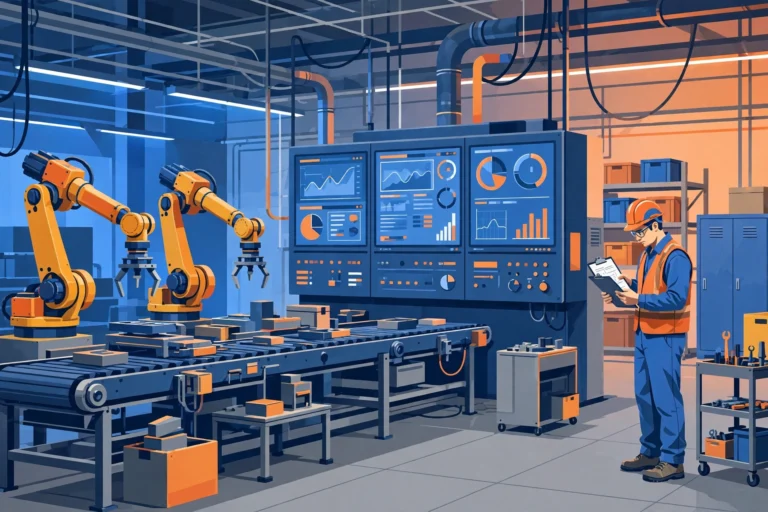
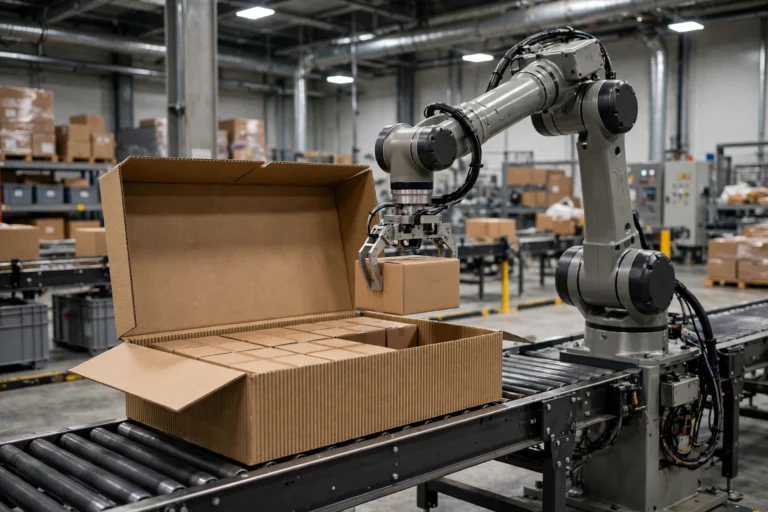
Collaborative robots and Industry 5.0. Cobots share a workbench with technicians instead of working behind safety cages, as factories shift from Industry 4.0’s connectivity-first model toward Industry 5.0, where automation works alongside people. The global cobot market is estimated at roughly $2.8 billion in 2026 and is expected to pass $10 billion in the early 2030s, according to The Industry Outlook. See also our guides to AI for manufacturing changeovers and engineering process automation.
What do these technologies cost?
A desktop metal 3D printer can cost less than a mid-range car; an industrial system for flight-certified parts runs into seven figures, plus certification. Digital twin platforms are usually licensed per site or per asset, and the real expense is often the sensors and integration work — not the software licence. Cobots are the cheapest entry point: a single cobot cell can pay for itself in under two years on a repetitive task. Budget as much for integration, training, and data quality as for the technology itself.
What do you need before adopting them?
Three prerequisites decide whether these tools pay off. First, clean data: a digital twin fed by unreliable sensors is an expensive screensaver. Second, a specific problem: the best deployments start with one bottleneck — a changeover that takes too long, a part that fails too often — not with a technology looking for a use. Third, trained people. Companies that skip these steps are part of why only about 5% of organisations say their AI and digital twin investments have delivered real value, according to BCG data cited in a 2026 industry review.
What are the risks and limits?
AI-generated designs can be unmanufacturable if the constraints are wrong, and they need an engineer to check them. Digital twins are only as good as their data — stale sensor feeds produce confident wrong answers. Additive manufacturing is still slower and pricier per part than casting or machining at high volumes, and material choice is narrower. Cobots are slower than industrial robots and need careful safety assessment. Teams that adopt the tools without training end up with expensive equipment and the same old workflow.
Analysis: what actually matters in 2026
Our take: the technology that wins in 2026 is not the most advanced — it is the most proven. The GE nozzle and the PepsiCo twin share a pattern: a specific, expensive problem, a measurable result, and a team that owned the integration. The losers share a pattern too: buying a platform first and hunting for a problem afterwards. Pick the bottleneck that costs you the most today, pilot one technology against it, and measure the result before scaling. That is also the advice in our explainer on AI-first engineering.
Frequently asked questions
What is the most important emerging technology in engineering?
There is no single winner — the technologies work together. AI-assisted design creates better parts, digital twins test them before they exist, and additive manufacturing builds them. If forced to pick one starting point, digital twins deliver the broadest payoff because they improve decisions across design, production, and maintenance.
Are digital twins worth the investment?
They can be, when aimed at a specific expensive problem. PepsiCo reported a 20% throughput increase from a digital twin deployment. But only about 5% of organisations say their AI and digital twin investments have delivered real value so far, so the deciding factor is execution — clean data, a clear problem, and trained staff — not the software itself.
Is 3D printing used for real production parts?
Yes. GE Aviation has mass-produced more than 100,000 3D-printed fuel nozzle tips for the CFM LEAP jet engine since 2015. Each nozzle replaced 20 welded parts with a single piece that is 25% lighter and five times more durable. It is still slower and costlier per part than traditional methods at very high volumes, so it fits complex, low-volume, high-value parts best.
What is Industry 5.0?
Industry 5.0 is the shift from Industry 4.0’s connectivity-first automation toward systems where automation works alongside people. Collaborative robots are the clearest example: they share a workspace with human technicians instead of operating behind safety cages, combining robot precision with human judgement.
Do engineers need to learn AI to stay relevant?
Engineers do not need to become AI researchers, but they do need to work with AI-assisted tools. Knowing how to set constraints for generative design, interpret simulation results, and judge when an AI suggestion is wrong is becoming a core engineering skill, much like CAD was a generation ago.
Sources
- GE — How a walnut-sized part changed the way GE Aviation builds jet engines
- Global Market Insights — Digital Twin Market Size, Forecasts Report 2026–2035
- IMARC Group — Digital Twin Market Size, Share, Trends & Forecast 2034
- MarketsandMarkets — Digital Twin in Manufacturing Market Report 2025–2032
- EdgeX — Digital Twins Move From Concept to Production in 2026
- Idea Group — Top 10 Machine Design Trends for 2026
- The Industry Outlook — 8 Emerging Technologies Reshaping Electronic Component Manufacturing
- Fabbaloo — Five Breakthrough Industries Shaping 2026