How to Play Piano for Beginners: Step-by-Step Guide (2026)
Key takeaway: To play piano, start with a 61-key keyboard, sit with elbows level with the keys, and learn middle C and the groups of two and three black keys. Practice one hand at a time, then add four chords — C, G, Am and F. With 15–20 minutes of daily practice, beginners play songs within two to four weeks.
Learning how to play piano is one of the most rewarding skills you can pick up at any age. Unlike instruments that require months of physical conditioning just to produce a clean tone, a piano produces a clear note the moment you press a key. That instant feedback makes it easier to hear melodies, understand rhythm, and build confidence from your very first session.
Still, many beginners stall out because they jump straight into complex songs without learning the basics of posture, keyboard layout, and hand coordination. Whether you are practicing on a full acoustic upright or a compact digital keyboard, following a structured path will help you progress faster and avoid frustrating habits.
1. Choose the Right Instrument for Starting Out
You do not need an acoustic grand piano to learn piano for beginners. A 61-key or 88-key digital keyboard works well at home, saves space, and supports headphone practice. Look for touch-sensitive, weighted keys so pressing harder creates a louder sound and builds real finger control.
Pair your keyboard with a sturdy stand and an adjustable bench rather than a soft couch, keeping your wrists and shoulders comfortable during practice.
2. Master Proper Piano Posture and Hand Position
Before playing your first melody, take a minute to set up your body. Good technique prevents tension and lets your fingers move freely across the keys, as highlighted in Kawai’s beginner piano posture tips.
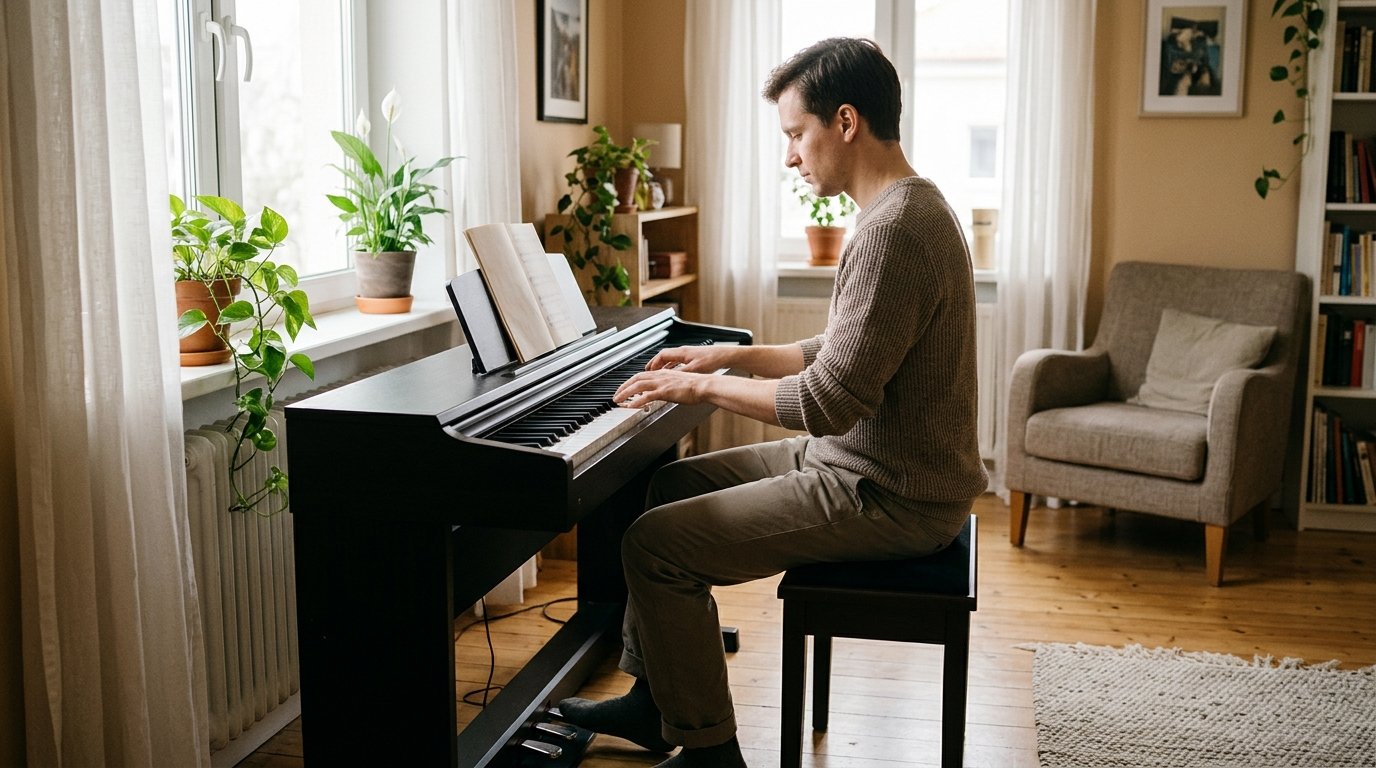
- Sit on the front half of the bench: Keep your back straight, shoulders relaxed, and feet flat on the floor.
- Align your elbows: Your forearms should sit roughly parallel to the floor, level with the white keys.
- Curve your fingers gently: Imagine holding a small ball or bubble in each palm. Strike the keys with the pads of your fingertips rather than flat fingers.
- Learn piano finger numbers: In piano music, both hands number fingers from 1 (thumb) to 5 (pinky). Keeping these numbers in mind makes sheet music and chord shapes much easier to follow.
3. Understand the Piano Keyboard Layout and Find Middle C
At first glance, 88 keys can look intimidating, but the piano keyboard layout is actually a simple 12-note pattern that repeats over and over. Look closely at the black keys: they are arranged in alternating groups of two and three.

Use those black-key groups as landmarks to name the white keys using the first seven letters of the alphabet (A, B, C, D, E, F, G):
- Locate any group of two black keys.
- The white key immediately to the left of that two-black-key group is always C.
- Move upward to the right across the white keys: C, D, E, F, G, A, B, and then you arrive at the next C.
- Find the C closest to the center of your keyboard (usually near the brand logo)—that is Middle C, your primary home base.
4. Play with One Hand First, Then Both Hands Together
A common mistake when learning how to start playing piano is rushing both hands together too early. Start by placing your right-hand thumb (1) on Middle C, with fingers 2 through 5 on D, E, F, and G, and play up and down slowly.
Next, practice the same five-note pattern with your left hand one octave lower (pinky on C, thumb on G). Once each hand feels steady, play them together slowly. As music2me’s step-by-step guide notes, repeating short bars three times without mistakes builds muscle memory.
5. Learn Four Easy Piano Chords to Play Real Songs
You do not need years of theory to play recognizable music. A chord is simply three or more notes played at the same time. Four basic chords—C Major, G Major, A Minor, and F Major—appear in hundreds of popular pop, rock, and folk songs.
| Chord Name | Notes to Press Together | Suggested Right-Hand Fingers | Sound Character |
|---|---|---|---|
| C Major | C – E – G | 1 – 3 – 5 (Thumb, Middle, Pinky) | Bright and resolved |
| G Major | G – B – D | 1 – 3 – 5 | Open and uplifting |
| A Minor | A – C – E | 1 – 3 – 5 | Warm and reflective |
| F Major | F – A – C | 1 – 3 – 5 | Full and steady |
Hold each chord for four slow counts, then practice switching cleanly between C Major and G Major before adding A Minor and F Major.
6. Build Rhythm and Basic Sheet Music Reading
Rhythm brings notes to life. Use a metronome app set to 60–70 BPM and count aloud: “1, 2, 3, 4.” Clapping a rhythm before playing locks the timing in.
Alongside chords, spend a few minutes each week learning how to read piano sheet music. Piano music uses two staffs stacked together: the treble clef (usually played by your right hand for higher notes) and the bass clef (usually played by your left hand for lower notes). Knowing basic note values—whole notes (4 beats), half notes (2 beats), and quarter notes (1 beat)—opens up thousands of beginner songbooks.
7. Create a Realistic Daily Piano Practice Routine
Consistent short sessions beat marathon weekend cramming. Aim for 15 to 20 minutes a day, five days a week:
- Minutes 1–5 (Warm-up): Play a five-finger scale or gentle finger exercises slowly to loosen your hands.
- Minutes 6–12 (Skill Focus): Work on a specific chord transition, short song section, or hand-independence drill.
- Minutes 13–20 (Fun Play): Practice a song you genuinely enjoy so every session ends on a motivating note.
Frequently Asked Questions About Learning Piano
Can you teach yourself how to play piano?
Yes. Many beginners teach themselves with structured video lessons, apps, and method books. Check your posture in a mirror occasionally to avoid stiff wrists or flat fingers.
How long does it take to learn piano?
With 15–20 minutes of daily practice, most beginners can play simple melodies and four-chord songs within 2 to 4 weeks. Playing comfortably with both hands and reading basic sheet music typically takes 3 to 6 months of steady practice.
What are the most common beginner piano mistakes to avoid?
The most common pitfalls are playing too fast, staring constantly at your hands, and tensing your shoulders. Slow down, keep your wrists loose, and master small sections first.