Business Process Automation Experts Explained: What They Do, When to Hire One, and What It Costs
Key takeaway: Business process automation experts find the repetitive work eating your team’s week, redesign it, and build software that does it for you — around the tools you already use. Independent consultants typically charge $100–$300 an hour in 2026, with a workflow costing $1,500–$7,000, and the right time to hire one is when a manual process is high-volume, error-prone, and defined.
If your team still copies data between systems by hand or rebuilds the same report every Friday, a business process automation expert is the person you call. They map how work moves through a business, remove the manual steps, and build the software that takes over.
What business process automation experts actually do
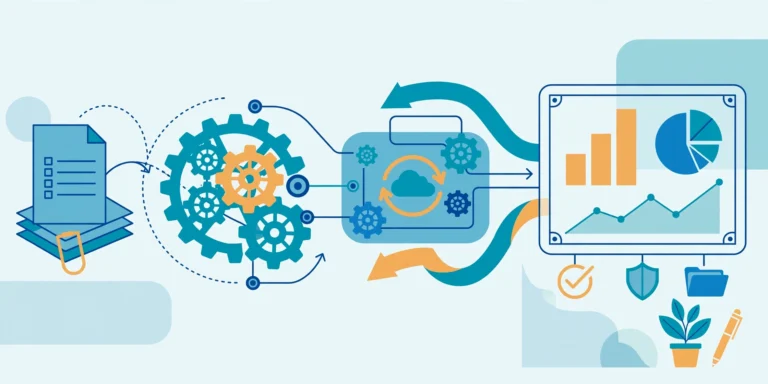
The work usually follows five stages: audit, prioritise, build, hand over, and keep it running. First, the expert watches how a task happens today, step by step, including the exceptions nobody documented. Then they redesign the process before building anything — workflow tools, software robots (RPA), API integrations, document automation, or scheduled reports.
Three kinds of firm sell under the same label, and the contract tells you which one you are talking to. A strategy firm runs an assessment, delivers a roadmap, and leaves. A systems integrator or RPA shop builds bots, bills by the hour, and hands over a configuration your IT team now owns. A newer third type builds the automation, runs it in production, and is paid on the savings it produces. FlowScope’s guide to BPA consulting argues the real value sits in the discovery and the redesign — the steps that decide what the tool should do.
The scope is narrower than the name suggests. The McKinsey Global Institute found that fewer than 5 percent of occupations could be automated entirely with demonstrated technology, while about half of all the activities people are paid to do could be — which is why experts automate tasks, not whole jobs. Good candidates are high-volume, manual, and rule-based, with a known exception path: invoice matching, customer onboarding, and report building. Our guide to the problems BPA can solve covers the most common starting points.
Business process automation experts vs agencies vs in-house hires
| Option | Typical cost in 2026 | Best for | Speed to start |
|---|---|---|---|
| Independent consultant | $100–$300 per hour; $1,500–$7,000 per workflow | One to three scoped workflows | Days to weeks |
| Automation agency | $3,000–$25,000 fixed project, or $2,000–$10,000 a month retainer | Several connected workflows that just need building | One to two weeks |
| In-house hire | $70,000–$140,000 a year in base salary, plus benefits and recruiting | Continuous, proprietary automation work | Two to four months to recruit |
These bands come from 2026 pricing guides by CloudMotiv and dipoleDIAMOND. For scale, the US Bureau of Labor Statistics puts median pay for management analysts at $101,860 a year as of May 2025.
What business process automation experts cost in 2026
Pricing splits into three models. Hourly billing runs about $100–$300 an hour for independent or boutique consultants, and $300–$600 an hour at large firms. Project-based pricing runs $1,500–$7,000 for a single workflow, $8,000–$25,000 for a proof of concept, and $50,000–$250,000 for a production system with multiple integrations and enterprise security.
Most engagements start with a paid discovery audit — typically $1,000–$3,000 — that maps the process and produces a roadmap before any building starts. A typical implementation runs about four weeks for simple task automation and up to six months for complex, multi-system work, according to Ultimate Info Services’ hiring guide. Small-business specialists quote lower: KeyProcess lists one automated process from $1,000 and three to five connected automations from $3,000.
When to hire one — and when not to
Hire one when the process is high-volume, manual, rule-based, and painful enough that the hours are measurable — invoice processing, order entry, onboarding paperwork, and weekly reporting are the classic cases. A scoped engagement of one to three workflows typically runs $5,000–$25,000 and can be live in weeks, versus a $190,000–$260,000 first-year cost for one technical hire once salary, benefits, recruiting, and ramp time are counted, according to CloudMotiv.
Do not hire one when the budget is under roughly $2,000 a year — no-code tools used directly will deliver more value than any engagement at that size. And do not hire an outside expert for work that is continuous and proprietary across the business; once the workload is proven, bringing the talent in-house makes more sense. Related reading: unattended automation explains how bots run on their own once built, and our sales automation experts guide covers the same hiring questions for sales teams.
Risks and red flags to watch for
The biggest risk in 2026 is paying for a strategy deck instead of working automation. Gartner warned in June 2025 of “agent-washing” — relabelling existing automation software as agentic AI — and predicted that more than 40 percent of agentic AI projects will be cancelled by the end of 2027. A consultant who promises an AI agent for every problem, without naming the workflow it replaces, is selling the label.
Other red flags: no written plan or fixed quote before work starts, no handover, and no one responsible when something breaks after launch.
Our analysis: the verdict on hiring business process automation experts
Analysis: For most small and mid-size businesses, the right move is a small scoped engagement — one to three workflows, fixed price, built in your own systems, with a handover. The expert’s value is the discovery and redesign that decide what the tool should do, so pay for outcomes — hours back, fewer errors — not for licences or a roadmap.
What does a business process automation expert do?
A business process automation expert maps how a process runs today, redesigns it to remove steps that only move data between people and systems, builds the automation — workflow tools, RPA bots, or API integrations — and runs it in production until the savings show up. Most engagements follow five stages: audit, prioritise, build, hand over, and ongoing support.
How much does it cost to hire a business process automation expert in 2026?
Independent consultants typically charge $100–$300 an hour, and large firms $300–$600 an hour. A single workflow usually costs $1,500–$7,000 as a fixed project, a proof of concept $8,000–$25,000, and an ongoing retainer $2,000–$10,000 a month. A paid discovery audit of $1,000–$3,000 usually comes first.
Should I hire a consultant or bring automation in-house?
Hire a consultant for one to three scoped workflows with no clear long-term need — a scoped engagement runs $5,000–$25,000 and can be live in weeks. Bring the work in-house once automation is continuous and proprietary across the business, since a single technical hire costs $190,000–$260,000 in the first year including salary, benefits, recruiting, and ramp time.
How long does a business process automation project take?
A typical project runs about four weeks for simple task automation and up to six months for complex, multi-system work. Discovery and audit usually take one to two weeks, and a first working pilot can be live within one to two weeks of the build starting.
Sources
- FlowScope — Business process automation consulting: what to expect, and what to demand
- CloudMotiv — AI Process Automation Consultant: Costs, ROI & Hiring (2026)
- dipoleDIAMOND — In-House Automation Developer vs Outsourced Business Automation Consultant
- KeyProcess Automation — What Does an Automation Consultant Do? (October 2026)
- NetSudo — How Much Does Workflow Automation Actually Cost for a Growing Business?
- Ultimate Info Services — How to Hire a Business Process Automation Consultant