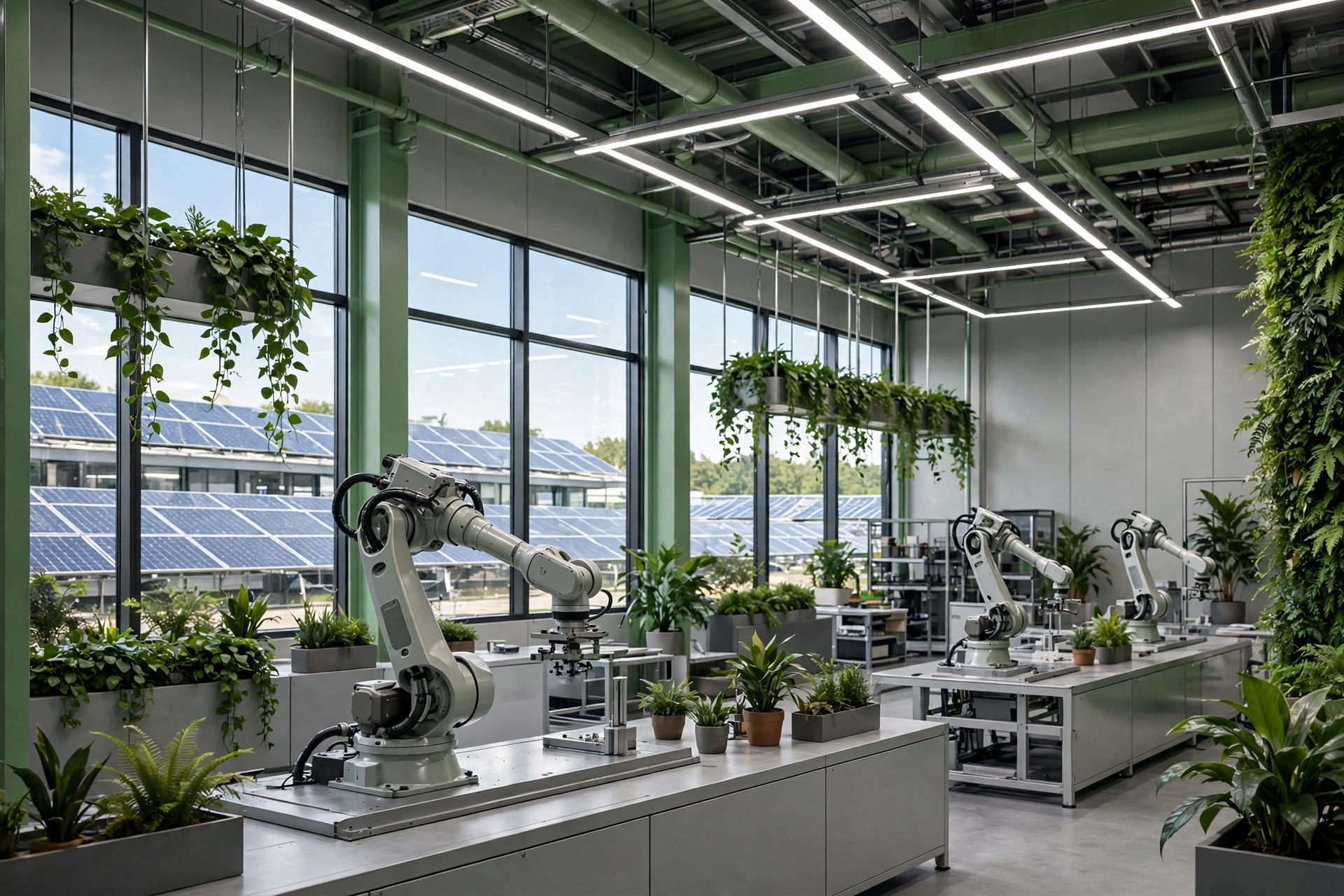
Sustainable Automation Solutions Explained: How Automation Cuts Energy, Waste, and Emissions
Key takeaway: Sustainable automation solutions use sensors, software, and robotics to cut the energy, materials, and emissions a factory or building uses to make each unit. They work by matching power to real demand, spotting waste early, and keeping equipment running at its best — so sustainability gains come from better control, not just newer machines.
Sustainable automation solutions are automation systems designed with an environmental goal in mind, not only a productivity goal. Instead of asking only “how fast can we produce this?”, they also ask “how much energy, water, and material does each unit cost, and where is that cost wasted?” The answer comes from connected equipment: sensors measure what is happening, software decides what should change, and automated controls act on that decision in real time.
This matters because industry is a large energy user. The International Energy Agency (IEA) reports that industry accounts for roughly 39% of total final energy use, and its Energy and AI analysis finds that widespread use of existing AI applications to optimise industrial processes could save energy equivalent to more than Mexico’s total energy consumption today. Automation is the layer that turns that analysis into action on the factory floor.
What sustainable automation solutions include
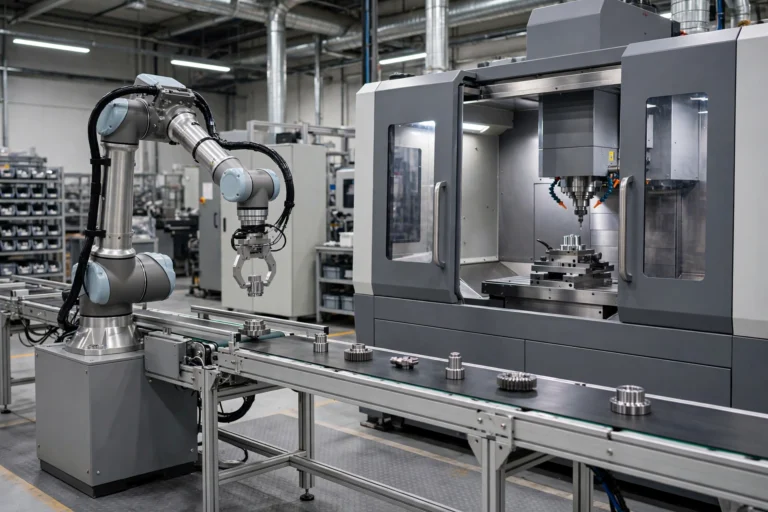
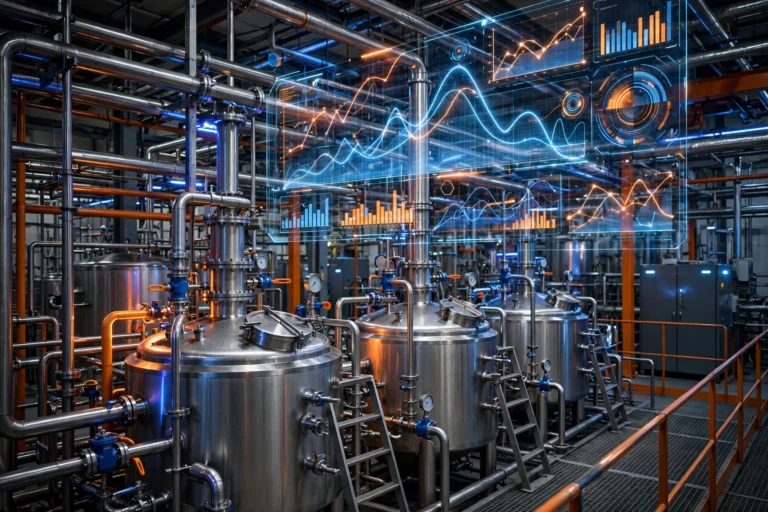
A sustainable automation solution is rarely one product. It is usually a combination of four layers working together. First, sensors and meters collect data on energy, temperature, vibration, and output. Second, control systems — such as programmable logic controllers (PLCs) and variable-speed drives — adjust motors, fans, and pumps to match actual demand instead of running at full power all the time. Third, software such as energy management systems and digital twins models the process and flags waste. Fourth, robotics and automated handling reduce defects and rework, which saves the materials and energy that faulty units would otherwise consume.
For example, a motor driving a fan or pump rarely needs full speed all day. A variable-speed drive slows it when demand falls, and smart sensors switch idle machines off. inFlow’s guide to green manufacturing notes that sensors connected to a network can power down unused machines and give operators the data to tune settings and limit energy use. Small adjustments, repeated thousands of times a day, add up to large savings.
How sustainable automation cuts energy and emissions
The most direct saving is energy. The IEA, as reported by Power Technology, found in studies of more than 300 energy-management cases across 40 countries an average energy saving of about 11% in the early years of a programme. Separately, the IEA’s World Energy Outlook 2025, summarised by ABB, estimates that AI and digital optimisation could further boost efficiency by 3% to 10% across transport and industry.
Waste falls for a similar reason: precision. Automation.com’s sustainable manufacturing guide describes how Balpack, a packaging-machinery maker, used precise torque control — adjustable to one-tenth of a percent — to cut capping failures and material waste. The same guide reports that right-sized Hunter industrial fans installed at an airport delivered nearly 30% energy savings compared with oversized equipment. And when Yupo, a synthetic paper maker, upgraded its PLCs, it reused existing input/output modules, delaying their disposal as electronic waste.
Compressed air is a useful cautionary example. Camozzi Automation reports that up to 35% of compressed air can be wasted through leaks — a vendor figure, but a reminder that automation only saves energy if leaks, idle running, and oversized equipment are actually measured and fixed.
Sustainable automation vs conventional automation
| Feature | Conventional automation | Sustainable automation |
|---|---|---|
| Main goal | Speed, output, and labour cost | Output per unit of energy and material |
| Energy control | Machines often run at fixed speed | Speed and power matched to real demand |
| Measurement | Production counts mainly | Energy per unit, scrap rate, and emissions tracked alongside output |
| Maintenance | Fixed schedules or breakdown repair | Predictive maintenance based on vibration, heat, and power draw |
| End of life | Equipment replaced wholesale | Upgrades reuse compatible parts where possible |
The distinction matters for buyers: a system can be highly automated and still wasteful if it runs flat-out, makes defective units, or hides its energy use. Sustainable automation solutions make energy and waste visible first, then automate the fix.
What sustainable automation costs, and what it saves
Costs vary widely, from a few sensors and a drive retrofit on one line to a plant-wide energy management system. Retrofits are usually cheaper than full replacement: reusing compatible controllers, drives, and wiring — as in the Yupo PLC upgrade — keeps capital cost down. Newer, high-efficiency motors paired with variable-speed drives can also pay back quickly; ABB cites a US customer case where such an upgrade was projected to save $1.3 million in electricity costs over 25 years, with a payback period of nine months, though payback depends heavily on local energy prices and running hours.
On the savings side, expect a range, not a guarantee. The IEA-linked case studies above averaged about 11% early energy savings from energy management, while individual projects report much larger figures where the baseline was poor — the airport fan example reached nearly 30%. Treat any vendor claim of 30% or more as a project-specific result to verify against your own baseline, not a promise.
What you need before you start
Three prerequisites decide whether a project works. First, a baseline: meter energy use per unit of output for at least a few weeks before changing anything, or savings cannot be proved. Second, connectivity: sensors, drives, and software must share data, which may mean standard protocols such as OPC-UA or Modbus rather than a patchwork of closed systems. Third, someone who owns the numbers — an energy or operations manager who reviews the data weekly and acts on it. Automation without ownership tends to drift back to old settings.
Smaller firms can start narrow: meter the single biggest energy user, fix its leaks and idle running, then expand. Larger plants usually start with an energy management system covering the whole site, because the biggest savings often sit in the interaction between lines, not in one machine.
Risks and limits to watch
Analysis: sustainable automation is not automatically green. New sensors, servers, and robots carry their own manufacturing and electricity footprint, and a more efficient line can tempt a firm to simply produce more — a rebound effect that cancels part of the saving. Automation also creates electronic waste when upgrades are handled badly, and it can displace workers whose roles change, which needs planning, not just technology. The honest test is energy and material use per unit of useful output, measured over a full year, not a single good week.
Other limits are practical: legacy equipment may not support modern sensors, data quality may be poor, and savings claimed in a pilot may not survive scaling to a full plant. Pilot on one line, measure against the baseline, and only then roll out.
How this affects you
If you run a factory, warehouse, or large building, start with measurement, not purchase. Find your biggest energy cost, meter it, and ask vendors to guarantee savings against that baseline in writing. If you buy products rather than make them, the same logic applies: suppliers that report energy per unit and scrap rates are easier to compare than suppliers that only advertise “green automation.” For background on related automation approaches, see USABite’s explainers on types of process automation, business automation workflows, and infrastructure automation services.
Frequently asked questions
What are sustainable automation solutions?
Sustainable automation solutions are connected systems — sensors, controls, software, and robotics — designed to reduce the energy, materials, and emissions needed to produce each unit. They match power to real demand, cut defects and rework, and track energy per unit so waste becomes visible and fixable.
How much energy can sustainable automation save?
Results vary by baseline. IEA-linked energy-management case studies averaged about 11% energy savings in their early years, while individual retrofit projects have reported up to nearly 30% where equipment was oversized or poorly controlled. Measure your own baseline first, and treat large vendor claims as project-specific results.
Is sustainable automation only for large factories?
No. Large plants gain the most in absolute terms, but the same tools scale down: a small workshop can meter its biggest motor, add a variable-speed drive, fix compressed-air leaks, and schedule idle machines off. Starting with the single biggest energy user keeps costs low and savings measurable.
What is the difference between green automation and sustainable automation?
The terms overlap, but “green” is often used loosely for any eco-friendly claim, while sustainable automation implies measured results: lower energy and material use per unit, tracked over time. When comparing vendors, ask for energy-per-unit data rather than accepting a green label at face value.
Does automation itself use extra energy?
Yes — sensors, servers, and robots consume power and materials to make. A credible project shows that its net effect is positive: the energy saved by better control must clearly exceed the energy used by the new equipment, measured over a full year of operation.
Sources
- IEA — Energy and AI, executive summary
- Power Technology — IEA energy management findings
- ABB — Industrial energy efficiency, summarising IEA World Energy Outlook 2025
- Automation.com — Sustainable manufacturing: a practical approach
- inFlow — Green manufacturing: how automation drives sustainability
- Camozzi Automation / PECM — Sustainable innovation in pneumatics