Why Did NASA Stop Exploring the Ocean? Debunking the Myths and Analyzing the 2026 Scientific Shift
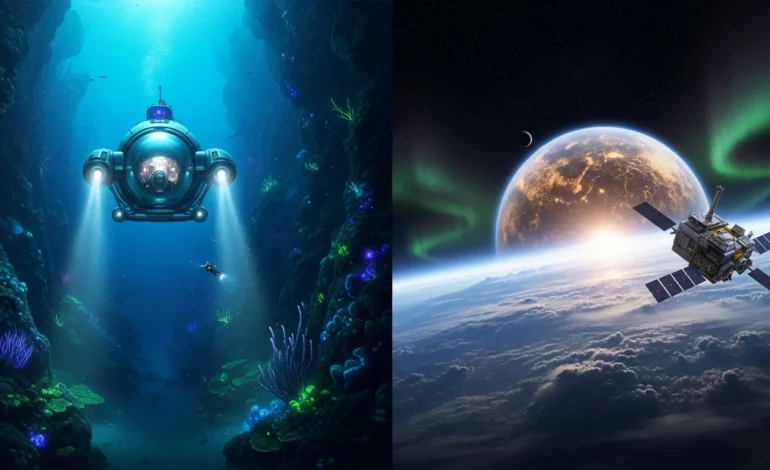
The Jurisdictional Divide: NASA vs. NOAA in 2026
In the early summer of 2026, social media remains flooded with viral theories suggesting NASA abandoned ocean exploration because they discovered something terrifying in the depths. However, the reality is far more grounded in federal policy and specialized engineering. NASA never actually “stopped” exploring the ocean because, by legislative design, it was never their primary mission. The National Aeronautics and Space Act of 1958 specifically tasked NASA with exploring the atmosphere and space, while the National Oceanic and Atmospheric Administration (NOAA) was later established in 1970 to lead the charge in marine and atmospheric research.
Today, as Nvidia Market Dominance fuels a new era of AI-driven data processing, the division between these two agencies has become even more distinct. NASA focuses on the “macro” view of our planet from above, while NOAA handles the “micro” exploration of the seabed. This separation of powers ensures that federal funding is not duplicated across agencies, allowing each to specialize in the extreme environments they were built to conquer.
Engineering for the Abyss vs. the Vacuum
One of the most significant reasons NASA does not build deep-sea submersibles is the fundamental difference in physics between space and the deep ocean. In space, the primary challenge is the vacuum, which creates an internal pressure of 14.7 psi that the spacecraft must contain. Conversely, the deep ocean presents a crushing external pressure. At the bottom of the Mariana Trench, the pressure is over 15,000 psi—the equivalent of having an elephant stand on your thumb. This requires entirely different materials, seals, and structural philosophies than those used for the Artemis moon missions or Mars rovers.
- Material Science: Spacecraft prioritize lightweight composites to escape Earth’s gravity, whereas submersibles require thick titanium or specialized glass to resist compression.
- Communication: Radio waves travel easily through the vacuum of space, allowing NASA to communicate with probes billions of miles away. In the ocean, water blocks most radio frequencies, requiring acoustic signals or physical tethers.
- Energy Management: Solar power is a staple for NASA satellites, but it is useless below the ocean’s photic zone (about 200 meters), necessitating high-capacity batteries or nuclear power sources.
NASA’s “Eyes in the Sky” Approach to Oceanography
While NASA may not be sending manned submarines to the ocean floor, they are arguably the most important contributor to modern oceanography. Through the Earth Science Division, NASA operates a fleet of satellites that monitor sea-level rise, ocean temperature, and chlorophyll concentrations. Just as the scientific community had to redefine its parameters when discussing why is Pluto not a planet, the public must redefine what “ocean exploration” looks like in the 21st century. It is no longer just about physical presence; it is about global data sets.
In 2026, the Surface Water and Ocean Topography (SWOT) mission continues to provide the first-ever global survey of Earth’s surface water. By measuring the height of the ocean with unprecedented precision, NASA helps scientists understand how the ocean absorbs heat and carbon dioxide. This data is critical for American coastal cities facing rising tides and more frequent storm surges. NASA hasn’t left the ocean; they have simply moved to a vantage point where they can see the entire system at once.
The Strategic Importance of Marine Exploration in 2026
The misconception that NASA “fled” the ocean often ignores the strategic and economic reasons why the U.S. government prioritizes different frontiers. Much like the historical motivations explored in the analysis of why the Great Wall of China was built, modern exploration is driven by resource security and territorial sovereignty. While NASA looks toward lunar mining and Martian colonies, NOAA and the U.S. Navy focus on the “Blue Economy,” which includes undersea cables, deep-sea minerals, and sustainable fisheries.
The 2026 federal budget reflects this specialized focus. Rather than having NASA build underwater drones, the government has increased grants for private-public partnerships involving NOAA and companies like OceanX. This allows NASA to remain the world leader in aerospace while ensuring that the 80% of the ocean that remains unmapped is addressed by agencies specifically equipped for the task. The “stop” in exploration is a myth; the reality is a sophisticated, multi-agency strategy to master both the heavens and the depths.
Frequently Asked Questions
Did NASA find something scary in the ocean that made them leave?
No. This is a popular internet myth with no basis in fact. NASA’s transition away from deep-sea research was a result of the creation of NOAA in 1970. The federal government decided to separate space and oceanic research into two distinct agencies to maximize efficiency and expertise. There is no evidence of any “discovery” prompting a retreat from the sea.
Does NASA still do any work underwater?
Yes, but primarily for astronaut training. The NEEMO (NASA Extreme Environment Mission Operations) project uses the Aquarius underwater laboratory off the coast of Florida. Astronauts live and work underwater for weeks at a time because the buoyancy and isolation of the ocean provide an excellent analog for the conditions of space and the lunar surface.
Why is it said that we know more about space than the ocean?
This is largely true regarding mapping. We have high-resolution maps of the entire surfaces of the Moon and Mars because satellites can easily photograph them from orbit. In contrast, seawater is opaque to most satellite sensors, meaning we have to map the ocean floor using sonar from ships, a process that is much slower and more expensive.
Is NASA involved in searching for life in alien oceans?
Absolutely. NASA’s expertise in oceanography is being applied to “Ocean Worlds” in our solar system, such as Jupiter’s moon Europa and Saturn’s moon Enceladus. By studying Earth’s extreme ocean environments, like hydrothermal vents, NASA scientists are developing the technology and biological models needed to search for life in the vast, ice-covered oceans of other worlds.
How much of the Earth’s ocean has been explored as of 2026?
As of 2026, approximately 25% of the global seafloor has been mapped to high resolution. While this is a significant increase from previous decades—thanks to international initiatives like Seabed 2030—the vast majority of the deep ocean remains unobserved and unmapped. This work is primarily led by NOAA and international maritime organizations, not NASA.