The Final Reckoning: Legal Teams Face Off for Closing Arguments in Trump’s Historic Criminal Trial
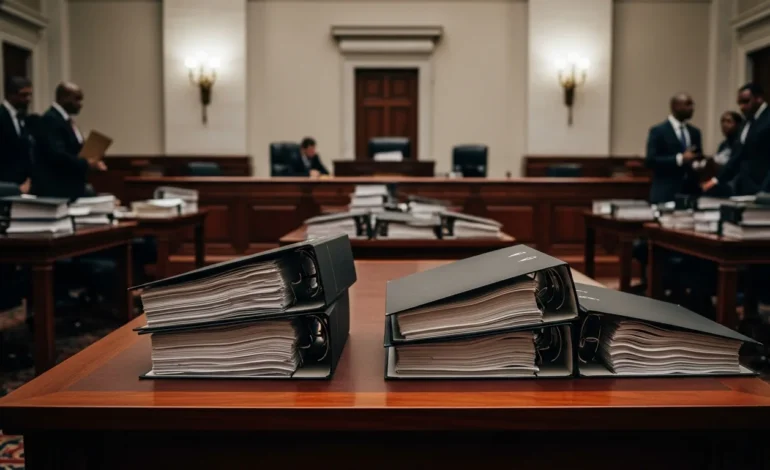
NEW YORK — In a watershed moment for the American judiciary, the Manhattan criminal trial of former President Donald Trump is entering its final, most critical phase as legal teams finalize their closing arguments scheduled for next week.
nn
The proceedings, which have captivated the nation and dominated the political landscape for over a month, represent the first time in United States history that a former commander-in-chief has faced a criminal jury. With 34 felony counts of falsifying business records hanging in the balance, both the defense and the prosecution are meticulously refining the narratives they will present to the 12-member jury before deliberations begin.
nn
The trial centers on allegations that Trump orchestrated a scheme to influence the 2016 presidential election by suppressing damaging information and subsequently falsifying internal business records to conceal those payments. As the evidentiary phase concludes, the closing arguments will serve as the final opportunity for attorneys to synthesize weeks of complex testimony and technical financial documents into a cohesive argument for conviction or acquittal.
nn
The Prosecution’s Final Push: Connecting the Dots
nn
For the Manhattan District Attorney’s office, the closing argument will likely focus on the “intent to defraud” and the underlying motive of election interference. Legal analysts suggest that prosecutors will emphasize the following key pillars of their case:
nn
- n
- The Paper Trail: Highlighting the specific invoices, ledger entries, and checks that the prosecution argues were intentionally mislabeled as legal expenses rather than reimbursements for a “hush money” payment.
- The Conspiracy Narrative: Framing the payments not as an isolated incident, but as part of a broader “catch and kill” scheme designed to deceive the American electorate in the final weeks of the 2016 campaign.
- Corroborating Evidence: While much of the case has relied on high-profile witness testimony, prosecutors are expected to point to handwritten notes and digital communications that they claim validate the testimony of their central witnesses.
n
n
n
nn
Reports suggest the prosecution will aim to convince the jury that the falsification of records was not a mere clerical error, but a calculated criminal act intended to subvert the democratic process. By elevating these records violations to felonies, the state must prove that the intent to defraud included the intent to commit or conceal another crime—in this case, a violation of state election laws.
nn
The Defense’s Counter-Offensive: Attacking the Foundation
nn
Conversely, the defense team for Donald Trump is expected to deliver a closing argument centered on reasonable doubt and the credibility of the state’s witnesses. Throughout the trial, the defense has maintained that Trump had no direct involvement in the specific accounting entries at the heart of the case and that the payments were legitimate legal expenses.
nn
Defense strategies are anticipated to focus on several critical areas:
nn
- n
- Witness Credibility: Aggressively attacking the character and reliability of the prosecution’s star witnesses, characterizing them as individuals with personal vendettas or histories of dishonesty.
- Lack of Direct Knowledge: Emphasizing a lack of “smoking gun” evidence that directly links Trump to the creation of the specific ledger entries in question.
- The “Ordinary Business” Defense: Arguing that the payments were standard legal retainers and that the former president was busy running the country, leaving administrative financial details to his subordinates.
n
n
n
nn
Legal experts note that the defense only needs to convince a single juror that reasonable doubt exists to prevent a conviction. Their narrative will likely portray the entire case as a politically motivated prosecution, often referred to by the defendant as a “witch hunt,” designed to hinder his current political aspirations.
nn
A High-Stakes Deliberation: What Happens Next?
nn
Once closing arguments conclude, the judge will provide the jury with specific legal instructions. These instructions are vital, as they define the legal parameters the jury must use to evaluate the evidence. The 12 jurors must reach a unanimous verdict on each of the 34 counts. If they cannot agree, the judge may declare a mistrial, a result that would likely be seen as a significant victory for the defense.
nn
For typical Americans, this trial is more than just a legal battle; it is a test of the principle that no individual is above the law. The outcome could have profound implications for the 2026 political cycle and the future of the American presidency. Regardless of the verdict, the trial has already set a precedent that will be studied by legal scholars for generations.
nn
The Broader Impact on the American Legal System
nn
The conclusion of this trial marks a historical inflection point. Beyond the immediate political ramifications, the case examines the boundaries of executive privilege, the reach of state prosecutors over federal candidates, and the integrity of financial record-keeping in political campaigns. As the jury prepares to take center stage, the eyes of the world remain fixed on the Manhattan courthouse, awaiting a decision that will echo through history.
nn
Frequently Asked Questions
nn
What exactly are the 34 felony counts?
n
The counts consist of 34 instances of Falsifying Business Records in the First Degree under New York Penal Law. Each count corresponds to a specific document—such as an invoice, a check, or a general ledger entry—that prosecutors allege was falsified to hide payments made to suppress negative information during the 2016 election.
nn
What are the possible outcomes of the jury’s deliberation?
n
The jury can return a verdict of guilty or not guilty on any or all of the 34 counts. If the jury is unable to reach a unanimous decision after extensive deliberation, the judge may declare a hung jury, resulting in a mistrial. In the event of a mistrial, the prosecution would have to decide whether to seek a new trial with a different jury.
nn
What happens if Donald Trump is found guilty?
n
If convicted, the judge will schedule a sentencing hearing. Each count carries a maximum sentence of up to four years in prison, though legal experts suggest that for a first-time offender in a non-violent white-collar case, probation or fines are also possible outcomes. A conviction would almost certainly be followed by a lengthy appeals process.
nn
How long will the jury take to reach a verdict?
n
There is no set timeframe for jury deliberations. It could take a few hours or several weeks. The jury is tasked with reviewing a vast amount of evidence and testimony from the multi-week trial, and they must reach a unanimous decision on each of the 34 individual counts.







2 Comments
[…] shooting occurs as the capital remains on high alert during Trump’s historic criminal trial proceedings in New York, which have dominated the national political […]
[…] ruling comes amid a flurry of historic legal battles currently unfolding in the nation’s capital, highlighting a period of intense judicial scrutiny over executive branch authority and […]