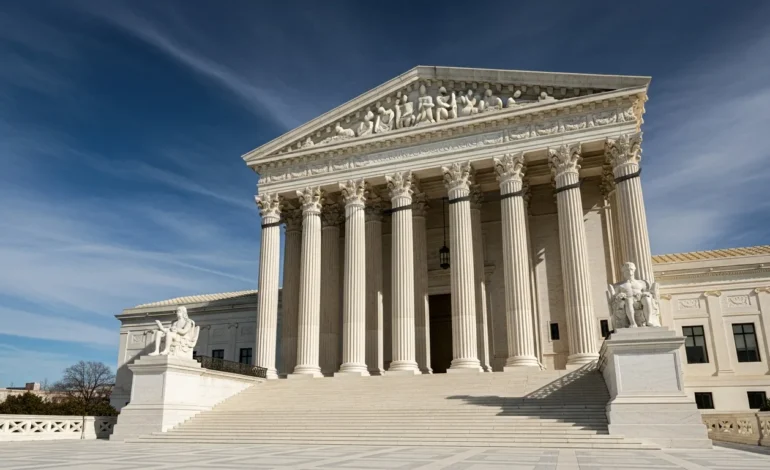
High Stakes for the Postmark: Supreme Court Saves Late-Arriving Ballots in 5-4 Ruling

For a voter in rural Mississippi, the difference between a counted ballot and a discarded envelope often rests on the speed of a local mail truck navigating backroads. On Monday, the Supreme Court ensured those transit delays would not result in disenfranchisement, narrowly upholding state laws that allow ballots to be counted if they arrive after the polls close.
In a 5-4 decision in Watson v. Republican National Committee, the court protected a Mississippi statute permitting ballots postmarked by Election Day to be tallied up to five business days later. Justice Amy Coney Barrett, writing for the majority, was joined by Chief Justice John Roberts and the court’s three liberal justices to cement the ruling.
A Shield for State-Level Election Deadlines
The decision effectively halts a legal challenge led by the Republican National Committee and the Trump administration that sought to invalidate such grace periods. By doing so, the court overturned a lower court ruling that had deemed these extensions inconsistent with federal election statutes.
The ruling carries immediate weight as the country prepares for the 2026 midterm elections this November. Legal experts suggest the decision secures similar ballot-receipt windows in dozens of other states, preventing a massive wave of litigation just months before the first votes are cast.
- The Mississippi law specifically allows a five-business-day window for postmarked ballots.
- Federal law, the court found, does not preempt state-level administrative deadlines for ballot receipt.
- The ruling preserves the status quo for states that rely on mail-in infrastructure to handle high voter volume.
Dissenting Voices and the Constitutional Divide
The court’s conservative wing remained deeply divided, with Justices Samuel Alito, Clarence Thomas, Neil Gorsuch, and Brett Kavanaugh penning a sharp dissent. They argued that federal law establishes a single day for the election, implying that the receipt of ballots after that date undermines the statutory framework.
Justice Barrett’s majority opinion countered that the act of voting occurs when the ballot is cast, not when it is physically processed by a clerk. This distinction marks a significant shift in how the court views the intersection of federal authority and state-led election administration.
The Death of the ‘Election Day’ Traditionalism
This ruling signals a final departure from the concept of a single 24-hour window for national results. By validating the five-day receipt window, the court has acknowledged that the modern American election is a multi-week administrative process rather than a singular event.
For many election officials, the ruling provides a sense of relief after years of uncertainty regarding the legality of their counting procedures. However, the narrow 5-4 margin suggests that the legal battle over the timing of American democracy is far from settled, even as the 2026 cycle enters its most critical phase.
Frequently Asked Questions
Does this ruling allow ballots to be postmarked after Election Day?
No, the ruling only applies to ballots that are postmarked on or before Election Day but arrive at the election office during the state’s designated grace period.
Which states are most affected by this decision?
While the case centered on Mississippi, the ruling impacts approximately 20 states and the District of Columbia that currently have similar laws allowing for post-election ballot receipt.
Will this delay the final results of the 2026 midterms?
In close races, final tabulations may take several days longer in states that utilize these grace periods, as officials must wait for the receipt window to close before certifying totals.
What was the primary argument of the RNC in this case?
The Republican National Committee argued that federal law mandates a uniform national election day, and that counting any ballots received after that date violates federal statute.