Electronics Manufacturing Automation: How Modern Factories Build Your Devices
Key takeaway: Electronics manufacturing automation is the use of automated machines — SMT assembly lines, pick-and-place robots, and AI-powered inspection systems — to build circuit boards and electronic devices with minimal hands-on labor. It is how phones, cars, and medical devices are produced at scale today: faster, more consistent, and far more precise than manual assembly ever could be.
Your phone, your laptop, the sensors in your car — all started life on an automated production line. Electronics manufacturing automation is the system of machines that builds printed circuit boards (PCBs) and assembles devices with very little human touch: conveyors that move bare boards, robots that place components smaller than a grain of sand, and cameras that catch defects the human eye cannot see.
What Electronics Manufacturing Automation Is
It is automated machinery applied to the steps of building electronics: preparing circuit boards, placing components, soldering connections, and inspecting quality. The dominant method is surface-mount technology (SMT), which mounts components directly onto the board’s surface instead of threading leads through drilled holes. SMT was developed in the 1960s and became the industry standard in the 1980s as devices shrank (PCBMay’s SMT line guide).
Through-hole assembly survives mainly for prototyping and parts that must endure harsh physical stress. For volume production, SMT wins on speed, density, and automation.
How an Automated SMT Line Works
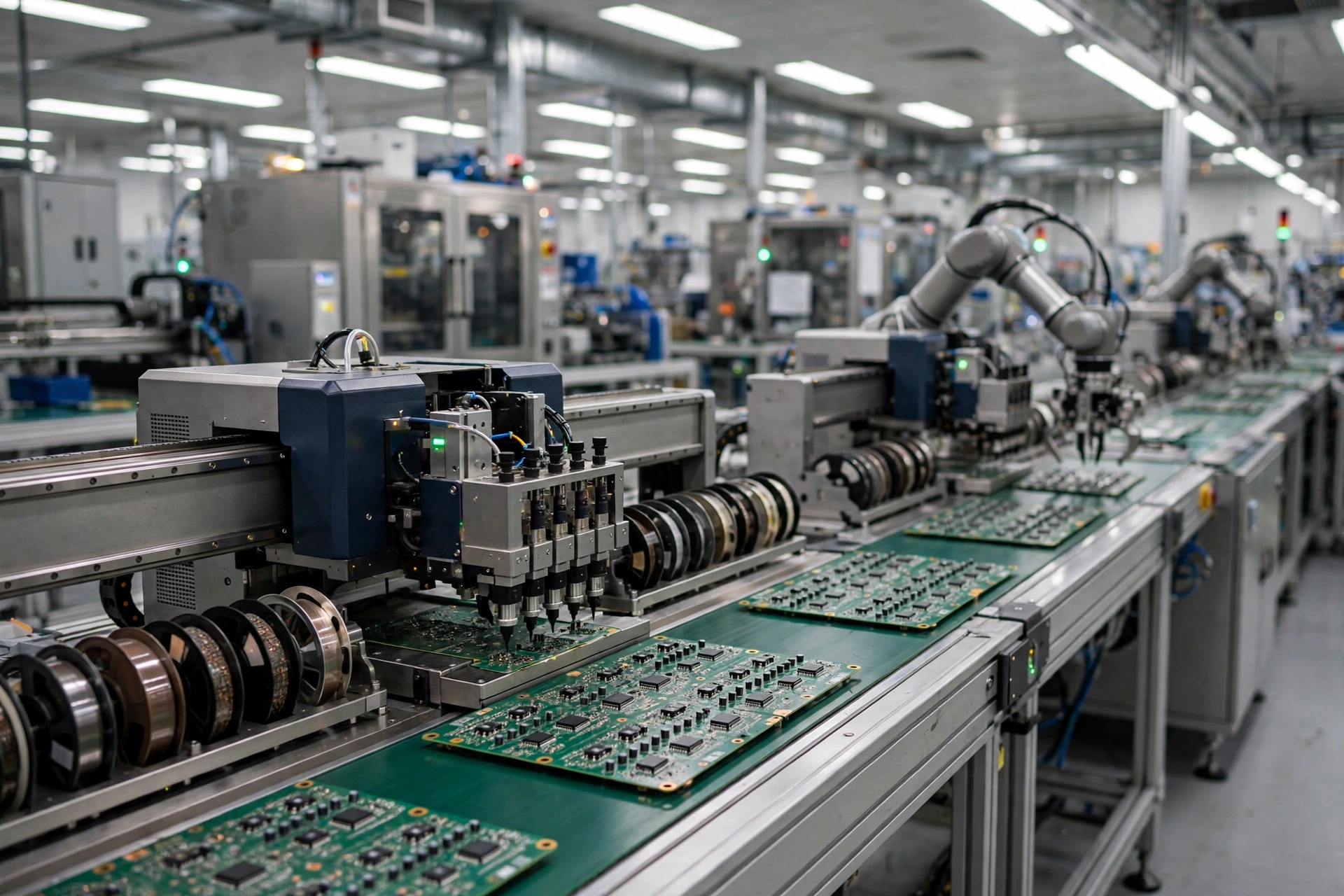
A modern SMT line is a chain of machines in sequence:
- Solder paste printing. A stencil printer deposits paste onto the pads where components will sit — the foundation the whole process depends on.
- Solder paste inspection (SPI). A 3D system measures paste volume, height, and alignment before placement, catching defects at the cheapest point (Wikipedia).
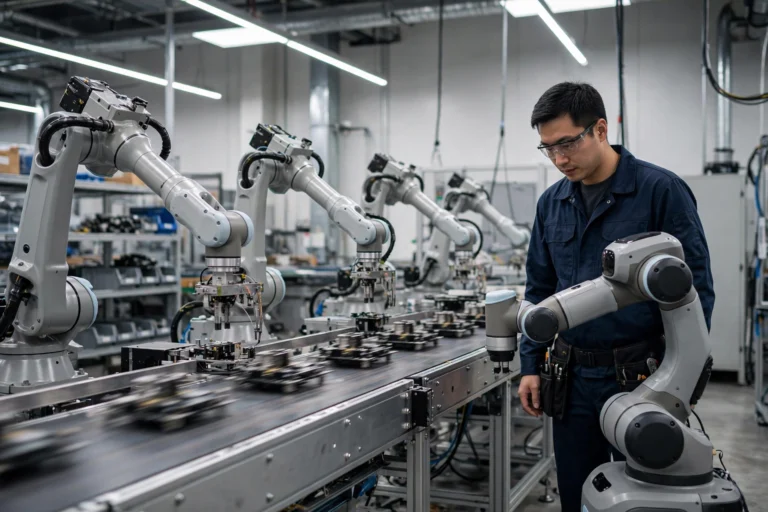
- Pick and place. Robots set components on the board at very high speed — one supplier cites about 100,000 components per hour for a four-machine line (PCBMay) — close cousins of the custom robotics used across factory automation.
- Reflow soldering. The board passes through an oven that melts the paste in a controlled temperature profile, locking components in place.
- Final inspection. Automated optical inspection (AOI) cameras check for missing or misaligned parts and visible solder defects; X-ray (AXI) examines hidden joints under dense chips like BGAs (JLCPCB).
The three layers are complementary: SPI stops bad foundations, AOI verifies the visible result, X-ray covers what is hidden. And they are getting smarter — modern AOI systems increasingly use AI to improve detection and cut false rejects, with data feeding process control so engineers catch drift early (Wikipedia; FS Technology).
Why It Matters Now
Two forces are driving factories to automate. First, miniaturization: the smallest common components measure fractions of a millimeter, and only machines place them reliably at volume. Second, economics: rising labor costs and supply-chain shocks have made automation a resilience strategy, not just a cost play — the same logic behind broader manufacturing productivity investments.
The money follows. One market research estimate values the electronics manufacturing automation market at $68.4 billion in 2025, rising to $148.6 billion by 2034 at about 9% a year, with Asia-Pacific accounting for nearly 44% of spending (Dataintelo). A separate industry outlook puts PCB and SMT assembly equipment alone at $63.7 billion in 2025, with fully automated systems now more than half of equipment spending (GlobeNewswire industry outlook). The headwind: high upfront capital costs slow adoption for smaller manufacturers (PMarketResearch).
What This Means for You
Buying electronics: automation is a big reason devices are affordable and consistent — and why they are hard to repair. Dense, machine-built boards with microscopic components are not designed for hand servicing.
Working in manufacturing: the skill mix is shifting toward machine programming, machine vision, and process control. Hand-soldering roles are giving way to line operation and quality engineering.
Building hardware products: your contract manufacturer’s automation level sets your quality ceiling. Ask about their inspection stack (SPI, AOI, X-ray) before you ask about price.
Analysis: Where It Is Heading
Analysis: The next wave is intelligence, not just motion — AI-powered defect detection and inspection is among the fastest-growing equipment segments as factories chase yields on denser boards (industry forecast summary). Expect more collaborative robots between stations and digital twins simulating lines before they are built. The caveat: automated lines amplify whatever process you feed them — discipline still comes first.
Frequently Asked Questions
What is electronics manufacturing automation?
It is the use of automated equipment — SMT assembly lines, pick-and-place robots, conveyors, and AI-powered inspection — to build electronic circuit boards and devices with minimal manual labor.
What is an SMT line?
An SMT (surface-mount technology) line is an automated assembly line that mounts components directly onto a printed circuit board’s surface. The standard sequence: solder paste printing, paste inspection, pick-and-place placement, reflow soldering, and automated inspection.
What is the difference between SPI, AOI, and X-ray inspection?
SPI checks solder paste deposits before placement, measuring volume, height, and alignment. AOI uses cameras to check finished assemblies for missing or defective parts and visible solder problems. X-ray sees through the board to check hidden solder joints under dense chips.
Does automation make electronics cheaper?
Mostly, yes. It cuts labor cost per unit, reduces defects, and enables the huge volumes that spread fixed costs thin. The trade-off is repairability: machine-built boards are difficult to service by hand.
Sources
- PCBMay — What Is an SMT Production Line
- Wikipedia — Automated Optical Inspection
- JLCPCB — Automated Optical Inspection: Enhancing PCB Quality
- FS Technology — AOI in the SMT Process
- Dataintelo — Electronics Manufacturing Automation Market
- GlobeNewswire — Consumer Electronics Manufacturing Equipment Market Outlook