Automation Short Form: Common Abbreviations You Need to Know
Key takeaway: Automation short forms are the abbreviations professionals use to name different types of automation. The most common are RPA (Robotic Process Automation), BPA (Business Process Automation), DPA (Digital Process Automation), IPA (Intelligent Process Automation), and IA (Intelligent Automation). Learning what each one means helps you read vendor pages, job posts, and research reports without getting lost in the jargon.
What Does “Automation Short Form” Mean?
When people search for an “automation short form,” they usually want to know what abbreviations like RPA or BPA stand for. Unlike most technical fields, automation does not have one single short form. Instead, there is a family of abbreviations, and each one points to a different scope or method of automating work.
Some short forms describe software that automates a single task, while others describe strategies that redesign whole workflows. The distinction matters: if a vendor says a product “does automation,” the abbreviation tells you whether you are getting a desktop bot, a workflow platform, or an AI-assisted system.
Below are the most widely used automation abbreviations, explained in plain English.
The Most Common Automation Short Forms
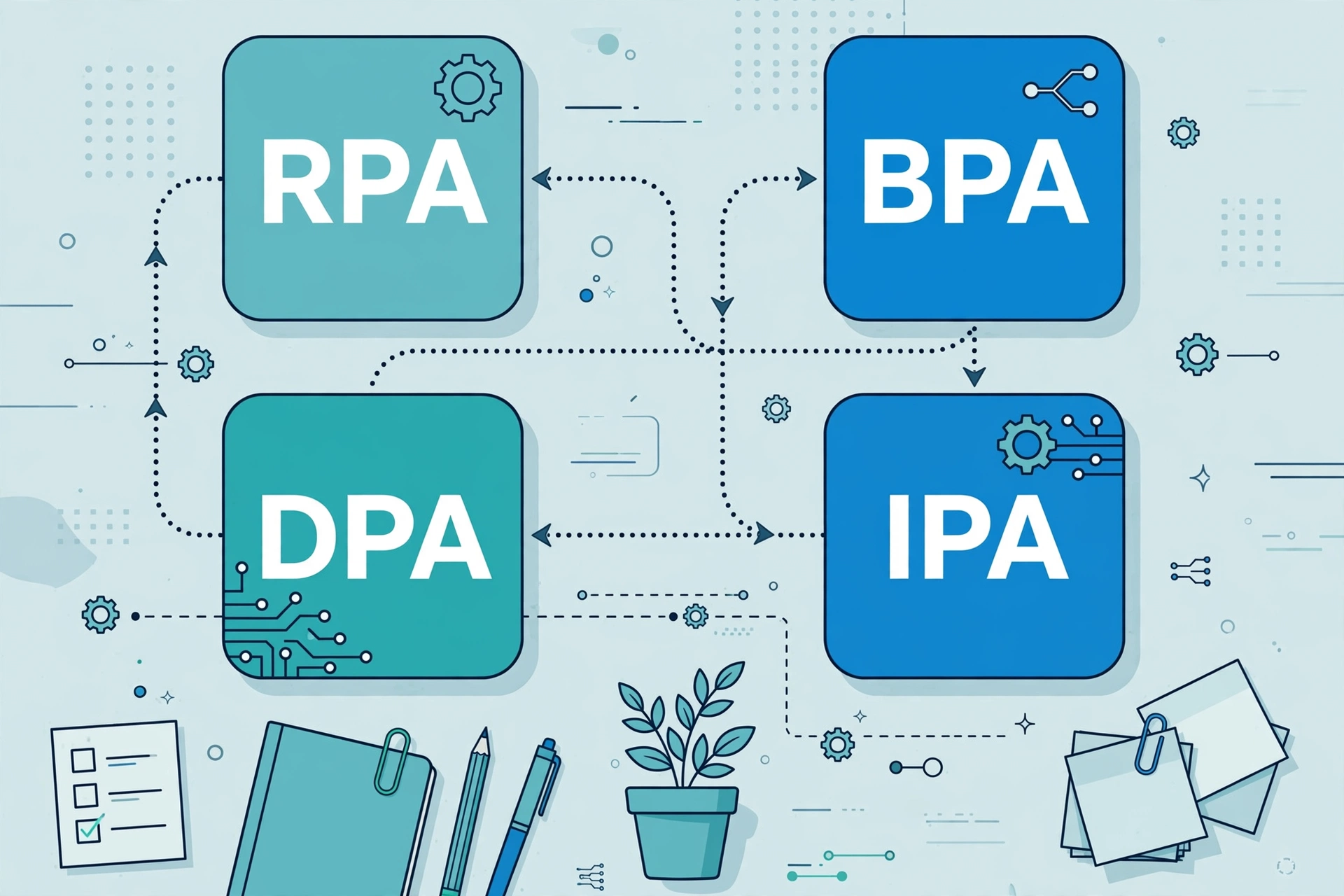
RPA — Robotic Process Automation
The best-known automation short form. RPA uses software “robots” (bots) that mimic how a human clicks through applications to perform repetitive, rule-based tasks such as data entry, report generation, or copying data between systems. The bots follow predefined scripts and work without human intervention once configured (Robotics & Automation News).
BPA — Business Process Automation
BPA takes a broader view than RPA. It means automating entire end-to-end business processes — often across multiple steps and integrated systems — using a mix of technologies that can include RPA, workflow tools, case management, and AI. In fact, RPA is generally considered a subset of BPA, since BPA is the technology-enabled automation of activities that accomplish a full business workflow (TechTarget).
DPA — Digital Process Automation
DPA is the term Forrester Research popularized as an evolution of business process management (BPM). A useful rule of thumb: RPA automates tasks, while DPA works with entire workflows and processes. DPA solutions often assume processes are already digital and focus on optimizing them to improve the experience of the people doing the work, whereas RPA and BPA typically remove work from human hands altogether (TechTarget).
IPA — Intelligent Process Automation
IPA builds on RPA by combining it with artificial intelligence and machine learning, plus tools like natural language processing and computer vision. The result is automation that can handle more sophisticated work — reading documents, understanding language, or adapting to process changes — rather than just repeating fixed steps (TechTarget).
IA — Intelligent Automation
IA is closely related to IPA and is sometimes used interchangeably with it. It refers to the combination of RPA, BPA, and advanced AI and ML that enables the automation of work requiring cognitive capabilities, such as complex decision-making and predictive analysis (Robotics & Automation News).
RDA — Robotic Desktop Automation
RDA describes small-scale RPA that lives on an individual employee’s computer, handling specific desktop tasks. It is sometimes called “attended automation” because it often works alongside the person, unlike traditional RPA bots that run unattended on servers (TechTarget).
Automation Short Forms at a Glance
A quick reference table of the abbreviations above:
| Abbreviation | Full name | Scope |
|---|---|---|
| RPA | Robotic Process Automation | Individual, rule-based tasks |
| BPA | Business Process Automation | End-to-end business processes |
| DPA | Digital Process Automation | Workflows and processes, people-centered |
| IPA | Intelligent Process Automation | RPA combined with AI/ML |
| IA | Intelligent Automation | Cognitive, decision-making automation |
| RDA | Robotic Desktop Automation | Attended desktop tasks |
How to Use Automation Short Forms Correctly
Three practical rules will keep you out of trouble. First, always spell out an abbreviation the first time you use it in a document — for example, “robotic process automation (RPA)” — because readers arrive with different backgrounds. Second, be careful with DPA and IA: some vendors use DPA to mean “desktop process automation,” and some use IA and IPA interchangeably, so check how your source defines its terms (TechTarget).
Third, do not assume one short form is better than another. RPA suits simple repetitive tasks, BPA and DPA suit redesigning processes, and IPA or IA suit work that needs judgment. If you are choosing tools for your team, start with what custom business automation can do, look at how AI agents extend business automation, and review the basics of automating IT operations before buying anything.
Analysis: The alphabet soup of automation exists because vendors needed new labels for overlapping ideas, and analysts coined terms like DPA and “hyperautomation” to describe combinations of those ideas. For readers, the practical move is not to memorize every abbreviation but to ask one question whenever a new one appears: does it describe a task, a process, or an intelligent system?
Frequently Asked Questions
What is the short form of automation?
There is no single short form for automation. The right abbreviation depends on the type of automation: RPA for robotic process automation, BPA for business process automation, DPA for digital process automation, IPA for intelligent process automation, and IA for intelligent automation. Each describes a different scope of automated work.
What does RPA stand for in automation?
RPA stands for Robotic Process Automation. It refers to software bots that mimic human interactions with digital systems to perform repetitive, rule-based tasks like data entry and report generation. It is the most widely recognized automation abbreviation in business and IT.
What is the difference between RPA, BPA, and DPA?
RPA automates individual tasks, such as copying data between apps. BPA automates entire end-to-end business processes and often includes RPA as one of its tools. DPA, a term from Forrester Research, focuses on optimizing digital workflows and improving how people interact with those processes.
What is IPA in automation?
IPA stands for Intelligent Process Automation. It combines RPA with artificial intelligence, machine learning, natural language processing, and computer vision so automation can handle more complex work, such as reading documents or detecting objects on a screen, rather than only repeating fixed steps.
Is hyperautomation an automation abbreviation?
No. Hyperautomation is not an abbreviation; it is a term Gartner popularized to describe the effective combination of many automation tools, including RPA and AI, to automate and augment business processes end to end. It describes scope and strategy rather than a single technology.
Sources
- Robotics & Automation News — An introduction to digital automation: RPA, BPA, and intelligent solutions explained
- TechTarget — What is Intelligent Process Automation (IPA)?
- TechTarget — What is Business Process Automation (BPA)?
- TechTarget — RPA vs. BPA vs. DPA: Compare process automation technologies
- Appian — Types of Process Automation, Explained and Compared