Smart Curriculum Explained: What It Is and How It Works in 2026
Key takeaway: A smart curriculum is a course of study that adapts to each learner, using AI and learning data to personalize pace, content, and feedback. Unlike fixed syllabi, it adjusts as students progress. Researchers describe smart curricula as dynamic, adaptive, and student-centered, with AI acting as the teacher’s ally rather than a replacement — and UNESCO’s 2024 framework adds AI literacy and ethics as core student competencies.
What a smart curriculum actually is
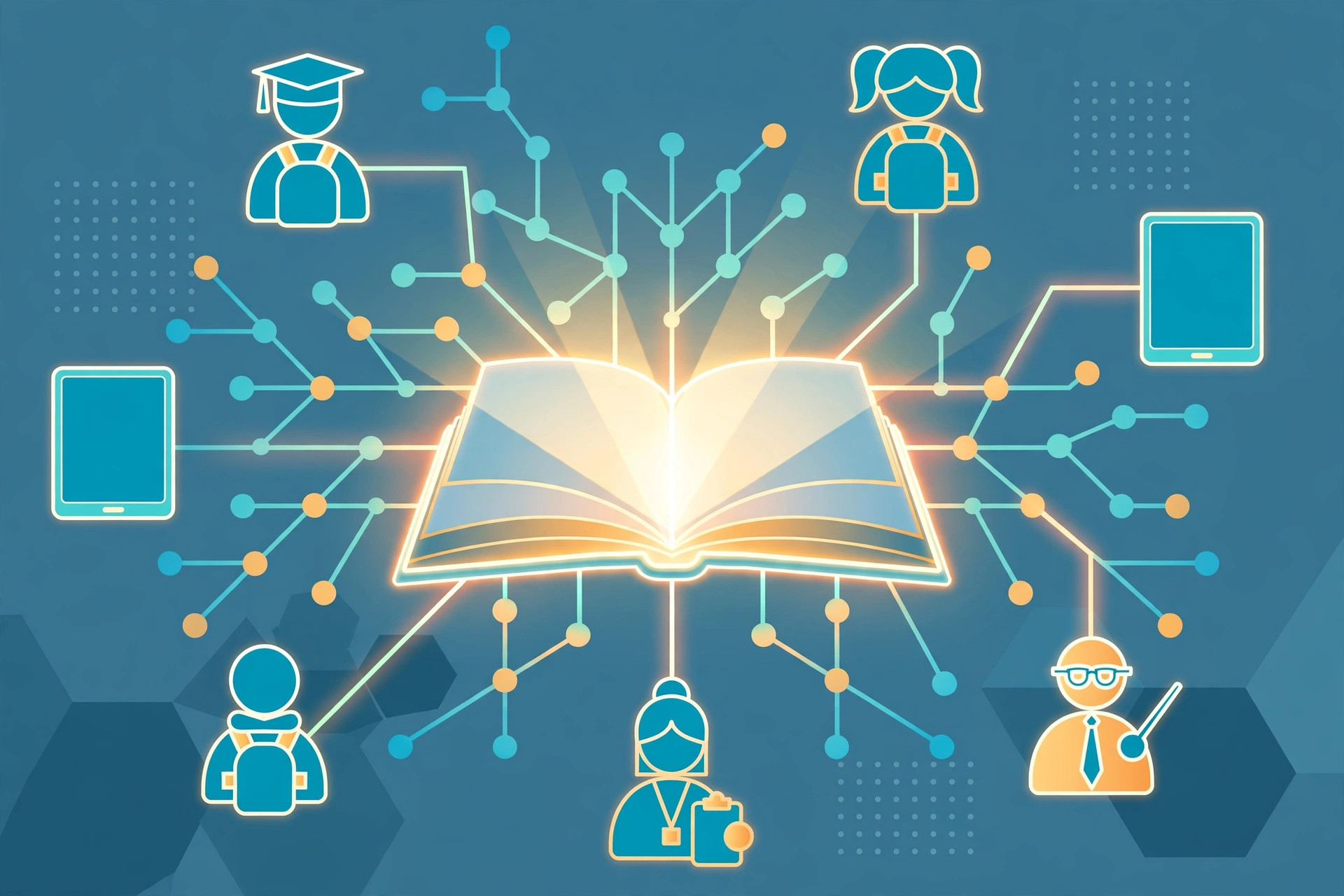
A smart curriculum is a curriculum built to respond to the learner, not a fixed document every student marches through in lockstep. It uses technology — increasingly AI — to adjust what is taught, how fast, and in what form, based on how each student is doing.
There is no single settled definition yet. A recent research chapter on intelligent curricula describes smart curricula as educational structures that incorporate AI technologies in a critical, ethical manner — dynamic, adaptive, and student-centered, promoting personalized learning based on data (ResearchGate; IGI Global).
It helps to separate two ideas people mix up: a curriculum that adapts itself to the student using AI, and a curriculum that teaches students about AI. Both matter in 2026. On the second meaning, UNESCO now offers an international reference: the AI Competency Framework for Students (2024), with 12 competencies across four dimensions — human-centred mindset, ethics of AI, AI techniques and applications, and AI system design — each spanning three levels: Understand, Apply, Create (Oide Technology in Education). The framework is deliberately tool-neutral: values and judgment first, products second.
How a smart curriculum works in practice
The mechanics are simpler than the name suggests. An adaptive system typically runs a loop: a diagnostic assessment, software analysis that finds strengths and gaps, a personalized learning path, customized content with real-time feedback, and continuous refinement as performance changes (The Education Magazine).
Researchers give this behavior formal names: a smart curriculum should adapt, sense what the learner is doing, infer conclusions from the data, learn from new information, anticipate what the learner needs next, self-organize its content, and improve through feedback (Shoikova, Nikolov and Kovatcheva, 2017; Uskov et al., 2019; via Academia.edu). The environment around it must be context-aware and seamlessly connected, adapting the interface, the content, and the learning-status reports to the learner (Zhu, Yu and Riezebosch, 2016; Hwang, 2014).
The building blocks are already in everyday classrooms: Google Classroom’s “Gemini in Classroom” offers Read Along, giving students real-time feedback while reading aloud, and Microsoft’s Copilot in Teams for Education helps teachers generate personalized classwork, rubrics, and quizzes (The Education Magazine). These are narrow features, not full smart curricula — but they show the pieces in place.
Why schools are adopting it in 2026
Three forces are pushing adoption. First, guidance now exists: UNESCO’s frameworks give curriculum designers an approved, ethics-first template for weaving AI objectives into official curricula. Second, the classroom reality is old — thirty students never learn at the same pace, and an adaptive curriculum can quietly give a struggling student extra practice while a faster student moves ahead, without the teacher hand-building two lesson plans every night. Third, generative AI has made content generation cheap: drafting leveled readings, practice questions, and rubrics that used to take hours now takes minutes (for background, see our explainer on the main goal of generative AI).
What it means for students and teachers
For students, the payoff is pace and fit: material that meets them where they are, feedback that arrives while it still matters, and AI literacy built into ordinary subjects. For teachers, the job shifts from content delivery toward mentoring and judgment — which is the intended design. Holmes and Tuomi (2022) emphasize that generative AI should be used as a tool to enhance learning, not to replace the teacher or homogenize instruction (ResearchGate). Teachers also face integrity questions around AI tools in class — grading, feedback, detection — which we covered in our guide on AI detectors in schools.
Our analysis: the honest limits
The following is analysis based on the research above, not new verified fact. Three constraints decide whether a smart curriculum works in a given school: equity (adaptive systems assume devices, connectivity, and clean data — the schools that need help most often have the least), the teacher’s role (researchers insist AI assists rather than replaces, but budget-strapped districts can easily hear “efficiency” and reach the wrong conclusion), and data (personalization runs on student data, so privacy and consent must be designed in from day one). A school should audit all three before buying any software.
Frequently asked questions
What is a smart curriculum in simple terms?
A smart curriculum is a course of study that adjusts itself to each student. Instead of everyone reading the same pages at the same speed, software tracks how a student is doing and changes the pace, difficulty, and content to fit — while the teacher guides and makes the important judgment calls.
How is a smart curriculum different from a normal curriculum?
A normal curriculum is a fixed plan: same topics, same order, same timeline for everyone. A smart curriculum keeps the same learning goals but personalizes the path to them, using AI and learning data to decide what each student needs next, when they need extra practice, and when they are ready to move on.
Do smart curricula replace teachers?
No — that is explicitly not the goal in the research. Education researchers including Holmes and Tuomi describe generative AI as a tool to enhance learning, not replace the teacher or homogenize instruction. In practice, AI handles routine work like drafting practice questions and tracking progress, while teachers handle motivation, fairness calls, and the human side of learning.
What should schools check before adopting a smart curriculum?
Three things: whether every student has the device and connectivity to use it fairly, whether teacher training and staffing plans keep AI in an assisting role rather than a replacing one, and whether student data is collected with clear consent and strong privacy safeguards. UNESCO’s 2024 AI competency frameworks give schools an ethics-first checklist for this.
Sources
- Intelligent Curricula: Personalizing Learning With Artificial Intelligence and Developing Transformative Skills — ResearchGate publication
- Intelligent Curricula — IGI Global chapter preview
- Development of Smart Curriculum in Terms of Operational Research Methods (Duran & Gökalp) — Academia.edu
- The UNESCO Competency Framework for Students — Oide Technology in Education
- UNESCO’s guidance on technology and AI in education — UNESCO
- Personalized Learning: Adaptive & Smart Classrooms — The Education Magazine