Custom Automation for Life Sciences: What It Is and How Labs Use It in 2026
Key takeaway: Custom automation for life sciences means designing robots, liquid handlers, vision systems, and software around one lab or factory’s exact workflow — instead of forcing that workflow onto an off-the-shelf machine. It is used to assemble medical devices, run high-throughput drug screening, fill and package pharmaceuticals, and process diagnostic tests, all under strict quality and traceability rules.
Life sciences work is unusually hard to automate with generic equipment. A diagnostic cartridge, a prefilled syringe, and a cell-culture plate all have different shapes, tolerances, and regulatory requirements. That is why many labs and manufacturers commission systems built for their product — custom automation for life sciences — rather than buying a standard machine and adapting their process to fit it.
What Custom Automation for Life Sciences Actually Means
Custom automation is engineering, not just purchasing. A vendor studies the workflow — say, assembling and testing a point-of-care diagnostic device — then designs a system around it: robotic cells for assembly, feeding systems for tiny parts, conveyors to move product, machine vision to inspect it, and software to log every result. Suppliers such as Eclipse Automation describe these as tailored solutions built for high-precision, high-volume production while maintaining regulatory compliance, safety, and traceability.
The work typically falls into four buckets:
- Factory automation — robotic assembly, coating, inspection, fluid handling, and primary packaging for medical devices and drug-delivery products.
- Laboratory automation — liquid handling, plate handling, and high-throughput screening for drug discovery and diagnostics.
- Pharma fill and finish — syringe, vial, and cartridge filling, inspection, labelling, and cartoning under aseptic conditions.
- Diagnostics manufacturing — assembly and testing of test cartridges, strips, swabs, and point-of-care devices.
Keller Technology, which builds custom factory automation for life sciences, notes that many of its systems are designed to operate in cleanroom and aseptic environments, including machinery suited to isolators and vaporized hydrogen peroxide sterilization cycles.
Where Custom Automation for Life Sciences Is Used
The same building blocks show up across very different products:
| Area | Typical automated tasks | Why custom, not standard |
|---|---|---|
| Medical devices | Assembly of catheters, implants, and surgical tools; vision inspection; traceability marking | Parts are tiny, tolerances are tight, and every unit needs a traceable record |
| Drug delivery | Auto-injector and prefilled-syringe assembly, testing, and packaging | Combination products mix drug, device, and packaging rules in one line |
| Diagnostics | Cartridge assembly, reagent dispensing, functional testing, pouching | Each assay has its own fluidics and read-out, so lines are product-specific |
| Pharma production | Fill and finish, vial handling, labelling, cartoning, and palletizing | Aseptic handling and cold-chain requirements rule out generic lines |
| Research labs | High-throughput screening, sample prep, cell culture, and compound management | Assays change often, so the system must flex with the science |
Lab Automation: The Engine of Drug Discovery
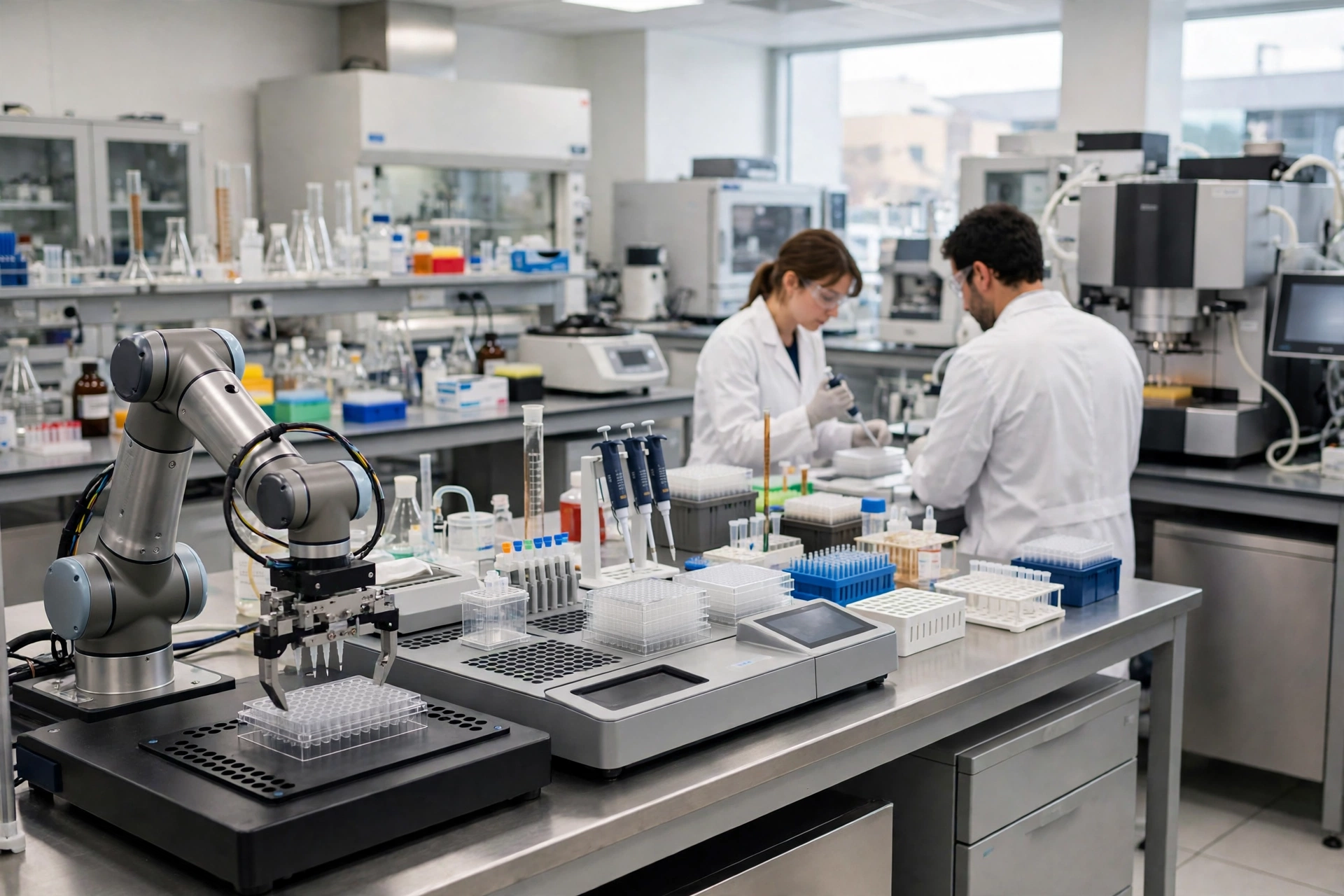
In research labs, custom automation usually starts with liquid handling. Robotic liquid handlers dispense, mix, and transfer liquids far faster and more consistently than manual pipetting — and in high-throughput screening (HTS), that consistency is the whole point. LabManager explains that HTS campaigns in 384- and 1536-well plates test hundreds of thousands of compounds against a biological target, and manual pipetting cannot reach the throughput, reproducibility, or sub-microliter precision those campaigns require.
One advanced technique worth knowing is acoustic droplet ejection (ADE), which moves nanoliter droplets with focused sound waves instead of pipette tips. SelectScience reports that ADE is widely accepted as the state-of-the-art liquid-handling approach in high-throughput screening, with benefits including assay miniaturization and the elimination of tip carryover between compounds.
Beyond liquid handling, lab automation ties instruments together: plate readers, incubators, imaging systems, and software that tracks every sample. Molecular Devices describes this as connecting cell culture, imaging, liquid handling, AI-driven decision-making, and data analysis into one workflow, so labs can standardize processes and scale from a single bench to multi-shift operation.
Custom vs. Off-the-Shelf Automation
Not every lab needs a bespoke system. The choice comes down to fit:
| Factor | Custom automation | Off-the-shelf automation |
|---|---|---|
| Best for | Unique products, unusual formats, regulated processes | Standard assays, common plate formats, routine tasks |
| Upfront cost | Higher — engineering, validation, and integration are included | Lower — you buy a finished product |
| Flexibility | Built around your workflow, and adaptable as it changes | Fixed capabilities; you adapt your workflow to the machine |
| Time to deploy | Longer — design, build, and validation take months | Weeks, once installed and trained |
| Compliance | Designed in from the start (cGMP, traceability, audit trails) | You must verify it meets your regulatory needs |
A useful middle path exists: vendors often start from a proven platform and customize only the parts that differ — a gripper, a fixture, a software module — which keeps most of the cost and risk of a standard product while solving the one problem that made standard equipment unusable.
Compliance Is Part of the Design, Not an Afterthought
Life sciences automation lives under quality rules that other industries rarely face. Systems built for pharmaceutical and medical-device production are commonly designed to be cGMP-compliant, with full traceability of materials, processes, and results. Electronic records and signatures in regulated environments fall under rules such as the FDA’s 21 CFR Part 11, which is why automation software in this sector emphasizes audit trails, user access controls, and validated data handling.
Practically, this means three things for anyone scoping a project: budget time for validation alongside build time, insist on data integrity features (who did what, when, to which sample) from day one, and treat documentation as a deliverable, not paperwork to catch up on later.
How to Scope a Custom Automation Project
If you are considering custom automation for a lab or production line, a sensible sequence is:
- Map the workflow first. Document every step, handoff, and decision point before talking to vendors — automation magnifies a messy process, it does not fix one.
- Automate the bottleneck, not everything. The highest-value target is usually the slowest, most error-prone, or most repetitive step.
- Define the data you need out. Traceability, quality records, and analytics requirements shape the software as much as the hardware.
- Plan for change. Assays, products, and regulations change; build in modularity so a new format does not mean a new line.
- Validate in phases. Prove the system on one product or assay, then expand — rather than betting the whole line on day one.
Analysis: Why Demand Keeps Growing
Analysis — this section is interpretation, not a reported fact. Three forces are pushing life sciences automation forward at once: drug-discovery pipelines are screening larger compound libraries, diagnostics makers are under pressure to scale point-of-care testing, and skilled lab labour is scarce in many regions. Custom automation sits at the intersection because the products in this sector are too varied — and too regulated — for one-size-fits-all machines. Expect the fastest growth in modular, software-driven systems that can be reconfigured for a new assay or product without rebuilding the line.
For readers exploring automation more broadly, our explainers on automation examples in industry, business process automation in healthcare, and end-to-end process automation cover adjacent ground.
Frequently Asked Questions
What is custom automation for life sciences?
It is automation engineered around a specific lab or factory workflow in the life sciences sector — robots, liquid handlers, vision systems, and software designed for one product or process, rather than a standard machine adapted to fit. It covers medical-device assembly, drug-delivery production, diagnostics manufacturing, pharma fill and finish, and laboratory workflows such as high-throughput screening.
How is custom automation different from standard lab automation?
Standard lab automation is a finished product built for common tasks, like pipetting into standard microplates. Custom automation is designed from your workflow outward, so it handles unusual product formats, tight tolerances, aseptic conditions, and regulatory traceability requirements that standard equipment cannot. The trade-off is higher upfront cost and a longer build and validation timeline.
What does custom automation for life sciences cost?
Costs vary widely with scope: a single customized workstation costs far less than a full turnkey production line, and vendors often reduce cost by customizing a proven platform rather than building everything from scratch. Because pricing depends on throughput, complexity, and validation requirements, reputable vendors quote after a workflow assessment rather than from a catalogue price.
Which industries use custom life sciences automation?
Pharmaceutical and biotech companies, medical-device manufacturers, diagnostics makers, contract manufacturers, and research laboratories all use it. Typical applications include assembling auto-injectors and catheters, filling syringes and vials, producing diagnostic test cartridges, and running high-throughput compound screening in drug discovery.
Do small labs need custom automation?
Usually not at first. Small labs generally get more value from standard liquid handlers and modular instruments, and only commission custom work when a unique assay format, throughput target, or regulatory requirement makes standard equipment unusable. A common path is to automate one bottleneck with a standard tool, then customize around it as volume grows.
Sources
- Eclipse Automation — Life Sciences Factory Automation
- Keller Technology — Custom Factory Automation for Life Sciences
- ATS Life Sciences
- LabManager — High-Throughput Screening in Pharma Using Automated Liquid Handling
- SelectScience — Acoustic Liquid Handling Enables Breakthrough Innovations