Emerging Technologies in Media Explained: AI, Immersive Experiences, and the New Rules of Entertainment
Key takeaway: Emerging technologies in media — led by generative AI video, smarter personalization, immersive AR and VR, and short-form creator formats — are changing how stories are made, discovered, and paid for. The winners will be the studios and creators who use these tools to serve audiences better while keeping human creativity and clear labelling at the centre.
Media used to change slowly: a new channel here, a new device there. That pace is gone. In 2026, emerging technologies in media are arriving together — AI that can draft, dub, and edit; headsets and phones that can place viewers inside a story; and recommendation systems that know what you want before you finish scrolling. This guide explains what each technology actually does, what it costs, and what to watch before you invest time or money in it.
What counts as an emerging technology in media?
An emerging technology in media is any tool that is already in real use but has not yet settled into a standard way of working. Generative AI video, AI dubbing, virtual production, immersive AR and VR experiences, and short-form micro-dramas all qualify. They share one trait: they lower the cost of making something, while raising new questions about quality, ownership, and trust. Deloitte’s TMT Predictions 2026 frames the shift as streaming, social video, and storytelling colliding into a single attention economy.
Generative AI video: faster production, harder trust questions
Generative AI video tools can now produce footage approaching Hollywood quality from a text prompt, letting independent creators make work that once needed a full studio. Deloitte’s TMT Predictions 2026 notes that this empowers independent creators and opens new revenue streams for platforms — but warns that the scale and realism of AI-generated video raise challenges around authenticity, audience trust, and responsible use, pushing platforms toward stronger moderation, watermarking, and labelling. Analysis: the practical edge here is speed and experimentation, not replacement of human direction; audiences still reward work with a clear human point of view.
AI personalization: from “because you watched” to “what you want next”
Recommendation systems are moving beyond simple similarity matching. Platforms now weigh viewing behaviour — pauses, rewinds, time of day, and mood — to predict what a viewer wants in the moment, and AI-curated highlights and recaps help viewers decide faster. According to Avenga’s 2026 media and entertainment trends overview, AI-driven personalization has become a central competitive battleground as streaming choice keeps growing. For viewers, the practical benefit is less scrolling; for publishers, it means metadata — genre, tone, pacing, and language — matters as much as the content itself.
Immersive media: AR, VR, and virtual production go mainstream
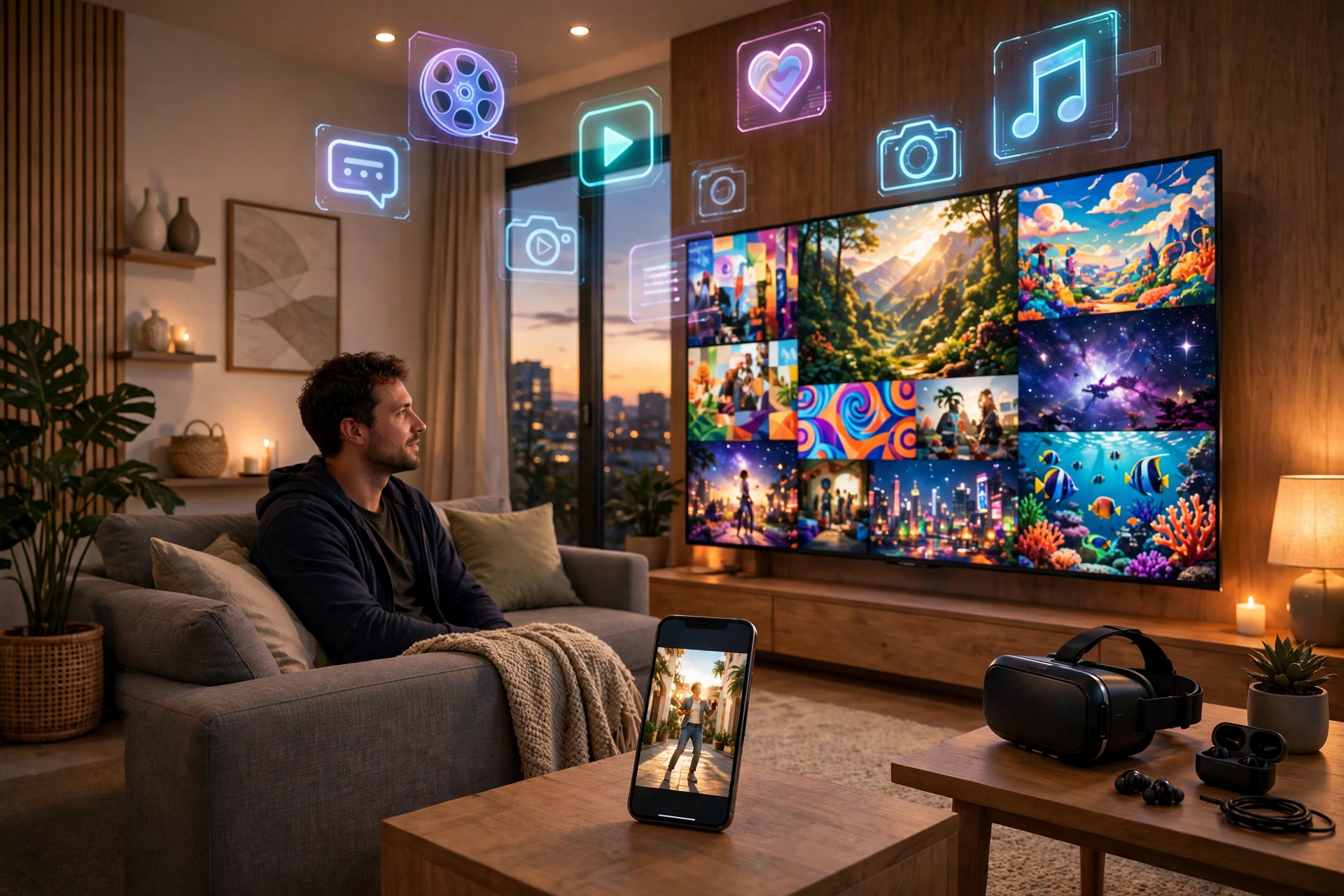
Cheaper headsets, 5G connectivity, and real-time rendering are moving immersive media beyond novelty. TO THE NEW’s 2026 media trends analysis points to VR fan gatherings, virtual concerts, and digital twins in virtual production studios as the formats gaining ground, alongside hybrid social games that change how audiences participate and pay. Virtual production — filming actors against LED walls showing computer-generated sets in real time — is the quiet workhorse here: it cuts location costs and lets directors change a scene without a reshoot.
Short-form and creator-led formats: micro-dramas and vodcasts
Two formats show how fast media habits are shifting. Micro-dramas — two-to-five-minute episodic series made for phones — already attract more than half a billion viewers a year, and Deloitte forecasts their in-app revenue rising from $3.8 billion in 2025 to $7.8 billion in 2026. Meanwhile podcasting is migrating to video: a leading platform already offers video for more than 60% of its top shows, and Deloitte forecasts global podcast and vodcast advertising revenue of roughly $5 billion in 2026, up nearly 20% year on year. The lesson for creators: short clips are now the discovery engine, and the full show increasingly lives wherever the audience already watches video.
Emerging media technologies compared
| Technology | What it does best | Biggest limit |
|---|---|---|
| Generative AI video | Fast drafts, effects, and variations at low cost | Trust, labelling, and rights questions |
| AI personalization | Helps viewers find content faster | Needs rich metadata and risks filter bubbles |
| AR / VR immersive media | Experiences viewers can step inside | Headset cost and comfort still limit reach |
| AI dubbing and localization | Opens shows to new language markets | Voice quality and performer consent |
| Short-form / micro-drama | Cheap, mobile-first discovery | Hard to sustain attention and pricing |
What does it cost to use these technologies?
Costs vary widely, which is the point: a creator can test generative video or short-form formats for little more than a subscription, while immersive production and virtual-production stages need serious capital. Deloitte India’s reporting on its TMT Predictions puts basic micro-drama episodes at roughly Rs 25,000 to Rs 50,000 per episode without major stars, with AI use pushing costs lower still. The sensible budget rule is to pay for audience learning first — a small test that proves viewers return — before committing to expensive production.
What do you need before you start?
Three prerequisites matter more than any single tool. First, rights: confirm you own or license the voices, likenesses, and footage your AI tools will imitate or remix. Second, labelling: plan how you will disclose AI-generated or AI-assisted content, since platforms and regulators are moving toward requiring it. Third, distribution: pick the format your audience already uses — short video for discovery, streaming for long-form, live for events — rather than building an experience and hoping viewers find it. Our broader guide to emerging trends in information technology covers the underlying AI and connectivity shifts behind these media changes.
What are the risks and limits?
The biggest risk is trust. Deloitte’s survey work, reported by Digital Content Next, found 27% of fans interested in a generative AI digest of their streaming, social, podcast, and actor updates — but also that nearly 40% of fans would accept AI-created entertainment only if it is clearly labelled, while 24% want the option to co-create with generative AI. The risks to manage: undisclosed synthetic content, performer and writer consent, age-verification rules for AI video, and the “AI slop” problem — flooding feeds with low-effort content that trains audiences to skip your brand. Human review before publication is the cheapest safeguard available.
What to watch next
Watch three things. First, labelling and age-verification rules for AI-generated video, which Deloitte expects to sharpen in 2026. Second, whether micro-drama revenue really doubles as forecast, or stalls once novelty fades. Third, whether audiences embrace co-creation — alternative endings, remixes, fan-made scenes — or treat it as a gimmick. As with getting cited in Google’s AI Mode, the durable advantage belongs to publishers whose content is original, clearly sourced, and genuinely useful — the qualities answer engines and audiences both reward.
Frequently asked questions
What are emerging technologies in media?
Emerging technologies in media are tools already in real use but not yet standard practice, including generative AI video, AI personalization and dubbing, immersive AR and VR, virtual production, and short-form creator formats like micro-dramas. They lower production costs and change how audiences discover and experience stories.
How is AI changing the media industry?
AI is changing media at every stage: generative tools draft and edit video, recommendation systems personalize what viewers see, dubbing tools open new language markets, and agentic systems automate post-production and marketing. The main gains are speed and personalization, while the main risks are trust, labelling, and rights.
What is a micro-drama?
A micro-drama is a short episodic series, usually two to five minutes per episode, designed for mobile viewing. Deloitte reports more than half a billion viewers a year and forecasts in-app revenue rising from $3.8 billion in 2025 to $7.8 billion in 2026.
Will VR and AR replace traditional TV and film?
No. Immersive media is growing fastest in gaming, live events, concerts, and interactive storytelling, but traditional TV and film remain the default for long-form viewing. Expect immersive formats to complement screens, not replace them, for the next several years.
Should small creators invest in AI media tools?
Yes, but start small. Test generative video, AI dubbing, or short-form formats on one series, label AI-assisted work clearly, and confirm rights before publishing. Scale up only when repeat viewing — not just first-week clicks — proves the format works for your audience.
Sources
- Deloitte, TMT Predictions 2026
- The Economic Times, “AI-led content, micro-dramas, live events to drive M&E growth: Deloitte”
- Digital Content Next, “How media brands can compete as AI floods the content market”
- Avenga, “2026 media and entertainment industry trends outlook”
- TO THE NEW, “Top Media & Entertainment Industry Trends in 2026”