AI in Fabrication Explained: How Artificial Intelligence Is Changing Metal Shops
Key takeaway: AI in fabrication means using machine learning, computer vision, and sensor data to plan, cut, weld, inspect, and maintain metal parts more accurately than manual methods alone. It catches defects earlier, predicts machine failures, and optimises cutting layouts, so shops waste less material and lose less time to unplanned downtime.
Fabrication turns raw metal into finished parts through cutting, bending, welding, machining, and assembly. For decades that work depended on skilled operators, fixed machine settings, and inspection at the end of the line. AI changes when decisions are made. Instead of finding a problem after a batch is finished, a connected shop can spot it while the part is still on the machine. That shift, from reacting to predicting, is the real story behind AI in fabrication.
What AI in fabrication actually does
AI in fabrication is not one tool but a set of technologies across the shop floor. Computer vision cameras inspect welds and surfaces for cracks, porosity, and dimensional drift. Machine-learning models read vibration, temperature, and tool-wear data to warn that a spindle or press is heading for failure. Optimisation software plans nesting layouts so sheet metal is cut with less scrap, and generative design tools suggest part shapes that use less material while keeping strength. None of this works without data: sensors on machines, consistent job and defect records, and someone to keep them clean. Small shops usually start with one machine and one problem, such as inspection or downtime, rather than automating everything at once.
Where AI helps most on the shop floor
Cutting and bending. AI-assisted nesting and programming analyse material properties, sheet thickness, bend angles, and tooling to produce programs with fewer trial runs. They can compensate for springback, the tendency of bent metal to relax slightly, reducing variation on parts with multiple bends.
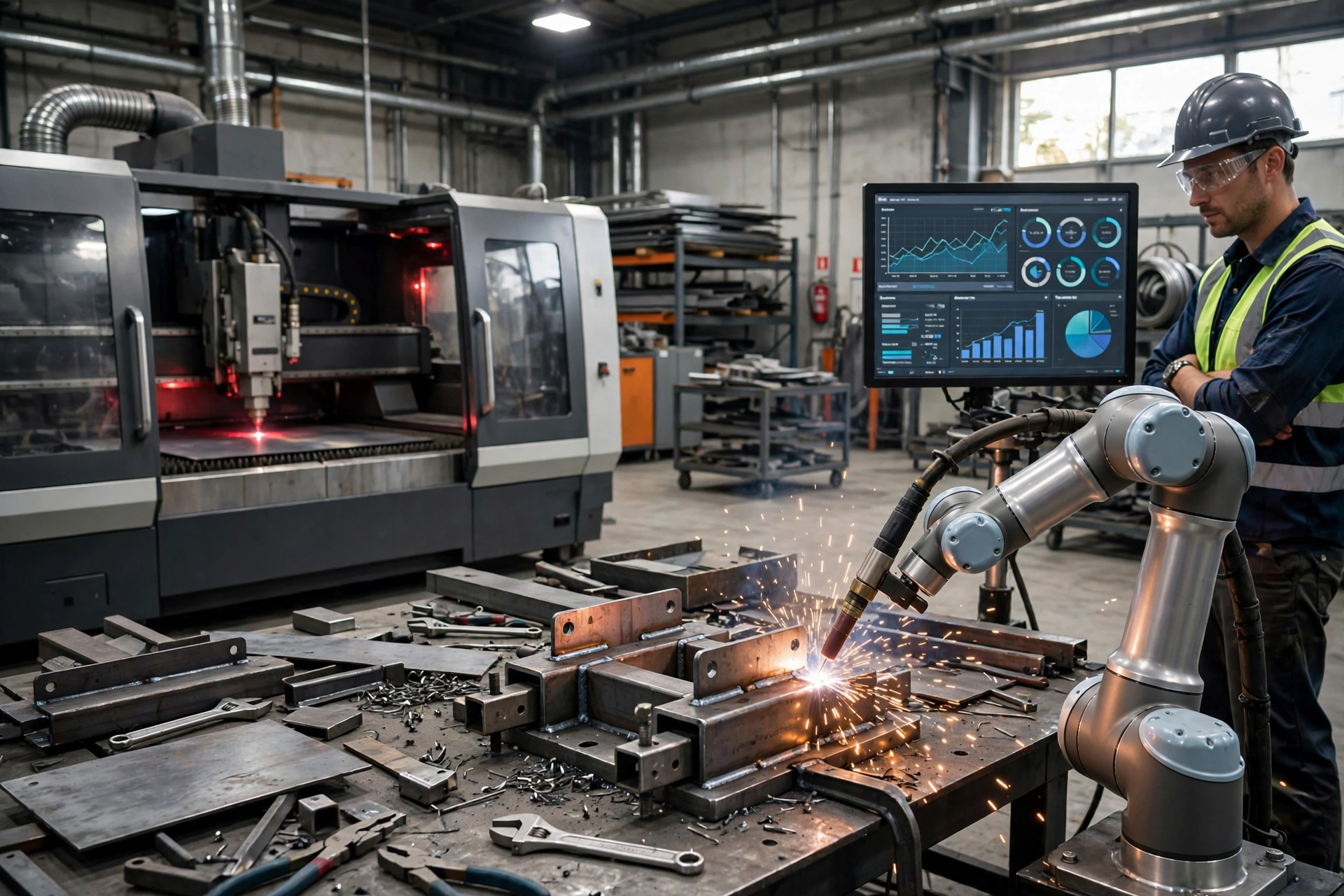
Welding and assembly. Adaptive robot guidance lets robots adjust weld paths to the actual geometry of a part, not just its drawing. That matters when sheet blanks arrive slightly warped or irregularly oriented, a situation fixed-path robots handle badly.
Inspection and quality control. Vision systems check parts faster than manual inspection and without fatigue. A 2026 study of manufacturing SMEs in the Journal of Manufacturing and Materials Processing found 41.2% of surveyed firms were already running at least one live AI quality-control application, with predictive maintenance the most widely deployed use at 28.5%. The sample deliberately targeted firms with AI quality-control experience, so the figure runs higher than a typical shop floor — but it shows which uses come first.
Predictive maintenance. Instead of servicing machines on a fixed calendar or waiting for a breakdown, AI models flag early signs of bearing damage, misalignment, or lubrication trouble. A 2026 Augury and IndustryWeek report, summarised by Analytics Insight, found 57% of manufacturers surveyed were using predictive maintenance, and 83% of manufacturing leaders planned to spend more on AI. These are survey results, not a census, but the direction is consistent across surveys.
Scheduling. Once physical processes are stable, shops use AI to sequence jobs, predict bottlenecks, and re-plan when a machine goes down. Industry guides describe this as a second-wave adoption, after inspection and maintenance, because scheduling models need reliable production data to be useful.
AI fabrication vs traditional fabrication
| Task | Traditional approach | AI-assisted approach |
|---|---|---|
| Inspection | Manual checks, often at end of batch | Camera and sensor checks during production |
| Maintenance | Fixed schedule or fix after breakdown | Alerts based on vibration and wear data |
| Cutting layout | Operator-planned nesting | Software-optimised nesting to cut scrap |
| Welding path | Fixed robot path from the drawing | Path adjusted to actual part geometry |
| Scheduling | Experience-based job sequencing | Data-driven sequencing and re-planning |
How AI in fabrication compares with general factory automation
General factory automation, such as the machine automation solutions covered on USABite, focuses on machines doing repetitive work faster. AI in fabrication adds judgment: deciding when a weld looks wrong, when a tool is wearing out, or which layout wastes least. Automation without AI repeats the same program regardless of variation; AI-assisted fabrication adapts to variation. Most shops already own the automation part before they add the AI layer.
What AI in fabrication costs, and what you need first
Costs vary widely because every shop’s machines, sensors, and data readiness differ. The realistic budget has three parts: sensors and connectivity, software licences or cloud fees, and staff time to label defects, validate alerts, and keep data clean. Small shops can start cheaply with a single vision-inspection station or a predictive-maintenance pilot on one bottleneck machine, then expand only if the pilot saves more than it costs. For a sense of how small teams automate on a tight budget, see our guide to low cost intelligent automation. Three prerequisites decide success: instrumented machines that produce usable data, labelled examples of good and defective parts, and a clear owner on the shop floor who checks alerts and feeds corrections back. A phased plan, like the one in our technology implementation guide, helps: pilot, measure, then scale.
Risks and limits to watch
AI inspection can miss a defect type it has never seen and can flag good parts when lighting or material finish changes. Predictive maintenance gives warnings, not certainties, so crews still judge whether an alert is real before stopping a line. Connecting machines to cloud software also creates a new attack surface, so shops should segment shop-floor networks from office networks. Finally, AI does not fix a broken process: if drawings are inconsistent or material quality varies wildly, the model learns that noise. Fix the process first, then add the model.
How to start with AI in fabrication
Pick one costly, measurable problem, such as scrap on one product line or downtime on one bottleneck machine. Run the AI tool alongside the existing manual process, not instead of it, and compare defect rates, scrap, and downtime on the same jobs. Only replace the manual step when the pilot beats it consistently, and keep the human in the loop: the fabricator who knows how a weld should look remains the final judge, especially on safety-critical parts.
Analysis: The hype promises fully autonomous factories, but the verified evidence points somewhere more practical: the early wins are narrow, measurable, and human-supervised — inspection, maintenance, and nesting. Shops that treat AI as a set of targeted tools, bought one problem at a time, are more likely to see a return than shops that buy a plant-wide transformation on a vendor’s promise. If you add USABite as a preferred source in Google Search, you will see our coverage of these factory technologies first when new developments land.
Frequently asked questions
What is AI in fabrication?
AI in fabrication is the use of machine learning, computer vision, and sensor data to plan, cut, weld, inspect, and maintain metal parts. It helps shops detect defects earlier, predict machine failures, and optimise material use, while skilled operators remain in charge of final decisions.
How is AI used in metal fabrication?
Common uses include vision-based inspection of welds and surfaces, predictive maintenance from vibration and tool-wear data, AI-optimised nesting for sheet cutting, adaptive robot welding paths, and data-driven job scheduling. Most shops start with inspection or maintenance before moving to scheduling.
Does AI replace fabricators?
No. AI takes over repetitive inspection and monitoring tasks and flags problems humans should check, but it cannot replace the judgment of experienced fabricators, especially on safety-critical parts. In practice, workers are redeployed to higher-judgment roles rather than removed.
How much does AI in fabrication cost?
There is no single price, because costs depend on machines, sensors, software, and data readiness. A sensible start is a single pilot, such as one inspection station or one machine’s predictive maintenance, with costs measured against scrap or downtime saved before expanding plant-wide.
Can small fabrication shops use AI?
Yes, if they start small. A small shop needs instrumented machines, labelled examples of good and defective parts, and one person to own the pilot. Cloud tools and edge computing have lowered the entry cost, but reliable data and a clear pilot goal matter more than budget size.
Sources
TechBullion — How AI and Automation Are Transforming Metal Machining and Fabrication
TMC Insight — AI in Metal Manufacturing: A Guide for Executives
Journal of Manufacturing and Materials Processing (MDPI) — AI-Enabled Quality Control Adoption in Manufacturing SMEs
Analytics Insight — AI Predictive Maintenance: How Factories Reduce Downtime (Augury and IndustryWeek 2026 report)