Dynamic AI Agents Explained: How They Plan, Adapt, and Get Work Done
Key takeaway: Dynamic AI agents are software systems that take a goal, make their own plan, use tools to carry it out, and change that plan when new information arrives. Unlike fixed automation that follows pre-written steps, a dynamic AI agent reasons, observes results, and retries a different route when something fails.
Most automation you meet every day is static: if this happens, do that. A dynamic AI agent works the other way round. You give it an outcome — “resolve this support ticket,” “reconcile these invoices,” “draft a plan for this project” — and it decides the steps itself, in real time. That shift, from following instructions to pursuing goals, is why the term “dynamic AI agents” keeps appearing in enterprise software, customer service, and IT operations.
This explainer covers what dynamic AI agents are, how they actually work under the hood, how they differ from chatbots and traditional automation, and when they are — and are not — the right tool. Salesforce’s guide to agentic reasoning describes the core loop well: an agent reasons, acts, observes the result, and adjusts its strategy rather than following one rigid chain of steps.
What Are Dynamic AI Agents?
Dynamic AI agents are autonomous systems that plan, adapt, and execute tasks based on their understanding of a problem, the tools available to them, and changing circumstances, with minimal human-defined structure. That definition, from PromptLayer’s glossary of dynamic agents, captures the three abilities that matter: autonomous planning, adaptive behaviour, and flexible tool use.
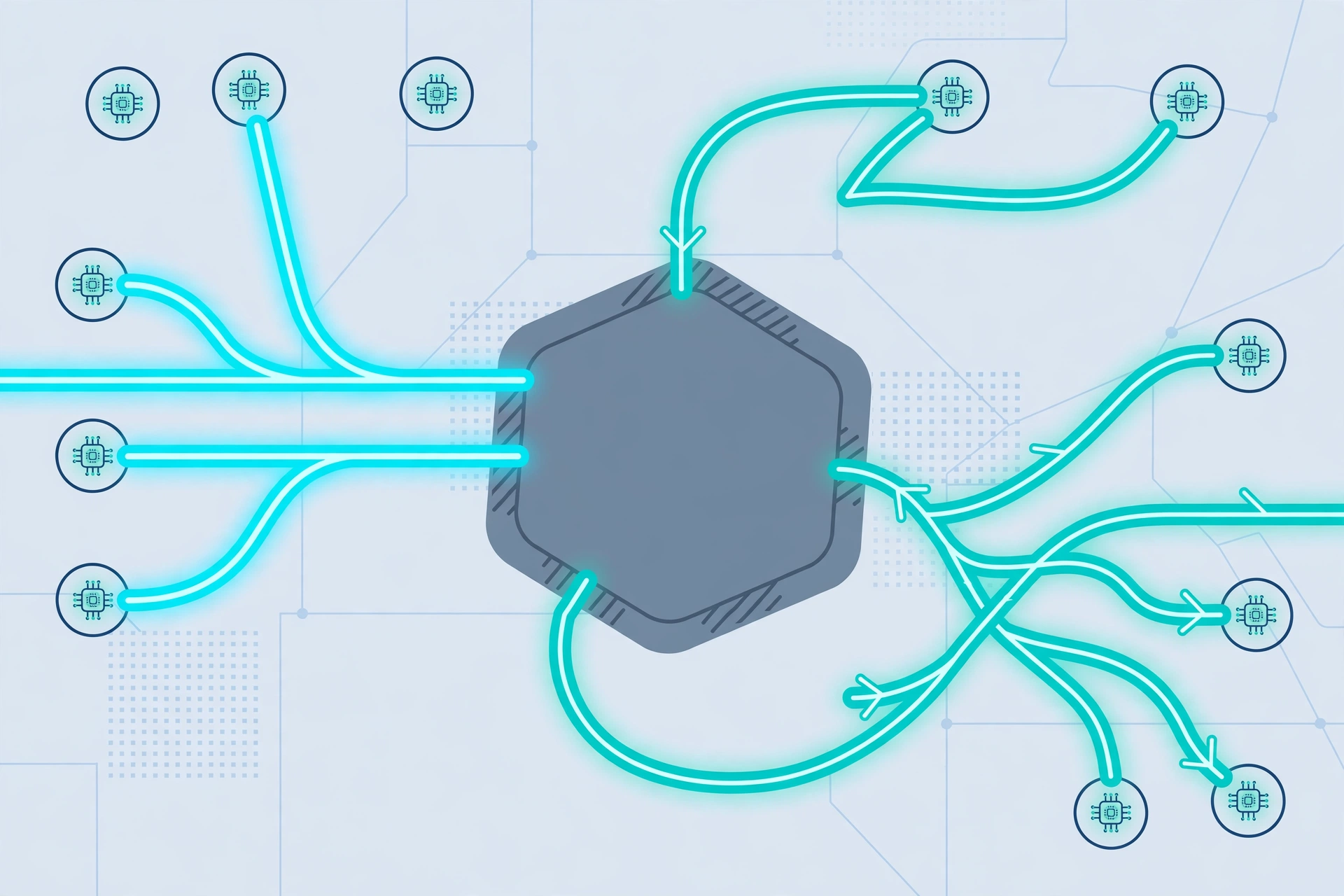
In practice, an agent combines a large language model with four supporting parts: a planner that breaks a goal into steps, memory that keeps short-term context and longer-term facts, tools such as APIs, databases, and search, and a supervisor that enforces budgets, permissions, and safety rules. The agent runs a loop — execute, observe, reflect, decide — until the goal is met or it hands the task back to a person.
A useful example: an IT support agent receives a report that a service is down. Instead of running one fixed script, it checks the logs, finds a failed deployment, rolls it back, verifies the service is healthy again, and writes a summary ticket. If the rollback fails, it tries the next most likely fix instead of stopping.
How Dynamic AI Agents Work: The Perceive, Plan, Act Loop
Most dynamic agents follow a loop first formalised as ReAct (Reason and Act), described by Yao and colleagues in 2022 and summarised by Salesforce: the agent interleaves reasoning traces with actions, observes the outcome of each action — such as a database query — and then decides the next step. If data is missing, it does not stop; it tries a different path. That is what makes the planning “dynamic”: the plan is a living document, not a script written in advance.
The loop has four stages. First, the agent perceives: it reads the goal, the available context, and the state of the systems it can touch. Second, it plans: it breaks the goal into sub-tasks and picks the first tool to use. Third, it acts: it calls an API, runs a search, writes a file, or sends a message. Fourth, it observes and reflects: did that step work, what changed, and what should happen next? The cycle repeats, with memory updated each time, until the goal is reached, a limit is hit, or a human needs to step in.
Two design choices shape how well this works. Memory matters: without it, an agent repeats questions and loses track of multi-step work. And guardrails matter even more: limits on which tools it may call, which data it may see, and which actions need approval are what keep a goal-seeking system safe in production.
Dynamic AI Agents vs Static Automation and Chatbots
Not everything called an “agent” is dynamic. Many products marketed as agents are really intelligent workflows: the execution path was written as code before runtime, and the model only fills in text at each step. A genuinely dynamic agent decides its own execution path at runtime, based on intermediate observations — the same input can produce a different route on a different day.
| Feature | Static automation / workflow | Dynamic AI agent |
|---|---|---|
| Control flow | Pre-written rules and branches | Decided at runtime by the model |
| When conditions change | Fails or needs manual fixes | Replans and tries another route |
| Tool use | Hardcoded integrations | Chooses tools based on the task |
| Error handling | Stops or follows a preset fallback | Self-corrects, retries, escalates |
| Best for | Stable, repeatable processes | Variable, multi-step, tool-heavy work |
A chatbot is also different. A chatbot answers one prompt at a time and then stops. A dynamic AI agent keeps going across many steps, uses tools, and checks its own progress. As Scaler’s guide to autonomous agents puts it, the execution model is loop-based rather than request-response: the agent continues running until its terminal objective is met.
Where Dynamic AI Agents Are Actually Used
The most convincing uses are ones where the steps genuinely vary. In customer operations, an agent can research a customer’s history, check warehouse stock, and draft a personalised resolution without a human toggling between screens — an example Salesforce highlights. In software development, agents write code, run tests, read the error logs, and iterate until tests pass. In finance operations, agents reconcile transactions, request missing documents, and escalate anomalies. In production planning, adaptive agents watch live orders, machine status, and material availability, then propose schedule changes when a machine goes down or a rush order arrives.
For readers of USABite’s earlier explainers, this builds on two related ideas: conversational AI for the enterprise, which covers how AI handles customer and employee conversations at scale, and AI agents for business automation, which looks at the broader automation case. Dynamic agents are the planning layer that sits on top of those capabilities.
Comparison: Dynamic Agents, Fixed Workflows, and Human Teams
The honest comparison is not “agent versus human” but “agent versus the alternatives for this specific task.” A fixed workflow wins on predictability, cost, and auditability whenever the process rarely changes. A human team wins on judgment, accountability, and handling genuinely novel or sensitive cases. A dynamic agent wins when the task is goal-based, spans several systems, and changes often enough that fixed logic keeps breaking — provided a human still reviews high-stakes actions.
That is also why the buyer rule published in 2026 decision guides is worth repeating: choose the least autonomous system that can still produce the outcome. Autonomy adds cost, variance, monitoring burden, and risk, so it should be spent where variability is the problem, not added for its own sake.
What Dynamic AI Agents Cost and What You Need Before You Start
Cost is the part vendors understate. A dynamic agent typically makes many model calls per task — one per reasoning step, plus tool calls — so a task that costs cents as a single chatbot reply can cost far more as an agent run. There are also hidden costs: evaluation (testing the agent on realistic cases), tracing and logging, human review time, and the engineering to keep tools and permissions up to date. Budget for those before promising savings.
Prerequisites are simpler than the marketing suggests. You need a clearly defined goal and a measurable success check, clean access to the tools and data the agent will use, permission boundaries (what it may read, what it may change, what needs approval), and an escalation path for the cases it cannot resolve. Without a success check, you cannot tell whether the agent actually finished the job or just stopped. If your underlying process is broken or your data is unreliable, fix that first — an agent will automate the mess faster, not fix it.
Risks, Limits, and the Governance Question
Dynamic agents carry risks that static automation does not. They can take unexpected routes, misread a tool’s output, loop on a failing step, or act on stale data. They can also expose data across systems if their tool permissions are too broad. That is why enterprise governance for agents now focuses on runtime behaviour — what the agent actually did, step by step — rather than only on its inputs and outputs. Audit logs, spending caps, approval checkpoints for irreversible actions, and the ability to roll back are not optional extras; they are the controls that make autonomy deployable.
Relatedly, a trust layer for AI — the set of controls that keeps enterprise AI safe, private, and auditable — is the natural companion to any agent rollout. The agent decides; the trust layer constrains what it is allowed to decide about.
Analysis: Why This Matters Now
Analysis: The excitement around dynamic AI agents is real, but the pattern of adoption is familiar. The first wave of any automation technology over-promises autonomy and under-prices oversight. The organisations that get value from dynamic agents in 2026 and beyond are likely to be the ones that deploy them narrowly — one bounded workflow, with clear success checks and human approval on consequential steps — and expand only after the logs prove the agent is reliable. Used that way, dynamic planning is a genuine step beyond static automation. Used as a general-purpose replacement for process design, it becomes an expensive way to rediscover why the process needed designing in the first place.
If you are evaluating a product that calls itself a dynamic agent, ask one question before anything else: show me the log of a task where the plan changed mid-run, and why. If the vendor cannot show a replanned route, you are probably looking at a workflow with good marketing.
Frequently Asked Questions
What is a dynamic AI agent in simple terms?
A dynamic AI agent is software that takes a goal, makes its own step-by-step plan, uses tools such as search, databases, and apps to carry it out, and changes the plan when results or conditions change. It keeps working across multiple steps until the goal is done or it needs human help.
How are dynamic AI agents different from chatbots?
A chatbot answers one message at a time and then stops. A dynamic AI agent runs a loop of reasoning, acting, and observing across many steps, uses external tools, remembers context, and checks whether its goal is actually achieved before finishing.
What is dynamic planning in AI agents?
Dynamic planning means the agent decides its execution path at runtime instead of following pre-written branches. Using frameworks such as ReAct, it reasons, acts, observes the result, and then picks the next step, backtracking or trying alternatives when a step fails or new information appears.
When should you use a dynamic AI agent instead of fixed automation?
Use a dynamic agent when the task is goal-based, spans several systems, and changes often enough that fixed rules keep breaking. Use fixed automation when inputs are stable, rules are clear, exceptions are rare, and predictable, auditable output matters most.
What are the main risks of dynamic AI agents?
The main risks are unexpected routes, errors from misread tool outputs, looping on failing steps, excessive model-call costs, and overly broad tool permissions that expose data. Mitigations include approval checkpoints for irreversible actions, spending caps, full audit logs, and human review of high-stakes decisions.
Sources
- PromptLayer — What Are Dynamic Agents?
- Salesforce — Agentic Reasoning: How AI Agents Plan and Solve Problems
- Scaler — Autonomous AI Agents: What It Is and How It Works
- Talentelgia — Autonomous AI Agents: Complete Enterprise Guide 2026