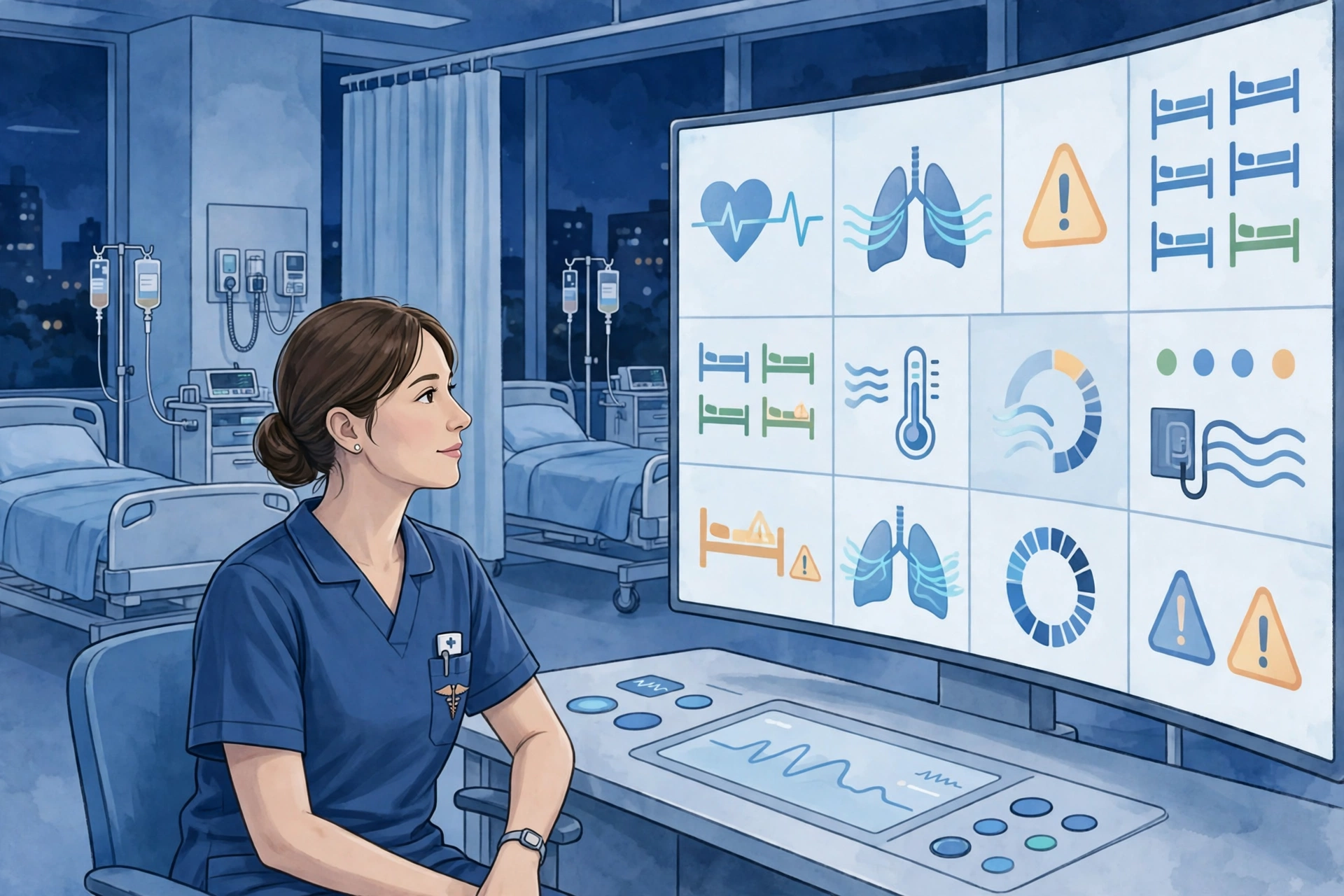
Hospital Safety AI Software Solutions Explained: What They Do, How They Work, and How to Choose One
Key takeaway: Hospital safety AI software solutions watch patient data around the clock, flag risks such as sepsis, falls, and deterioration hours earlier than routine checks, and route alerts to the right clinician. They work best as supervised decision support, not replacements for clinical judgment, and hospitals should judge them on validated accuracy and alert burden, not vendor demos alone.
Hospitals collect enormous amounts of patient data: vital signs, lab results, medication records, and nurses’ notes. The safety problem is not a lack of data but a lack of timely attention — a patient can deteriorate quietly between rounds, or an early infection can look like ordinary fever. Hospital safety AI software solutions close that gap by monitoring data continuously and surfacing risk before harm happens.
What hospital safety AI software solutions do
Hospital safety AI software solutions are tools that analyse electronic health record (EHR) data, vital signs, and sometimes room sensors to detect patterns linked to harm. Most fall into four groups: deterioration and sepsis prediction, fall-risk prediction, medication and infection safety, and incident-report analysis. Check each use case separately rather than assuming one platform covers everything.
Sepsis detection is the most studied example. Johns Hopkins University researchers developed the Targeted Real-Time Early Warning System, commercialised by Bayesian Health, which integrates EHR data with clinical AI to spot sepsis cases nearly two to 48 hours earlier than traditional methods in its deployments, and which has received US Food and Drug Administration (FDA) clearance. Johns Hopkins reports the system reduced sepsis mortality by 18% across dozens of hospitals, in a condition that claims more than 250,000 lives a year in the United States.
Fall prevention works differently. A 2025 review in Risk Management and Healthcare Policy describes human-centred AI decision-support systems that combine EHR data with sensor and wearable data to calculate fall risk and recommend personalised prevention steps. The point is practical: a risk score alone prevents nothing; the intervention it triggers is what keeps a patient safe.
A third group analyses safety reports themselves. A systematic review published in Safety in April 2026, covering 15 studies, found machine learning and natural language processing models can detect adverse events such as medication errors and hospital-acquired infections from large clinical datasets, and can even surface incidents that were never formally reported. The review notes that fewer than 10% of adverse events are recorded in traditional reporting.
Hospital safety AI software vs traditional patient monitoring
Traditional monitoring relies on scheduled observations, threshold alarms, and staff reporting. It is proven and familiar, but limited by staffing: a nurse cannot watch every patient continuously, and simple threshold alarms fire so often that staff learn to tune them out. AI monitoring adds pattern recognition across many data streams at once and, in principle, fewer but more meaningful alerts.
In practice the difference depends on validation. Epic’s sepsis model illustrates the point: a 2021 JAMA study found it correctly identified only 33% of relevant sepsis cases, while a later improved version identified 86% of true positives but with a positive predictive value of 33.8% — roughly three alerts to confirm one case. That trade-off between catching cases and over-alerting is the central design tension in this market.
| Approach | How it watches patients | Strength | Weakness |
|---|---|---|---|
| Traditional bedside monitoring | Scheduled observations and fixed threshold alarms | Simple, understood, no new data plumbing | Misses slow deterioration between checks; alarm fatigue |
| Rule-based early warning scores | Scored vital signs at set intervals | Transparent and auditable | Crude; misses patterns across labs, notes, and trends |
| AI safety software | Continuous analysis of EHR, labs, vitals, and sensors | Earlier, patient-specific warnings; finds unreported events | Needs validation, integration, and alert governance |
| AI room monitoring (sensors/cameras) | Continuous in-room sensing for falls and movement | Detects events no chart can show | Privacy and consent questions; hardware cost |
What hospital safety AI software costs
Hospital safety AI software solutions are almost never sold at a public list price. Vendors typically quote per hospital, per bed, or per module, with implementation, EHR integration, and ongoing validation bundled in. A cheap licence with a long integration project can cost more than a pricier tool that plugs into the hospital’s existing EHR.
Budget for more than the licence: EHR integration work, staff training, alert-governance time, hardware for any sensor-based product, and periodic revalidation as patient populations change. A pilot on one ward, with agreed success measures, is the cheapest way to learn the true cost before a hospital-wide rollout.
What a hospital needs before adopting one
Three prerequisites decide whether a safety AI tool helps or becomes shelfware. First, usable data: the tool needs reliable, timely EHR feeds — vitals, labs, medications, and notes. Second, clinical ownership: a named clinician group must own alert thresholds, review performance, and decide when to switch a model off. Third, workflow fit: alerts must land where staff already work, with a clear action attached to each alert type.
Regulatory status is a fourth check. Some tools are FDA-cleared medical devices, like the Johns Hopkins/Bayesian Health sepsis system; others are decision support or administrative tools with different oversight. Verify clearance status for the exact use case being bought, not a general claim of approval.
Risks and limits of hospital safety AI software
The evidence is encouraging but uneven. Models trained at one hospital can perform worse at another with different patients, devices, or documentation styles. Alert fatigue returns quickly if thresholds are set too sensitively. Privacy is a live concern for sensor and camera-based room monitoring, which needs clear consent and data-retention policies.
AI classification of safety events is also not yet a substitute for human review. A recent single-centre study of a large language model classifying hospital adverse-event reports found exact agreement with expert adjudication in just under half of 286 reports, though agreement was much stronger on the most serious cases and the AI work took minutes against roughly 61 hours of human review time. The authors’ conclusion is the right framing for the whole field: supervised decision support, with humans keeping final judgment.
Analysis: the pattern across the evidence is consistent. Sepsis and deterioration tools have the strongest real-world results, fall prediction depends on the intervention that follows the alert, and report-analysis tools are best used to find problems humans missed rather than to replace human safety review.
How to choose a hospital safety AI software solution
Start from the harm you want to reduce, not the technology. If sepsis deaths are the priority, shortlist sepsis tools with published, peer-reviewed, multi-hospital results. If falls dominate your incident reports, prioritise fall-risk tools with sensor or workflow evidence. Then ask every vendor the same questions: show sensitivity and positive predictive value from hospitals like ours; how are alerts tuned and who owns that work; what happens when the EHR goes down; and what does a one-ward pilot cost, including integration?
Also check integration and audit basics: does it plug into your EHR without a custom build, does it log every alert and outcome, and can safety teams export the data? For wider context, see our explainers on AI in safety management and conversational AI for employee support.
Frequently asked questions
What is hospital safety AI software?
Hospital safety AI software is technology that monitors patient data, such as vital signs, lab results, and electronic health records, to detect risks like sepsis, falls, deterioration, and medication errors early. It alerts clinicians so they can intervene sooner, and it works as decision support alongside clinical judgment rather than replacing it.
How does AI detect sepsis in hospitals?
Sepsis AI tools analyse trends across vital signs, lab results, and clinical notes to spot patterns that precede sepsis, often hours before obvious symptoms appear. For example, the Johns Hopkins Targeted Real-Time Early Warning System integrates electronic health record data with clinical AI and has been reported to detect sepsis cases nearly two to 48 hours earlier than traditional methods.
Can AI prevent patient falls in hospitals?
AI cannot prevent falls on its own, but it can predict which patients are at highest risk by combining health record data with sensor and wearable data. Prevention still depends on staff acting on the alert with measures such as supervised mobilisation, medication review, or bedside alarms, as described in a 2025 review of human-centred AI fall-prevention systems.
How much does hospital safety AI software cost?
There is rarely a public list price. Vendors usually quote per hospital, per bed, or per module, with implementation and electronic health record integration added. Hospitals should budget for integration, training, alert management, and revalidation, and run a one-ward pilot to learn the true total cost before a full rollout.
Is hospital safety AI software safe and reliable?
Reliability varies by product and setting, so hospitals should demand validated accuracy figures, including both sensitivity and false-alarm rates, from hospitals similar to their own. Tools with regulatory clearance for their specific use case, local validation, and human oversight of every alert are safer bets than unvalidated tools used without supervision.
Sources
- Johns Hopkins University — FDA approves early warning system for sepsis
- Elion — AI Inpatient Risk Monitoring Market Map
- Risk Management and Healthcare Policy (2025) — Streamlining Patient Fall Prevention Through Human-Centered AI-Based Decision Support Systems
- Safety (April 2026) — AI-Driven Approaches for Adverse Event Detection: A Systematic Review
- Science Magazine report — AI matches expert severity ratings in half of hospital adverse event reports