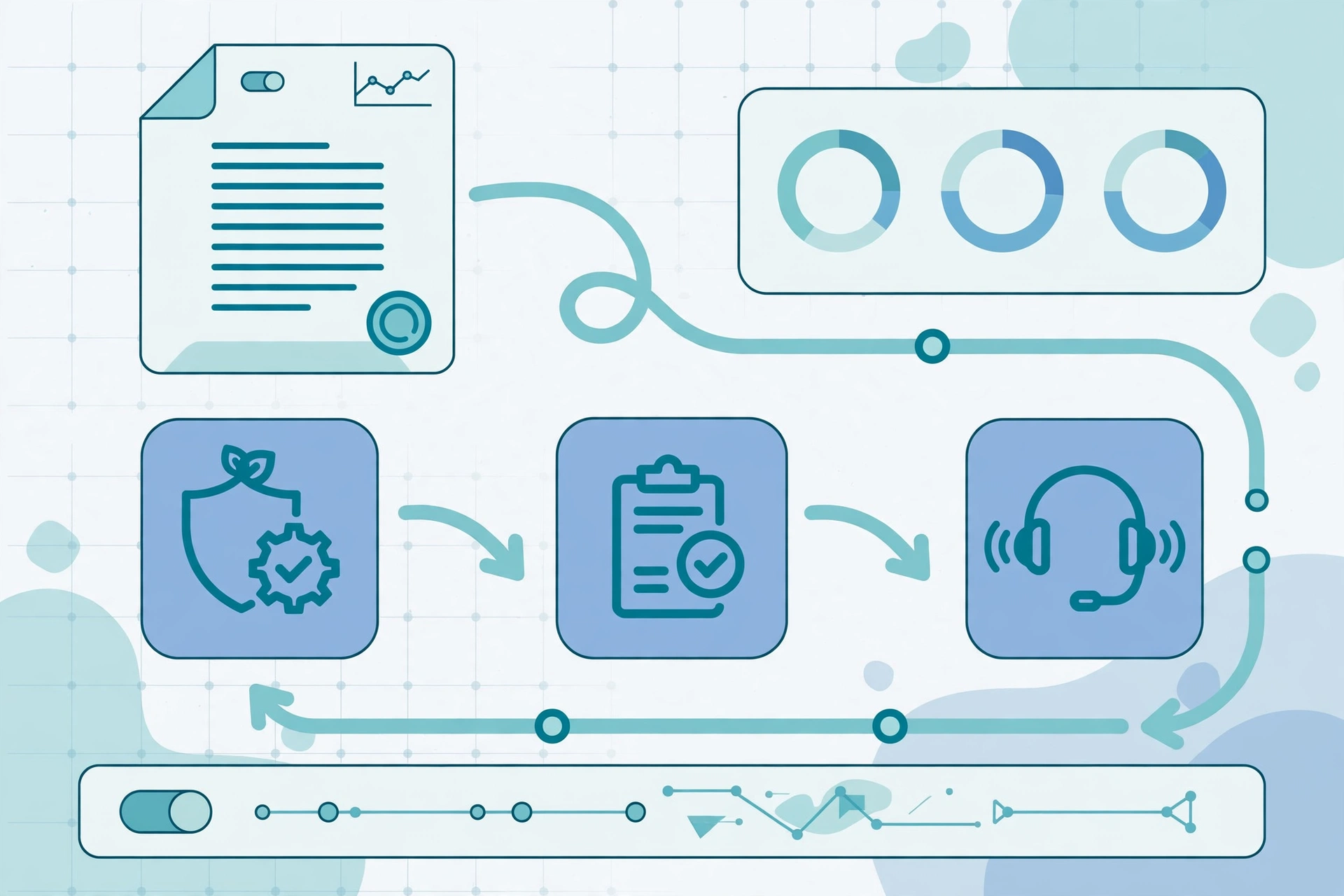
Automation in Life Insurance Explained: Faster Underwriting, Claims, and What It Changes for Buyers
Key takeaway: Automation in life insurance uses software, data and AI to speed up underwriting, claims and customer service — in many cases cutting a weeks-long application process down to days. It works best for straightforward cases; complex applications still need human underwriters, and buyers should check how their data is used.
Buying life insurance used to mean weeks of paperwork, a medical exam, and waiting for an underwriter to work through your file by hand. Automation in life insurance is changing that sequence. Insurers now pull data from electronic sources, apply rules and predictive models, and approve straightforward applications with little or no human touch.
This is not one product or one tool. It is a set of technologies — automated underwriting, digital claims processing, fraud detection and self-service portals — applied across the life policy lifecycle.
What automation in life insurance means
At its simplest, automation means software completing a task a person used to do manually: gathering and checking information, deciding against set rules, and moving a case to the next step without re-keying data.
Automated underwriting, the best-known example, uses technology — including rules-based systems and predictive algorithms — to review and approve applications that meet defined criteria, limiting human intervention. LIMRA distinguishes it from accelerated underwriting, where certain medical requirements, such as a paramedic exam or fluid collection, are waived for eligible applicants. Many insurers run both. The same pattern applies to claims, fraud checks and servicing — for a broader look at automation beyond insurance, see our explainers on AI agents for business automation and automating IT operations.
Where automation shows up in a life policy’s lifecycle
| Stage | What gets automated | What it changes for you |
|---|---|---|
| Application and underwriting | Data pulls (prescription history, motor vehicle records), risk scoring, fast decisions for standard cases | Faster approval, often without a medical exam |
| Policy servicing | Beneficiary updates, premium payments, document access via portals | Less waiting on phone lines for routine changes |
| Claims | Document checks, policy verification, payout processing for straightforward claims | Faster payouts when documents are complete |
| Fraud and risk checks | Pattern detection across applications and claims | Fewer manual re-checks — but automated flags may need explaining |
How much faster is it, really?
The clearest published numbers come from LIMRA’s research on US and Canadian life insurers. According to a LIMRA study, three out of four life insurance companies in the US and Canada have some type of automated and/or accelerated underwriting programme, and one in two has both. Within those programmes, companies reported that reaching a final decision took nine days on average, compared with 27 days under traditional underwriting — a two-thirds reduction. Almost all companies surveyed (82%) believed their programmes had reduced policy issue time.
Reinsurer Munich Re makes a similar case for the operational side: automated underwriting aims for high straight-through processing rates and quick turnaround times, while reducing error rates, rework and “not taken up” rates — applications that stall before completion.
Those averages hide an important split. Straightforward applicants — typically younger, healthier, with clean records — get near-instant decisions. Anything unusual, from a complex medical history to a high coverage amount, usually goes to a human underwriter anyway, and the timeline looks much more traditional.
Automation in life insurance vs traditional underwriting
| Traditional underwriting | Automated underwriting | |
|---|---|---|
| Decision time | Weeks; 27 days on average in LIMRA’s comparison | 9 days on average; minutes for some instant-issue products |
| Medical requirements | Paramedic exam and fluid tests common | Often waived for eligible applicants |
| Data used | Application, exam results, doctor’s statements | Plus prescription databases, motor vehicle and credit records |
| Main risk | Slow, manual errors, dropped applications | Opaque rejections, data errors, edge cases misjudged by the model |
What automation in life insurance costs — and why buyers should care
Automation is not free, and its costs shape what buyers experience. McKinsey’s July 2026 report on AI in insurance, as covered in trade press, found that two decades of digitisation had not cut the industry’s overall cost burden — cost ratios were around 10% higher than in 2005 — even though life insurance productivity improved by 24%, because technology spending, compliance costs and legacy-system complexity ate the gains. The same report said AI-led transformations were already delivering reductions of 20–40% in customer onboarding costs and improvements of 10–20% in agent productivity.
The practical read: automation savings do not automatically become cheaper premiums. They may show up as faster service or broader eligibility instead — or simply offset rising compliance and technology bills. Compare the premium and the policy terms, not the technology pitch.
What you need before automation can help you
Automated underwriting depends on clean, accessible electronic data. The prerequisites are simple: an accurate application, a prescription and medical history that can be checked electronically, and identity details that match official records. Where data is missing or inconsistent, the case usually falls back to manual review. Buyers can help their own case by disclosing medical conditions fully, keeping beneficiary details up to date, and telling beneficiaries where the policy documents are kept and how to claim.
The risks and limits of automated life insurance
A model can only judge what its data shows, so an applicant with a rare condition, an unusual occupation or a patchy record may be declined or priced unfairly by a system that misses the context. Data errors — a wrong prescription record, a mismatched identity — can also produce wrong decisions that are hard to appeal if no human explains them.
Privacy is the other trade-off. Automated underwriting draws on prescription databases, motor vehicle records and, increasingly, credit records; LIMRA notes that credit-record use has seen the greatest growth among these sources, while none of the companies in its study reported using wearables or social media. Check what data an insurer collects, whether consent is required, and how to correct an error.
Analysis: automation has made buying standard life cover genuinely faster and less painful, but it has not removed judgement from life insurance — it has moved it. Underwriters now concentrate on the hard cases, the appeals and the fraud patterns, while easy cases run themselves. That is a real improvement, but anyone with a complex health history should expect the old, slower process and budget for it.
Frequently asked questions
What is automation in life insurance?
Automation in life insurance means using software, data and AI to carry out tasks that people used to do by hand — gathering applicant data, assessing risk, approving straightforward policies, processing claims and handling routine servicing — so decisions happen faster and with fewer manual errors.
How long does automated underwriting take compared with traditional underwriting?
According to LIMRA’s study of US and Canadian life insurers, automated and accelerated programmes reached a final decision in nine days on average, versus 27 days for traditional underwriting. Some straightforward applicants get instant decisions, while complex cases are still routed to human underwriters and take longer.
Do I still need a medical exam with automated life insurance?
Not always. Under accelerated underwriting, eligible applicants can have requirements such as a paramedic exam or fluid collection waived. This usually applies to standard-risk applicants; higher coverage amounts or complex health histories typically still require exams or a doctor’s statement.
What data do insurers use for automated underwriting?
Insurers commonly use application data, prescription databases, motor vehicle records, lab results and, increasingly, credit records, alongside a health and lifestyle questionnaire. LIMRA found none of the companies in its study reported using wearables or social media data for underwriting.
Can an automated system decline my life insurance application unfairly?
It can make mistakes, especially on edge cases or where its data is wrong or incomplete. If you are declined or offered a higher premium, ask the insurer what data and reasons drove the decision, correct any errors in your records, and request a human review or consider applying elsewhere.
Sources: LIMRA, “Life Insurers Look to Make the Underwriting Process Easier for Customers”; Munich Re, “Automated life insurance underwriting guarantees the future success”; Devdiscourse coverage of McKinsey’s July 2026 report, “How AI will reshape the economics of insurance”.