
Gen AI Ecosystem Explained: The Layers, Players, and How They Fit Together
Key takeaway: The gen AI ecosystem is the stack behind generative AI: chips and cloud infrastructure at the bottom, foundation models in the middle, and development platforms, agent runtimes, governance tools and apps on top. No single company owns it. A weakness in any layer — data, cost or controls — limits what the whole system can do.
When people say “generative AI,” they usually mean one product: a chatbot, an image generator, or a coding assistant. But none of those stands alone. Each sits on a chain of other technologies, companies and decisions — and that chain is the gen AI ecosystem.
What is the gen AI ecosystem?
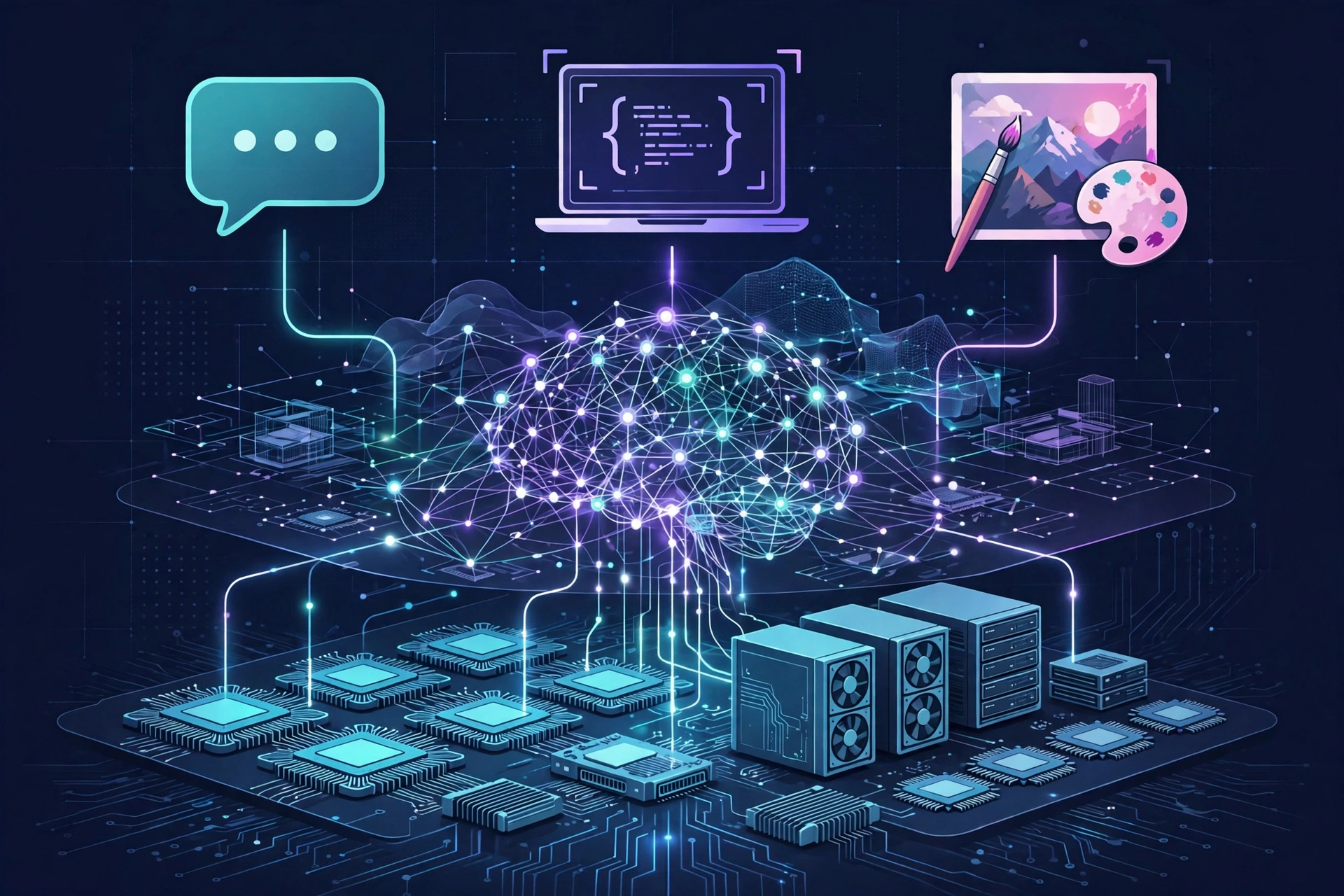
The gen AI ecosystem is the network of hardware, models, platforms, tools, services and rules that together let generative AI be built, run and used. MarketsandMarkets describes it as connected layers rather than a single market centred on model providers: hardware, foundation models, development platforms, governance and security, agentic runtimes, applications, and services. That framing explains why a chip shortage, a chatbot outage and a new regulation can all be “AI news” — each hits a different layer of the same system.
Generative AI itself creates new content — text, images, audio, video or code — based on patterns learned from training data, rather than only classifying or predicting. The ecosystem is everything that makes that creation possible at scale.
The layers of the gen AI ecosystem
The ecosystem is easiest to understand bottom-up, from the physical layer to the app you tap.
| Layer | What it does | Examples |
|---|---|---|
| Infrastructure | Compute, memory, storage, networking | NVIDIA, AMD, Intel; Microsoft Azure, Google Cloud, Amazon Web Services |
| Data | Training data and retrieval stores that ground outputs | Licensed datasets, company documents, vector databases |
| Foundation models | General-purpose models adapted for many tasks | OpenAI, Google, Anthropic, Meta, Mistral AI, Cohere, DeepSeek |
| Development platforms | Tools to build, fine-tune, test and deploy | Microsoft Foundry, Google Vertex AI, Hugging Face, LangChain |
| Agent runtimes | Systems letting AI agents plan and run multi-step work | Agent frameworks and orchestration platforms |
| Governance and security | Risk, policy, access and monitoring controls | Evaluation and observability tools |
| Applications | Finished products for end users | Chatbots, coding assistants, image generators, copilots |
| Services | Strategy, integration and managed operations | Consultancies and systems integrators |
Two connections between layers matter most. First, retrieval-augmented generation (RAG): an app retrieves relevant documents — a manual, a policy, a ticket history — and adds them to the prompt, so the model answers from current, specific facts. IBM describes RAG as the pattern that lets foundation models produce factually correct outputs for topics not in their training data. Second, agents: software that does not just answer, but takes steps using tools and workflows. Menlo Ventures’ 2026 State of Enterprise AI report, surveying nearly 400 US enterprise decision-makers, found agents now generate 80% of tokens on OpenRouter, roughly seven times human-driven usage.
Gen AI ecosystem vs a single AI product: the comparison that matters
A single AI product is one app with one job; the gen AI ecosystem is the whole supply chain behind it. Judging a product means testing what it does; judging the ecosystem means asking whether every layer it depends on is reliable, affordable and lawful. A brilliant model on fragile infrastructure, or a useful app with no governance, is weaker than either part looks alone.
How big is the gen AI ecosystem, and what does it cost to join?
MarketsandMarkets estimates the global generative AI market at USD 185.45 billion in 2026, projected to reach USD 1,658.97 billion by 2033, a compound annual growth rate of 36.8% — with infrastructure taking the largest share of 2026 spending. Treat any single market-size figure as an estimate, not a fact: firms define “generative AI” differently, so totals vary widely. The direction is consistent, though: spending is moving from pilots to production.
For a business, cost splits by layer. Hosted models charge per token, and agents multiply usage because they make many calls per task. Open models can cut per-token fees but add hosting and engineering costs. Menlo Ventures found enterprise AI spending reached USD 176.8 billion in 2026, up 5.4 times from USD 33 billion a year earlier, with 69% of every enterprise AI dollar going to Anthropic, Google and OpenAI. Disclosure: Menlo Ventures is an investor in Anthropic, and its figures are its own survey-based estimates.
What do you need before building on the gen AI ecosystem?
Before picking a model, a team needs four prerequisites. First, data it is allowed to use, cleaned and organised, with a retrieval store if answers must cite company facts. Second, a deployment choice: hosted API, private cloud, or on-premises, each with different cost and data-control trade-offs. Third, evaluation: testing outputs for accuracy, safety and cost before users see them, and after every model update. Fourth, governance: who approves a new model, who sees the data, and what happens when the system is wrong. For individuals, the checklist is simpler: know which app holds your data, whether its outputs are checked, and what it costs once free tiers end. See also our explainers on purpose-built AI and the primary goal of a generative AI model.
What are the risks and limits of the gen AI ecosystem?
Risks concentrate at the seams between layers. Models hallucinate — fluent text that is wrong — and RAG reduces but does not eliminate that, since retrieved documents can be outdated or misread. Concentration is a second risk: if three providers take most enterprise spending, their pricing or outage decisions ripple through every app built on them. Third, high infrastructure costs, data-privacy risks, uncertain returns and evolving regulation can slow adoption, especially in regulated industries — constraints MarketsandMarkets flags explicitly. Regulation also differs by country and is still moving, so a system lawful in one market may need changes in another.
Analysis: consolidating at the top, fragmenting below
Analysis — interpretation, not verified fact. The pattern across sources is a split: money and usage concentrate in a handful of frontier labs, while around them the ecosystem fragments into more chip vendors, open models, agent frameworks and governance startups. That split favours buyers who stay portable — standard interfaces, data retrievable outside any one vendor, and the ability to swap a model without rebuilding the app.
Frequently asked questions
What is the gen AI ecosystem in simple terms?
The gen AI ecosystem is all the parts that make generative AI work: the chips and cloud computers, the data, the foundation models, the tools developers use, the safety and governance controls, and the apps people use. No single company provides all of it, and a problem in any part can affect the rest.
What are the main layers of the gen AI ecosystem?
The main layers are infrastructure, data, foundation models, development platforms, agent runtimes, governance and security, applications, and services. Infrastructure provides the computing power, foundation models provide the intelligence, platforms help developers build, and applications deliver the finished product to users.
Who are the biggest players in the gen AI ecosystem?
At the infrastructure layer, NVIDIA, AMD, Intel and the major cloud providers dominate. At the model layer, OpenAI, Google, Anthropic, Meta, Mistral AI, Cohere and DeepSeek are the most prominent names. Around them sit development platforms like Hugging Face, agent frameworks, governance vendors, and thousands of application companies.
How much does it cost to use the gen AI ecosystem?
Costs depend on the layer. Hosted models usually charge per token, and agent workloads multiply usage because they make many calls per task. Open models can reduce per-token fees but add hosting and engineering costs. Enterprises should budget for evaluation, governance and data work, not just model access.
What is the biggest risk in the gen AI ecosystem?
The biggest risks are unreliable outputs, dependence on a few model providers, high infrastructure costs, and changing regulation. Retrieval-augmented generation helps ground answers in real documents, but it does not remove hallucinations entirely, so outputs still need checking before they are trusted.
Sources
- MarketsandMarkets, Generative AI Market Forecast 2026–2033 (via GlobeNewswire, October 1, 2026) — market size, layer structure, infrastructure share, adoption constraints.
- IBM, Retrieval Augmented Generation (RAG) — how RAG grounds foundation models in retrieved facts.
- Menlo Ventures, 2026 State of Enterprise AI (via GlobeNewswire, November 3, 2026) — enterprise spending, agent token share, market concentration; Menlo is an Anthropic investor.




One Comment
Comments are closed.