Why Was the Great Wall of China Built? A 2026 Historical and Strategic Analysis
The Strategic Imperative: Beyond a Simple Barrier
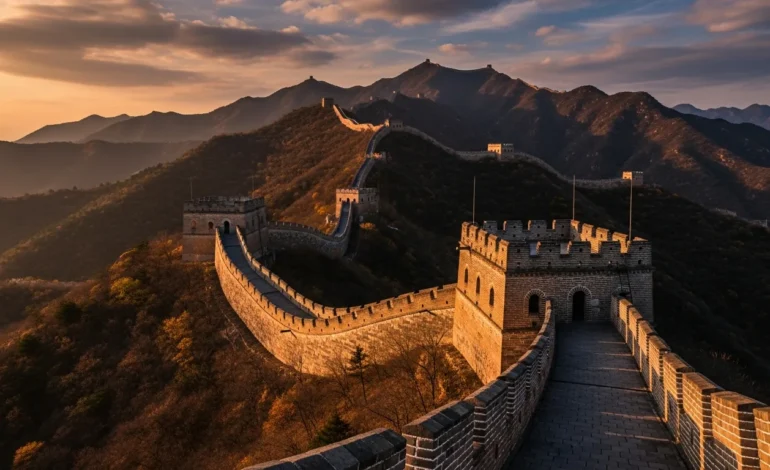
As we navigate the complexities of global security in 2026, the Great Wall of China remains the ultimate historical case study in border defense and national sovereignty. While often viewed through the lens of ancient history, the wall represents a massive, multi-generational investment in infrastructure that mirrors modern debates about national security and territorial integrity. As a National Travel Surge sees 44 million Americans hitting the road this season, many are looking toward international landmarks to understand the roots of modern civilization. The Great Wall was not a single project but a series of fortifications built over two millennia to address evolving geopolitical threats.
The primary reason for the wall’s construction was the persistent threat of invasion from nomadic tribes in the north, particularly the Xiongnu and later the Mongols. Unlike the agrarian society of central China, these nomadic groups were highly mobile and relied on raiding to supplement their resources. The wall served as a physical deterrent that neutralized the advantage of nomadic cavalry, forcing invaders to abandon their horses or engage in prolonged sieges for which they were ill-equipped. This strategic shift allowed the Chinese dynasties to maintain a stable interior economy, fostering the growth of one of the world’s most enduring civilizations.
Regulating the Silk Road and Economic Sovereignty
While defense was the catalyst, the Great Wall also functioned as a sophisticated customs and immigration system. By controlling the mountain passes and trade routes, the Chinese authorities could effectively tax goods entering and exiting the empire. This was particularly crucial for the Silk Road, where high-value commodities like silk, spices, and precious metals were traded. The wall ensured that trade was conducted at designated checkpoints, allowing the state to monitor foreign influence and secure economic revenue. This level of administrative control over trade routes is a precursor to modern customs and border protection agencies.
Furthermore, the wall provided a safe corridor for merchants and travelers. In an era where banditry was a constant threat, the presence of garrisoned troops along the wall offered a level of security that encouraged international commerce. Understanding this economic motivation helps explain why the wall was extended into remote desert regions where a massive invasion was unlikely. Much like how strategic shifts led to why Japan attacked Pearl Harbor to secure resources, the Chinese dynasties used the wall to safeguard their economic lifelines from external disruption.
The Ancient Information Superhighway
One of the most overlooked functions of the Great Wall was its role as a high-speed communication network. The wall featured a sophisticated system of beacon towers placed at regular intervals. By using smoke signals during the day and fire at night, soldiers could transmit warnings of enemy movements across hundreds of miles in a matter of hours. This early warning system allowed the central government to mobilize reinforcements and alert provincial governors long before an invading force reached the heartland. This capability was revolutionary, providing a level of centralized command and control that few other ancient empires could match.
The wall also served as a vital transportation artery. The top of the wall was wide enough in many sections to allow for the rapid movement of troops and supplies across rugged terrain that would otherwise be impassable. This logistical advantage meant that the Chinese military could respond to threats with agility, despite the vast distances involved. The ability to project power across a diverse landscape was a hallmark of Chinese imperial strategy, ensuring that the periphery remained connected to the political center.
A Symbol of Political Unity and Imperial Legacy
Beyond its practical uses, the Great Wall was a powerful tool for political propaganda and national identity. For various dynasties, particularly the Qin and the Ming, the construction of the wall symbolized the unification of China under a single authority. It served as a clear demarcation between the “civilized” agrarian world and the “barbaric” nomadic steppes. This psychological barrier was just as important as the physical one, reinforcing the idea of a unified Chinese state to both its citizens and its enemies. The massive scale of the project was a testament to the Emperor’s power and the state’s ability to mobilize millions of laborers.
This legacy of long-term planning and massive public works has influenced Chinese governance for centuries. The wall represents a commitment to national endurance that transcends individual lifetimes. This historical precedent for strong, centralized leadership and long-term infrastructure goals is similar to the administrative shifts seen when FDR served four terms as President, fundamentally reshaping the American government’s role in national defense and public welfare. Today, the wall stands not just as a ruin, but as a monument to the strategic vision that shaped the modern world.
Frequently Asked Questions
How long did it actually take to build the Great Wall?
The construction of the Great Wall was not a single event but a process that spanned over 2,000 years. It began during the Spring and Autumn period (7th century BC) and continued through the Ming Dynasty (1368–1644). While the most famous sections seen by tourists today were built by the Ming, many earlier walls were constructed of rammed earth and have since eroded, making the total construction time a multi-dynastic effort.
Is the Great Wall of China really visible from space?
Contrary to popular belief, the Great Wall of China is not easily visible from space with the naked eye. NASA has confirmed that from low Earth orbit, the wall is difficult to distinguish because its materials are similar in color and texture to the surrounding terrain. It is generally only visible under perfect atmospheric conditions or with high-powered camera lenses, debunking the common myth that it is the only man-made structure visible from the moon.
What materials were used to build the wall in different regions?
The materials used depended heavily on local resources. In eastern regions, builders used bricks and stone blocks held together with a mortar made of lime and sticky rice flour. In western desert areas, where stone was scarce, the wall was often constructed using rammed earth, willow reeds, and gravel. This adaptability allowed the wall to stretch across diverse landscapes, from high mountains to arid plains.
How many people were involved in the construction of the wall?
Historical estimates suggest that millions of people were involved in the construction over the centuries. This workforce included soldiers, peasants, and convicted criminals. The conditions were notoriously harsh, and it is estimated that hundreds of thousands of workers died during the process due to exhaustion, disease, and the extreme climate. This immense human cost has led some historians to refer to the wall as the longest cemetery on Earth.
Does the Great Wall still serve a purpose in modern China?
Today, the Great Wall serves primarily as a cultural icon and a major driver of tourism, attracting millions of visitors annually. It is a UNESCO World Heritage site and a symbol of Chinese national pride. While it no longer serves a military function, the Chinese government invests heavily in its preservation and restoration to protect it from environmental erosion and urban encroachment, ensuring it remains a vital historical educational tool.