What Were George Washington’s Teeth Made Of? The Truth Behind the Wooden Myth
The Persistent Myth of the Wooden Dentures
As millions of Americans prepare for the historic summer travel season of 2026, many will find themselves walking the grounds of Mount Vernon to honor the legacy of the nation’s first president. One question continues to dominate the curiosity of visitors more than any other: what were George Washington’s teeth actually made of? Despite the popular folklore taught in classrooms for generations, George Washington never wore wooden teeth.
The myth of the wooden dentures likely stems from the stained appearance of the ivory used in his various prosthetic sets. Over time, materials like hippopotamus ivory and bone would become deeply discolored by the president’s preference for dark tea and port, taking on a grainy, wood-like texture. In an era where the FDA is approving revolutionary gene therapies to restore vision, it is humbling to look back at the primitive and painful medical struggles of our first Commander-in-Chief.
Understanding the reality of Washington’s dental health provides a more humanized view of the man. His lifelong battle with tooth loss was not a result of poor hygiene alone, but rather the medical practices of the time, including the use of mercury-based medicines like calomel. This struggle highlights the physical toll of leadership, much like understanding the impact of long-term executive service on the American presidency throughout different eras of our history.
The Real Materials: A Gruesome 18th-Century Reality
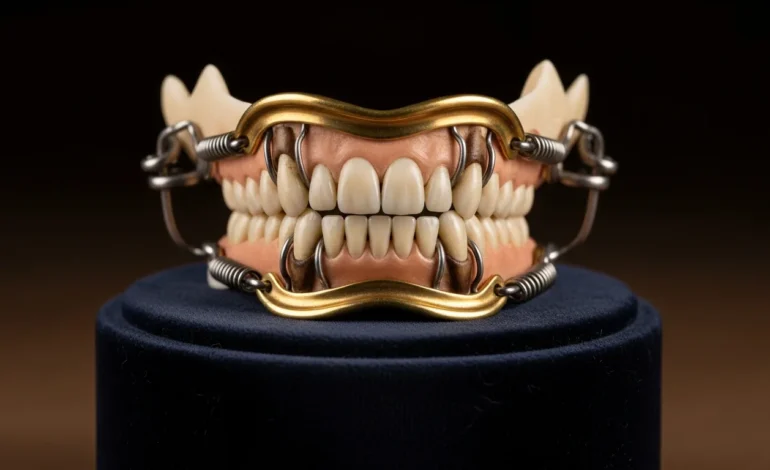
George Washington’s dentures were complex, multi-material apparatuses that represented the pinnacle of 18th-century technology. Far from simple wood, his most famous sets were constructed from a combination of human teeth, animal ivory, and metal alloys. Specifically, dentists used hippopotamus ivory, elephant ivory, and even cow teeth to carve the base and the replacement molars.
The use of human teeth was a common, albeit unsettling, practice in the late 1700s. These teeth were often sourced from the poor or, in Washington’s specific case, purchased from enslaved individuals at Mount Vernon. The teeth were fitted into a framework of lead or gold and held together by heavy steel springs that allowed the wearer to open and close their mouth.
- Hippopotamus Ivory: Used for the base plates due to its density and relative durability.
- Human Teeth: Sourced for the front incisors to provide a more “natural” appearance.
- Gold and Lead: Used for the structural chassis and weighting of the lower jaw.
- Steel Springs: These provided the tension necessary to keep the dentures from falling out.
The Role of Enslaved People in Washington’s Dental Care
Modern historical research conducted at Mount Vernon has brought a more somber light to the provenance of Washington’s dental materials. Ledger entries from 1784 show that Washington paid several enslaved workers for their teeth, which were then used in his prosthetics. While this was a financial transaction, the power dynamics of the era make it a significant point of study for historians today.
This reality adds a layer of complexity to the Father of His Country. It reminds us that the foundations of the United States were built on the contributions—both voluntary and involuntary—of a diverse and often marginalized population. Just as Americans today look for meaning in national symbols, such as understanding why flags are at half-mast during times of national mourning, we must also examine the physical realities of the people who shaped our early government.
How Dental Pain Shaped the American Presidency
Washington’s dental issues were more than a cosmetic concern; they were a source of chronic, debilitating pain. By the time of his first inauguration in 1789, he had only one natural tooth remaining in his mouth. The dentures of the time were notoriously ill-fitting, often rubbing against the gums and causing sores that never fully healed.
This physical discomfort directly influenced Washington’s public persona. The heavy springs required him to constantly clench his jaw to keep the teeth in place, which resulted in the stern, tight-lipped expression seen in his most famous portraits. It also made public speaking an agonizing task, contributing to his reputation for being a man of few words and making his inaugural addresses notably brief.
Modern Science and the Preservation of the Mount Vernon Dentures
Today, only one complete set of Washington’s dentures remains, and it is housed at the Mount Vernon estate. In recent years, laser scans and chemical analysis have confirmed that no wood fibers were ever present in any of the surviving fragments. These scientific advancements allow us to debunk myths while preserving the genuine artifacts of the Revolutionary era.
Preserving these items requires strict climate control and specialized lighting to prevent the ivory from further deteriorating. For the modern student of history, these dentures serve as a bridge to the past, illustrating the immense personal sacrifices made by those who founded the republic. They remind us that even the most legendary figures were subject to the same physical frailties and medical limitations as any other citizen of their time.
Frequently Asked Questions
Who was George Washington’s primary dentist?
Dr. John Greenwood was Washington’s most trusted dentist and the craftsman behind his most successful sets of dentures. Based in New York City, Greenwood was a pioneer in the field and even carved a hole in one set of dentures to accommodate Washington’s last remaining natural tooth. Their correspondence reveals a professional relationship built on the president’s desperate need for relief from constant dental discomfort.
How many real teeth did Washington have when he was inaugurated?
When George Washington took the oath of office as the first President of the United States in 1789, he had only one natural tooth left. This final tooth eventually fell out, and he famously gave it to Dr. John Greenwood as a keepsake. Greenwood kept the tooth in a glass-topped locket, which is now part of the collection at the National Museum of Dentistry.
Did the dentures affect his ability to speak or eat?
Yes, the dentures significantly hampered Washington’s ability to eat and speak. The steel springs were so strong that he had to exert constant pressure to keep his mouth closed, which made clear articulation difficult. Eating was also a challenge, as the ivory bases did not provide the same grinding power as natural teeth, often restricting him to softer foods during formal state dinners.
How were the dentures held together?
The upper and lower plates were connected by coiled steel springs. These springs pushed against both the roof and the floor of the mouth to keep the dentures in place. Because there was no suction or modern adhesive, the president had to rely entirely on the tension of these springs and the strength of his jaw muscles to prevent the prosthetics from popping out of his mouth unexpectedly.
Where can you see Washington’s teeth today?
The only surviving full set of George Washington’s dentures is on display at the Donald W. Reynolds Museum and Education Center at Mount Vernon in Virginia. Other fragments and individual teeth are held by the National Museum of American History at the Smithsonian Institution and the National Museum of Dentistry in Baltimore, providing a comprehensive look at 18th-century prosthetic technology.