End-to-End Process Automation: What It Is and How Businesses Use It
End-to-End Process Automation: What It Is and How Businesses Use It
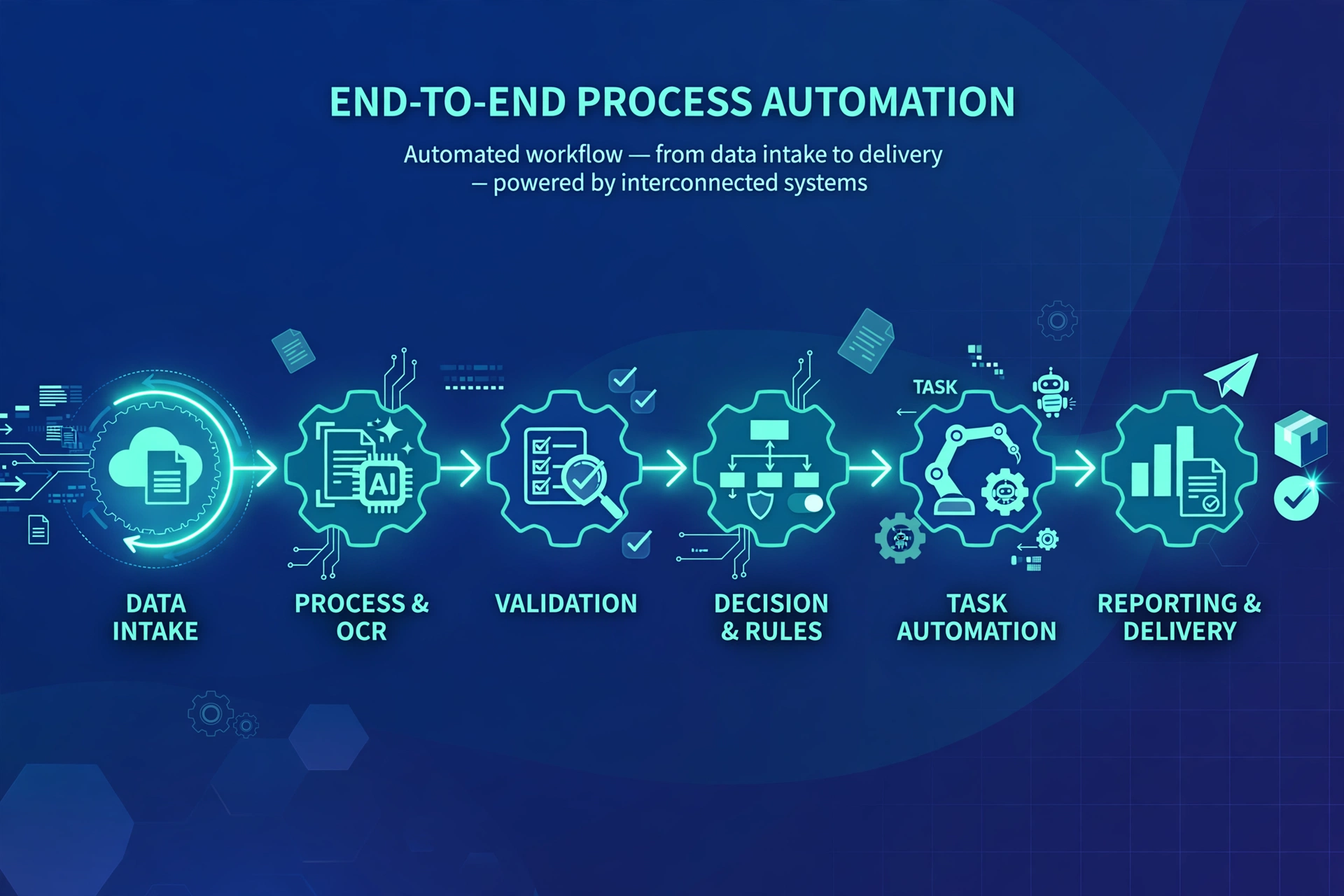
Key takeaway: End-to-end process automation uses software to run an entire business workflow from start to finish — no manual handoffs between steps. Instead of automating single tasks, it connects every stage of a process, from order intake to delivery, cutting errors and cycle times. Companies use it to cut costs, speed up service, and free staff for higher-value work.
Most businesses don’t suffer from one broken task — they suffer from broken handoffs. A sales rep enters an order, finance re-keys it into an invoice, the warehouse ships it, and support answers the follow-up call. Each step works. The gaps between them don’t. End-to-end process automation is the practice of automating the whole chain, not just the links.
What end-to-end process automation means
End-to-end process automation involves “leveraging software applications to streamline entire business processes, automating tasks from start to finish,” as process orchestration company Camunda explains in its process automation guide. Rather than scripting one repetitive task, it links systems, data, and people across a full workflow — intake, approvals, execution, and follow-up — so information flows without manual re-entry.
A classic example: a customer order triggers inventory checks, invoice creation, payment processing, warehouse picking, shipping labels, and a confirmation email — all automatically, with humans stepping in only for exceptions like failed payments. Every stage talks to the next one.
End-to-end process automation vs. RPA
This is where many teams get confused. Robotic process automation (RPA) — software bots that mimic clicks and keystrokes — is a tool within end-to-end automation, not the same thing. As Capacity’s automation guide puts it, business process automation “refers to the end-to-end automation of complex, multi-step workflows, often involving AI, integrations and decision logic across multiple systems,” while RPA bots handle the repetitive, structured tasks inside it.
In short: RPA automates the task; end-to-end automation automates the process. A company that only deploys bots on disconnected steps still has the handoff problem. Companies that orchestrate the whole flow eliminate it.
Why businesses are adopting it now
The numbers explain the momentum. The digital process automation market reached $16.52 billion in 2025 and is projected to hit $52.68 billion by 2035, growing at 12.3% annually, according to Market Research Future. McKinsey’s global survey found that 66% of organizations have experimented with business process automation in at least one function, and more than 80% plan to maintain or increase their automation investment (Gartner data, via Shno’s 2026 automation statistics roundup).
The financial case is unusually well-documented. Forrester’s Total Economic Impact study found that a composite enterprise deploying Microsoft Power Automate achieved a 248% three-year ROI, with payback measured in months. Automating accounts payable cuts the cost per invoice from $12.44 for manual processors to $4.98 — a 60% saving. And IDC data shows that 20–30% of annual revenue evaporates through re-keying, duplicated effort, and lost approvals in organizations that haven’t automated core workflows.
Real-world examples across industries
- Order-to-cash: A deal closing in the CRM automatically creates the invoice, checks stock, processes payment, and updates the ledger — the whole revenue cycle with no re-typing.
- Employee onboarding: A signed offer letter triggers account creation, hardware provisioning, payroll setup, and a training schedule across HR, IT, and finance systems.
- Healthcare admin: Patient scheduling, insurance verification, billing, and follow-up reminders run as one flow. For a deeper look at the healthcare angle, see our guide to business process automation in healthcare.
- Customer support: Tickets get auto-classified, routed, enriched with customer history, and resolved by AI agents or humans — with summaries and follow-ups logged automatically.
How businesses get started (the practical angle)
End-to-end automation works best when teams follow a few practical steps:
- Map the process first. Draw the full workflow as it actually runs — every handoff, approval, and system. Automating a broken process just makes bad things happen faster.
- Start with one high-volume, rule-based process. Invoice processing, order handling, or onboarding are common first wins.
- Pick tools that orchestrate, not just bots. You need integrations, APIs, and decision logic — not only screen-scraping bots. If you’re comparing bot options, our piece on robotic process automation webinars is a good primer on what’s available.
- Build in exception handling. Real processes break — bad addresses, failed payments, missing approvals. The automation should route exceptions to humans, not silently stall.
- Measure before and after. Track cycle time, error rate, and cost per transaction so the ROI is provable.
Analysis (our take): End-to-end automation is crossing into the mainstream in 2026, and the differentiator is shifting from whether to automate toward what layer does the orchestration. Task-level bots remain useful, but the documented ROI increasingly belongs to platforms that tie the whole flow together with integrations and AI decision-making. The biggest failure mode we keep seeing in vendor case studies isn’t the technology — it’s teams automating a process nobody mapped, then discovering the exceptions they never planned for.
Frequently asked questions
What is end-to-end process automation in simple terms?
It’s the use of software to run a complete business process from beginning to end without manual handoffs. Instead of automating one task, it connects every step — for example, from a customer placing an order to the invoice, shipment, and confirmation email — so work flows automatically between systems and teams.
How is end-to-end process automation different from RPA?
RPA is a single tool inside the bigger picture: software bots that mimic human clicks and keystrokes on individual repetitive tasks. End-to-end process automation is the broader strategy of orchestrating the entire multi-step workflow, using RPA bots, integrations, APIs, and AI decision-making together across all stages.
What are the benefits of end-to-end process automation?
The main benefits are lower operating costs, fewer errors, faster cycle times, and better visibility into how work flows. Documented results include a 248% three-year ROI on automation platforms (Forrester), 60% lower cost per invoice in accounts payable, and staff freed from re-keying data to focus on higher-value work.
What are some real examples of end-to-end process automation?
Common examples include order-to-cash (order to invoice to shipment), employee onboarding across HR/IT/finance systems, healthcare patient scheduling and billing flows, and customer support pipelines that classify, route, and resolve tickets automatically. Any high-volume, repeatable workflow is a candidate.
How should a business get started with end-to-end process automation?
Start by mapping one high-volume, rule-based process as it actually runs today, including every handoff and exception. Choose tools that orchestrate across systems (integrations and APIs, not just bots), build in human handling for exceptions, and measure cycle time and cost before and after so the return is clear.
Sources: Camunda — Process Automation: Examples and Benefits · Capacity — Business Process Automation Guide · FlowHunt — Business Process Automation · Market Research Future — Digital Process Automation Market · Shno — Workflow Automation Statistics 2026