What Is Smart Targeting? How AI Matches Ads to the People Most Likely to Care
Key takeaway: Smart targeting is a marketing technique that uses artificial intelligence to predict what individual website visitors are interested in, then shows them the most relevant content or ads. Instead of showing everyone the same message, it tailors what each person sees based on their behaviour, device, location, and stage in the buying journey.
Ever searched for a pair of running shoes, then seen ads for them on unrelated websites for days? Or logged into a site and been greeted by name, with recommendations matching your last purchase? That is smart targeting at work — one of the quiet engines behind modern digital advertising.
What is smart targeting?
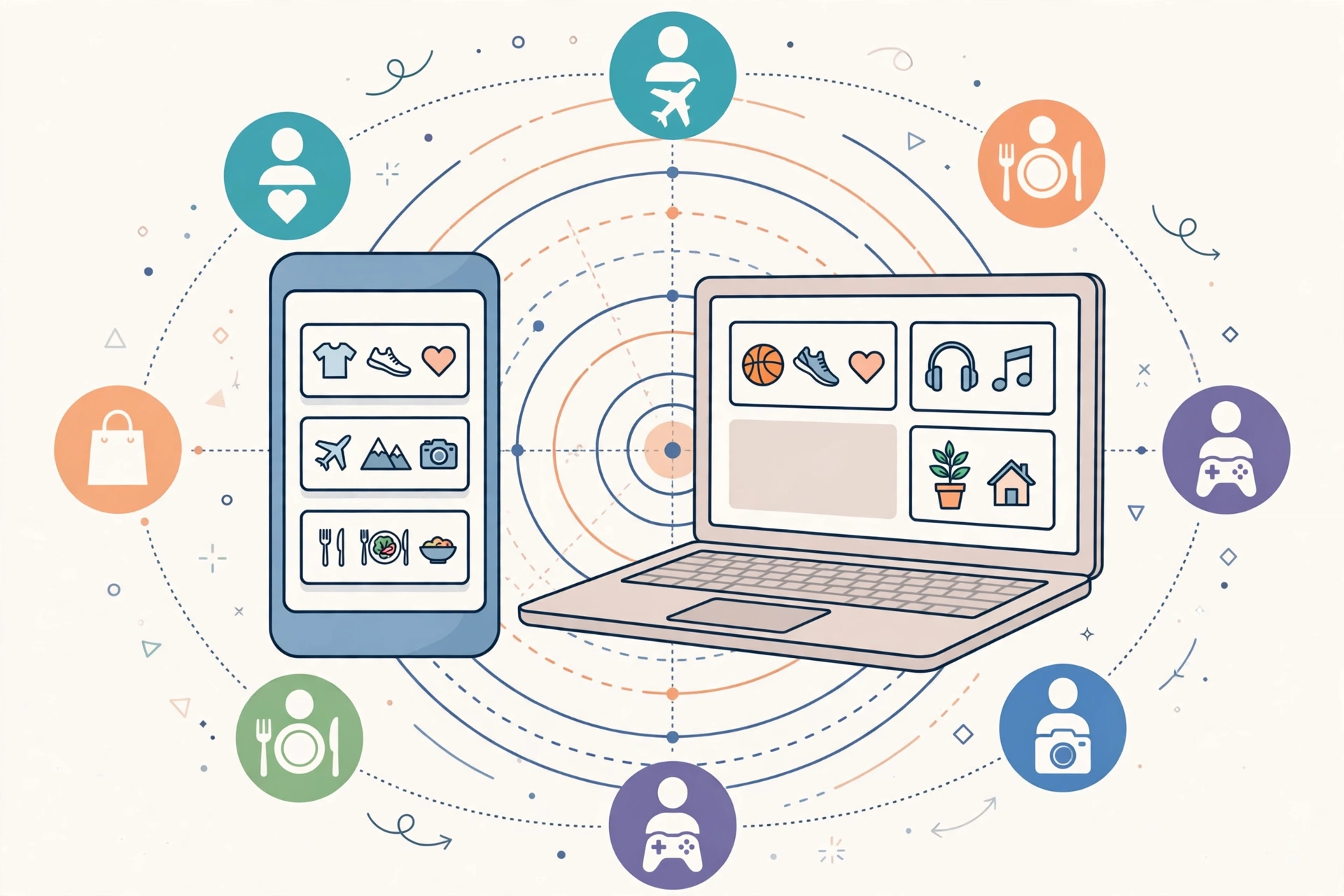
Smart targeting is the use of artificial intelligence (AI) software to predict the preferences and habits of internet users, then deliver content or advertising matched to those predictions. The system collects signals about a visitor — what they searched for, which pages they viewed, what device they use, where they are located — and uses that information to decide what to show them next.
As one guide to the technique puts it, smart targeting uses AI to track people’s interests as they browse, so companies can predict what consumers might want and adjust their marketing accordingly (Metadata.io). The goal is simple: show the right message to the right person at the right time, instead of broadcasting the same ad to everyone.
That personalisation goes beyond ads. A site might show a different homepage to a mobile visitor than to a desktop visitor, or offer a translation based on browser language. These are smart-targeting rules: criteria such as device type, referral source, language, and lifecycle stage deciding which version of a page a visitor sees.
How smart targeting works
Smart targeting typically follows four steps:
- Collect signals. The system gathers data from browsing behaviour, searches, clicks, purchases, and on-site actions.
- Build a profile. Those signals are analysed to identify patterns and group visitors with similar interests.
- Predict intent. AI models estimate what each visitor is likely to want next, from a product category to a piece of content.
- Serve the match. The visitor sees tailored ads, recommendations, or page content — and the system learns from whether they engage.
Marketers can also build an ideal customer profile from the traits of existing customers, then use smart targeting to find new people who closely fit it — wasting less ad spend on people who were never going to be interested.
Smart targeting vs behavioural and contextual targeting
Smart targeting is often confused with two related techniques. The distinction matters, because each uses different data and carries different privacy trade-offs. The core difference, as Avenga’s guide explains, is focus: behavioural targeting focuses on the user, while contextual targeting focuses on the environment where the ad appears. Smart targeting sits across both, using AI to combine behavioural data, contextual signals, and rule-based personalisation.
| Approach | What it is based on | Example | Privacy note |
|---|---|---|---|
| Behavioural targeting | The user’s past online behaviour: browsing history, searches, clicks, purchases | Running shoe ads follow you across sites after you searched for trainers | Needs user data and consent management, especially around cookies |
| Contextual targeting | The content of the page being viewed: keywords, topics, categories | Running shoe ads on an article about marathon training | Uses little or no personal data, since it targets the page, not the person |
| Smart targeting | AI prediction combining behavioural signals, context, device, and other rules | A returning visitor sees personalised recommendations and a greeting by name | Depends on the data it uses; AI prediction does not remove consent duties |
Why marketers use it — and where the limits are
The case for smart targeting is efficiency: ads shown to people who have already shown interest convert better than ads shown to everyone. A Network Advertising Initiative study cited in industry guides found behaviourally targeted ads generated a conversion rate 6.8 times higher than non-targeted run-of-network ads (Advergize). Google Ads builds this idea into its own tools: its targeting expansion feature uses smart targeting to find additional customers likely to convert (The Creative Momentum).
But there are real limits. First, privacy rules have tightened: behavioural targeting generally requires consent under laws like the GDPR, and the decline of third-party cookies has pushed many advertisers back toward contextual signals, which need no personal tracking history. Second, prediction is not understanding — a person who searched for a gift once is not necessarily a repeat buyer, and over-targeting can feel intrusive enough to damage the brand it is meant to help.
Analysis: the sensible direction for most businesses is a mix, not a single method. Use contextual targeting for awareness, behavioural and smart targeting where you have consent and a clear conversion goal, and rule-based personalisation on your own site, where the data is first-party and the value to the visitor is obvious.
How to use smart targeting without crossing the line
- Start with your own data. On-site behaviour, email engagement, and purchase history are more reliable — and more defensible — than bought third-party profiles.
- Get consent properly. Clear cookie and tracking notices are not optional extras under privacy law; they are the licence to target at all.
- Cap frequency. The same ad twenty times is not targeting, it is harassment. Frequency caps protect both the user and your budget.
- Test and measure. Compare targeted segments against an untargeted baseline so you know the lift is real, not assumed.
- Keep a contextual fallback. When consent or identifiers are missing, relevant page context still delivers useful reach without personal data.
For a related look at how AI spots patterns in audience behaviour, see our explainers on AI trend analysis and how direct sellers use AI to find and follow up with prospects.
Sources
- Metadata.io — A Simple Guide to Smart Targeting
- Avenga — What Is Behavioral Targeting?
- Advergize — What Is Behavioral Targeting?
- The Creative Momentum — How to Target Ads in a PPC Campaign
- Techtonic Marketing — Contextual vs Behavioral Advertising
Frequently asked questions
What is smart targeting in simple terms?
Smart targeting is AI-powered marketing that predicts what a website visitor is interested in and shows them matching content or ads. Instead of everyone seeing the same message, each person sees the version most relevant to their behaviour, device, and interests.
How does smart targeting work?
It collects signals such as searches, page views, clicks, and purchases, groups visitors with similar patterns, and uses AI to predict what each visitor wants next. It then serves tailored ads or page content and learns from whether the visitor engages with it.
What is the difference between smart targeting and behavioural targeting?
Behavioural targeting shows ads based on a user’s past online activity, while smart targeting is broader: it combines behavioural signals with contextual signals and rules such as device type, language, and lifecycle stage, using AI to decide the best match for each visitor.
Is smart targeting legal, and does it respect privacy?
It can be legal, but it depends on consent and data handling. Behavioural data generally requires user consent under laws like the GDPR, and the decline of third-party cookies is pushing advertisers toward contextual targeting, which uses little or no personal data.
Should a small business use smart targeting?
Yes, if it starts small: use first-party data from your own website and email list, set clear consent notices, cap ad frequency, and measure results against an untargeted baseline. That approach captures most of the benefit without the cost or privacy risk of large third-party data buys.