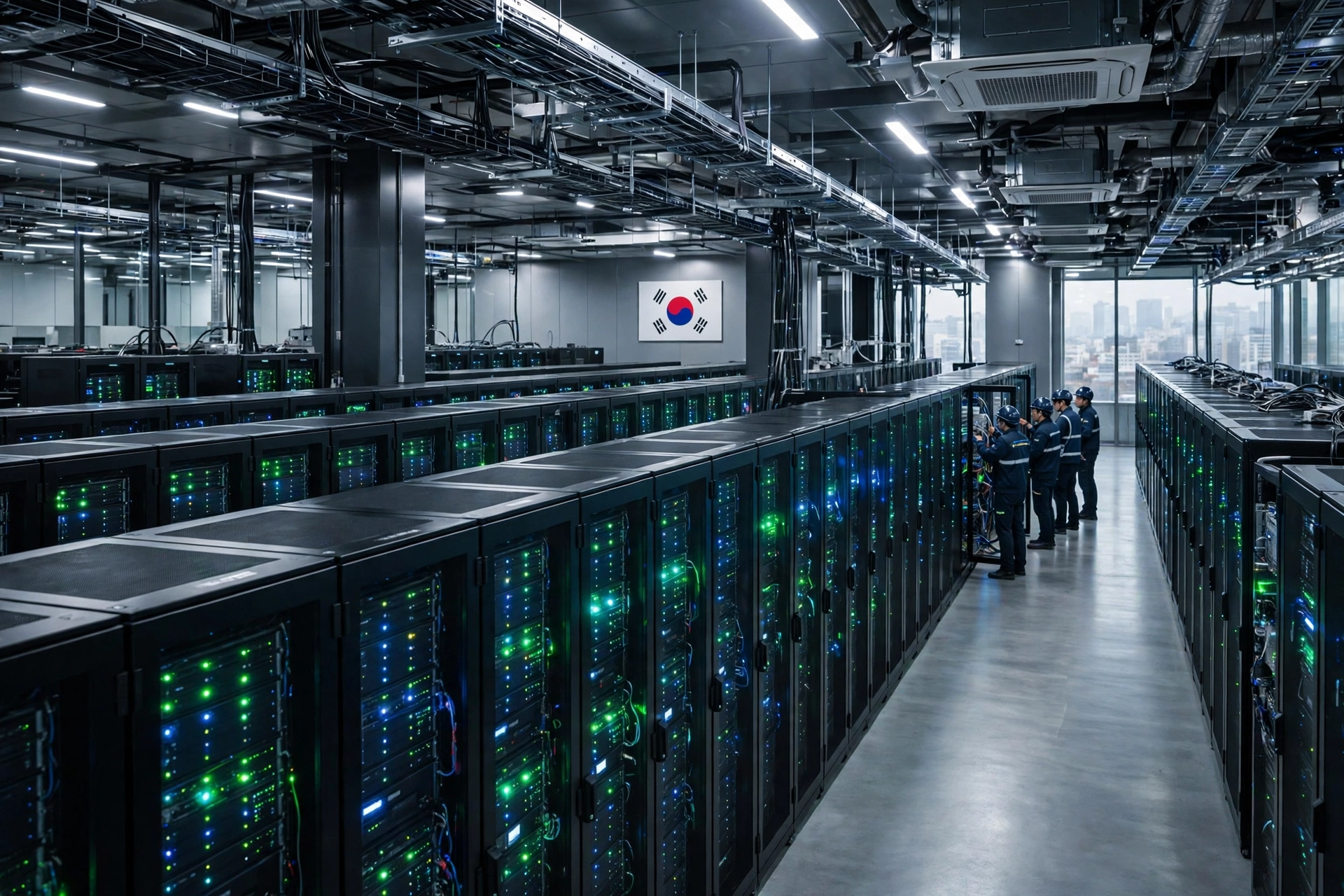
NVIDIA, Rebellions and SK Telecom Team Up on Korea’s Sovereign AI: Mixed GPU-NPU Racks Coming in 2028
Key takeaway: NVIDIA, Rebellions and SK Telecom announced a sovereign AI partnership on November 9, 2026, at AI Day Seoul. Under a memorandum of understanding, Rebellions’ next-generation Rebel R200 AI chips will connect to NVIDIA’s platform through NVLink Fusion and run inside SK Telecom’s data centres, with the first mixed GPU-NPU systems expected in 2028.
What was announced
NVIDIA, Korean AI chip startup Rebellions and SK Telecom signed a trilateral memorandum of understanding on Monday, November 9, 2026, to build a heterogeneous AI computing system for South Korea. The signing took place on the margins of AI Day Seoul, a two-day NVIDIA event in southern Seoul, with support from South Korea’s Ministry of Science and ICT (MSIT).
Under the deal, Rebellions will connect its next-generation Rebel R200 neural processing units (NPUs) to NVIDIA’s open infrastructure platform using NVLink Fusion, and build rack-scale systems on NVIDIA’s MGX architecture. SK Telecom plans to deploy those systems in its AI data centres, linking them to its own models and public services under Korea’s “AI for All” project. The R200 systems are expected to be ready for deployment in 2028.
“Korea is a technology leader, and with AI being one of the fastest growing technologies that has ever happened … this collaboration we are working on together, we believe, can help accelerate innovation in Korea,” said Jesse Clayton, NVIDIA’s principal manager for AI infrastructure, according to Yonhap.
How the mixed GPU-NPU racks will work
The core idea is disaggregated inference: splitting the work of generating an AI response across the processor best suited to each stage. In the planned setup, NVIDIA GPUs handle the “prefill” stage — processing the prompt — while Rebellions NPUs handle “decode”, the step-by-step generation of the answer. The goal is higher inference throughput and better power efficiency than running everything on one type of chip.
That is the practical difference from a GPU-only data centre. GPUs are general-purpose workhorses; NPUs are specialised for inference, the day-to-day running of trained models. NVLink Fusion is the bridge: it lets chip designers plug their own processors directly into NVIDIA’s rack-scale infrastructure and use its high-bandwidth, low-latency networking. The MGX architecture supplies the shared rack footprint, power delivery and cooling, so GPU and NPU systems can sit in the same racks. The bet is that purpose-built inference chips can do the decode stage cheaper and cooler — a trade-off that only pays off if the two chip types work together smoothly at rack scale, which is what the 2028 timeline is meant to prove.
What it costs — and what it could save
No prices, budgets or purchase volumes were published, so there is no hard cost figure to quote. The commercial aim is explicit, though: Korean reporting says SK Telecom will pilot the split setup to cut per-token costs — the unit cost of generating each AI response. That matters because inference, not training, is now the recurring cost of running AI services. Whether the savings materialise depends on real throughput and power numbers that will only emerge once the systems are built.
The software side: Korean models on NVIDIA’s stack
The hardware deal sits inside a broader NVIDIA–MSIT collaboration covering chips, data centres, models, skills and agent security. NVIDIA is working with three selected consortia and four Korean foundation-model builders, using its Dynamo inference-serving framework to optimise and scale inference. Deployment recipes have been released for four Korean open models: SK Telecom’s A.X K2, LG AI Research’s K-EXAONE 2.0, Upstage’s Solar Open 2 and Motif Technologies’ Motif-3. NVIDIA reports the recipes, optimised for its B200 GPUs, deliver up to twice the out-of-the-box performance — a vendor claim, not an independent benchmark.
Agent security joins the deal
The announcement also covers AI agent security. Hyundai Motor Group is exploring NVIDIA’s NemoClaw blueprints and the OpenShell runtime, while Korean security company AIM Intelligence is integrating its Starfort agent-control platform with OpenShell for employee-productivity and enterprise-workflow agents. OpenShell provides sandboxed execution and policy-based controls for sensitive data, tool access and autonomous agent actions.
Knowns, unknowns, and what to watch
Known: the three companies signed an MOU on November 9, 2026; the R200 connects via NVLink Fusion on MGX racks; SK Telecom will deploy the systems; model-serving recipes for four Korean models are already out; deployment is targeted for 2028.
Unknown: the performance and per-token cost of the mixed racks, since no benchmarks were published; the scale of SK Telecom’s deployment; and whether the collaboration extends to other Korean NPU makers — MSIT described it as the start of broader work between NVIDIA and Korean NPU companies.
What to watch: Rebellions’ R200 milestones through 2027, SK Telecom’s pilot results, and whether other Korean chipmakers sign similar NVLink Fusion deals. The deal is also a test case for sovereign AI: a country pairing its own silicon with a global platform rather than choosing one or the other.
Analysis: a template for sovereign AI, not just a chip deal
Analysis — this section is our take, not a reported fact. Sovereign AI usually means a country building its own stack from scratch, which is slow and expensive. This deal sketches a faster route: keep the global platform (NVIDIA’s interconnect and rack designs) and plug domestic silicon into it, so Korean chips gain a ready-made ecosystem and NVIDIA gains a foothold in Korea’s national AI build-out. If the 2028 systems deliver the promised per-token savings, expect other countries with domestic chip ambitions to copy the pattern. The risk is execution: an MOU is not a purchase order, and two years of integration work stand between the signing and a working rack.
Frequently asked questions
What did NVIDIA, Rebellions and SK Telecom announce?
On November 9, 2026, the three companies signed a memorandum of understanding to build a heterogeneous AI computing system for South Korea. Rebellions’ Rebel R200 NPUs will connect to NVIDIA’s platform through NVLink Fusion, and SK Telecom will deploy the resulting rack-scale systems in its AI data centres, with deployment expected in 2028.
What is NVLink Fusion and why does it matter?
NVLink Fusion is NVIDIA’s programme that lets hyperscalers and custom chip designers integrate their own AI processors directly into NVIDIA’s rack-scale infrastructure. It matters because it allows specialised chips like Rebellions’ R200 to use NVIDIA’s high-bandwidth networking and established ecosystem instead of requiring a separate, incompatible platform.
When will the mixed GPU-NPU systems be ready?
The companies say Rebellions’ R200 systems are expected to be ready for deployment in 2028. SK Telecom plans to verify performance and stability at its AI data centres first, then assess commercialisation, so the 2028 date is a target rather than a firm delivery commitment.
What is sovereign AI?
Sovereign AI means a country building AI capability — chips, models, data centres and services — that reflects its own language, industries and priorities, rather than relying entirely on foreign technology. In this deal, Korea pairs its own NPU designs and Korean-language models with NVIDIA’s platform, under a project supported by its Ministry of Science and ICT.
Which Korean AI models are part of the collaboration?
Four Korean foundation models have deployment recipes in the collaboration: SK Telecom’s A.X K2, LG AI Research’s K-EXAONE 2.0, Upstage’s Solar Open 2 and Motif Technologies’ Motif-3. NVIDIA says the recipes, optimised for its B200 GPUs, deliver up to twice the out-of-the-box performance.
Sources
- NVIDIA, Rebellions and SK Telecom Announce Collaboration to Advance Sovereign AI Infrastructure With NVIDIA NVLink Fusion — GlobeNewswire, November 9, 2026
- Nvidia, SKT, Rebellions to jointly establish heterogeneous computing system for AI — Yonhap News Agency, November 9, 2026
- NVIDIA Deepens Korean Sovereign AI Work on Chips and Rack Systems — Unite.AI, November 9, 2026
- Nvidia, SK Telecom, Rebellions team up to cut AI token costs and make Korea exporter — ChosunBiz, November 9, 2026
Related reading on USABite: Factory AI Applications in Manufacturing 2026 and Generative AI IoT Explained cover how AI hardware is moving into real-world systems, and Anthropic’s IPO plans show how much capital is flowing into AI infrastructure.