UN Human Rights Chief Warns of ‘Terrifying’ Escalation Against Rohingya in Myanmar
BANGKOK — In a major development that could reshape the regional landscape, the United Nations has issued a dire warning regarding the “terrifying” escalation of violence against the Rohingya minority in Myanmar.
United Nations High Commissioner for Human Rights Volker Türk stated on Thursday that the situation in Rakhine State has reached a catastrophic breaking point, with civilians caught in the crossfire of an intensifying civil war.
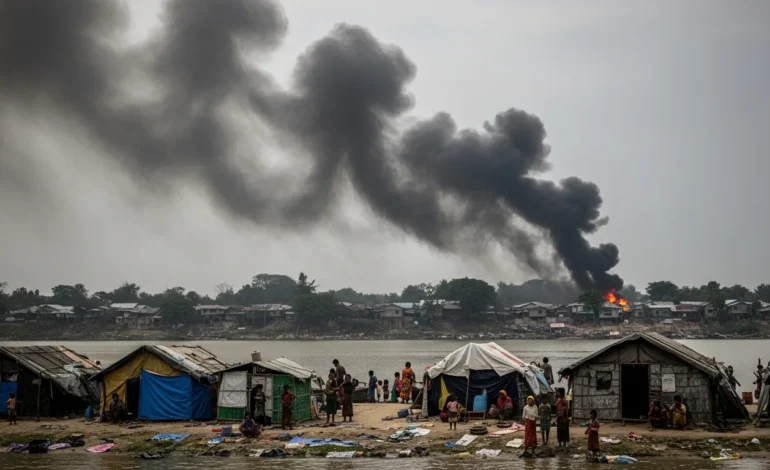
Reports from the ground indicate that thousands of Rohingya are currently fleeing their homes as the military junta and the Arakan Army, a powerful ethnic armed group, engage in scorched-earth tactics across the region.
The High Commissioner highlighted the “grave risk” of a repeat of the 2017 atrocities, which the international community has widely characterized as a genocidal campaign.
A Regional Crisis at a Breaking Point
The current surge in violence is centered in the townships of Buthidaung and Maungdaw, where satellite imagery and eyewitness accounts confirm that entire neighborhoods have been razed to the ground.
The pressure on international legal institutions to intervene is mounting, echoing the urgency seen when the UN’s top court ordered an immediate cessation of military operations in Rafah to protect civilian life earlier this year.
Türk noted that the military junta is allegedly using “divide and rule” tactics, forcibly conscripting Rohingya men to fight against the Arakan Army, a move that exacerbates ethnic tensions and places the minority in direct peril.
The UN human rights office has received reports of extrajudicial killings, mass arbitrary arrests, and the systematic denial of humanitarian aid to those displaced by the fighting.
- Over 200,000 people have been displaced in Rakhine State since the beginning of 2026.
- Communication blackouts have hindered the documentation of human rights abuses in rural areas.
- The Arakan Army now controls significant portions of the state, leaving the military junta in a desperate defensive position.
- International observers warn of a looming famine as agricultural cycles are disrupted by the conflict.
Geopolitical Implications and International Inaction
The shifting dynamics in Southeast Asia are also being influenced by broader geopolitical maneuvers that have left the region in a state of flux.
Observers point to the fact that regional stability is being tested by shifting U.S. priorities, such as when President Trump halted a $14 billion arms sale to Taiwan in an effort to stabilize relations with Beijing, potentially emboldening autocratic regimes in the area.
The Association of Southeast Asian Nations (ASEAN) remains deeply divided on how to address the Myanmar crisis, with its five-point consensus plan largely ignored by the military leadership in Naypyidaw.
Türk urged the UN Security Council to take decisive action, including a global arms embargo and a referral to the International Criminal Court.
Without immediate international intervention, the UN warns that the Rohingya face an existential threat that could destabilize the entire Indo-Pacific corridor.
Frequently Asked Questions
What is the current situation in Rakhine State?
Rakhine State is currently experiencing an intense escalation of fighting between the Myanmar military junta and the Arakan Army. This conflict has resulted in the mass displacement of civilians, particularly the Rohingya minority, and the widespread destruction of property.
Why is the UN calling the situation “terrifying”?
The UN Human Rights Chief used the term to describe the targeted attacks on civilians, the use of arson to destroy entire towns, and the forced conscription of the Rohingya, which mirrors the lead-up to the 2017 genocide.
How many people have been displaced?
While exact numbers are difficult to verify due to communication blackouts, the UN estimates that hundreds of thousands have been forced from their homes in 2026 alone, with many attempting to cross the border into Bangladesh.
What is the international community doing?
While the UN and various human rights organizations are calling for sanctions and arms embargos, the international response remains fragmented. Some nations are pushing for ICC intervention, while others prioritize regional diplomatic stability.