Utility Company Automation Explained: How Power, Water, and Gas Utilities Run Smarter
Key takeaway: Utility company automation uses sensors, smart meters, and control software to run power, water, and gas networks with far less manual work. Instead of waiting for a customer to phone in an outage or a crew to read a meter, the system detects faults, reroutes supply, and flags leaks on its own — cutting outage time, losses, and operating costs.
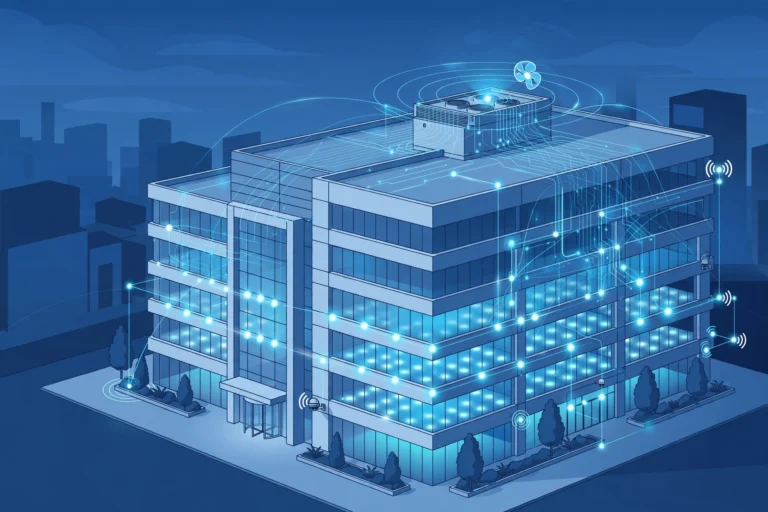
When the lights stay on through a storm, or a water leak is fixed before a street floods, automation is usually the reason. Utility company automation is the umbrella term for the sensors, communications networks, and control systems that let electric, water, and gas utilities monitor their networks in real time and act without waiting for a human to notice a problem.
What utility company automation actually covers
Utility company automation is not one product. It is a stack of systems that work together:
- SCADA (Supervisory Control and Data Acquisition): the control-room software that watches substations, pumping stations, and pipelines, and lets operators open or close equipment remotely.
- AMI (Advanced Metering Infrastructure): smart meters plus the communications network and data systems behind them, giving two-way communication between the utility and each customer.
- Distribution automation: smart switches, reclosers, and sensors on power lines that isolate faults automatically.
- ADMS (Advanced Distribution Management Systems): software that combines SCADA, outage, and network data into one operating picture, including FLISR — fault location, isolation, and service restoration — which automatically reconfigures feeders to keep the smallest possible number of customers off supply.
- Predictive maintenance: analytics on sensor data that warn of failing transformers, pumps, or pipes before they break.
For water and gas utilities, the same pattern applies: pressure and flow sensors, automated valves, and acoustic leak detection replace manual inspection rounds. A gas network can spot a pressure drop and isolate a section; a water utility can compare inflow against billed consumption to find losses.
How utility company automation works day to day
A typical automated response runs in four steps. First, sensors and smart meters stream measurements — voltage, current, pressure, flow — to the control room. Second, software compares those readings against normal ranges and flags anomalies. Third, automated controls act: a recloser tries to clear a momentary fault, a FLISR routine reroutes power around a damaged line section, or a valve closes on a suspected leak. Fourth, crews receive a precise location and diagnosis instead of a vague “power out somewhere” report.
The U.S. Department of Energy describes this as the core of grid modernization: smarter controls that communicate and work together can “greatly reduce the frequency and duration of power outages, reduce storm impacts, and restore service faster when outages occur,” while giving consumers easier access to their own usage data. The U.S. grid behind that effort is enormous — more than 9,200 generating units, over 1 million megawatts of capacity, and more than 600,000 miles of transmission lines.
Utility company automation vs. manual operations
| Task | Manual operation | Automated operation |
|---|---|---|
| Outage detection | Customer phone calls, crew patrols | Meters and sensors report the fault location instantly |
| Restoration | Crews switch feeders by hand, one section at a time | FLISR reroutes supply automatically around the fault |
| Meter reading | Monthly site visits, estimated bills | Remote reads, actual usage, daily or hourly data |
| Leak and loss detection | Periodic surveys and customer reports | Continuous pressure/flow comparison and tamper alarms |
| Maintenance | Fixed schedules or run-to-failure | Condition-based alerts before equipment fails |
How widespread is utility company automation?
Smart metering is the most visible layer, and it is already mainstream in the United States. The Federal Energy Regulatory Commission’s 2024 assessment counted 119.3 million advanced meters out of 165 million meters installed in the U.S. — a 72.3% penetration rate. That meter base is what makes outage detection, time-of-use pricing, and remote connect and disconnect practical at scale.
On the grid side, the Department of Energy has highlighted advanced distribution management systems, advanced sensors, and digital substations as tools that improve reliability by helping operators locate faults faster, with FLISR and smart reclosers automatically reconfiguring the system to minimize the number of customers interrupted. The same DOE analysis estimated that deploying advanced grid solutions nationwide could add up to 100 GW of effective capacity and defer $5–35 billion in transmission and distribution infrastructure costs over five years.
What utility company automation costs, and who pays
Automation is capital-intensive up front: smart meters, communications networks, sensors, and control-room software are multi-year investments, usually recovered through regulated rates after regulator approval. That is why rollouts are phased — meters first, then distribution automation, then advanced analytics — rather than done all at once.
The business case rests on avoided costs: fewer truck rolls, fewer manual reads, faster restoration, lower line losses, and deferred network upgrades. One vendor case study of a U.S. utility with more than 800,000 smart meters reported 30% faster detection-to-resolution for metering events and a 25% improvement in billing accuracy after unifying metering, billing, and field workflows. Treat vendor case studies as directional rather than guaranteed — savings vary with network age, geography, and how well legacy systems integrate.
What a utility needs before automating
Automation only works if the foundations are in place. Utilities need reliable communications to every device, whether cellular, radio mesh, or powerline; clean, integrated data across metering, outage, geographic, and SCADA systems (in practice these were often bought separately and do not naturally share data); trained control-room staff; and cybersecurity controls for equipment that is now reachable over a network. Smaller utilities often phase this in through managed services rather than building everything in-house.
Risks and limits of utility company automation
The main risk is cybersecurity. A National Academies report on grid resilience noted that added instrumentation and automation improve situational awareness and recovery, but the added complexity “can also introduce cybersecurity vulnerabilities.” Utilities therefore segment operational networks from office IT, patch on controlled cycles, and keep manual override capability for critical switching.
Other limits are practical: legacy equipment may lack sensors or standard protocols, rural areas may lack communications coverage, and automated switching cannot fix physical damage — a fallen pole still needs a crew. Automation shrinks the outage and speeds the response; it does not eliminate repair work.
What this means for customers
For households and businesses, the practical effects are shorter outages, bills based on actual rather than estimated usage, faster connection and disconnection when moving, and tools such as usage apps and time-of-use tariffs that reward shifting demand off peak hours. Customers in areas with full AMI coverage can also see hourly usage, which makes it easier to spot a faulty appliance or a hidden water leak.
Analysis: the next wave of utility automation is less about installing more meters and more about using the data they already produce — AI-assisted fault prediction, coordination with rooftop solar, batteries, and electric-vehicle charging, and automated demand response. Utilities that still run metering, outage, and SCADA data in separate silos will see the smallest return; the gains come from integration, not from any single device.
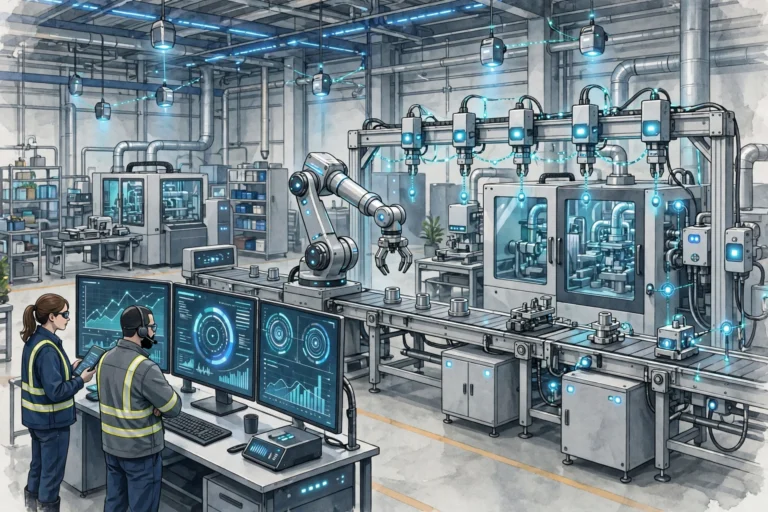
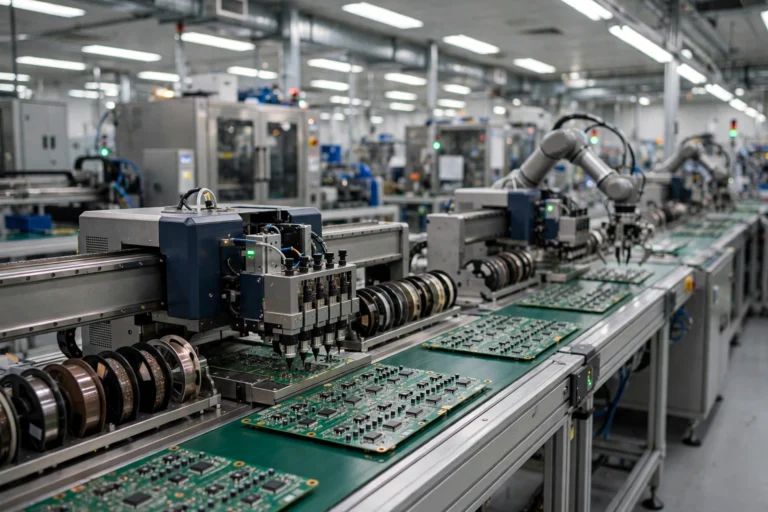
Read more on USABite: how connected machines run modern factories, how automation runs modern industry, and how automated SMT lines build electronics.
Frequently asked questions
What is utility company automation?
Utility company automation is the use of sensors, smart meters, control software, and communications networks to monitor and operate power, water, and gas networks with minimal manual work. It covers SCADA control rooms, advanced metering infrastructure, distribution automation, and predictive maintenance.
How does utility automation reduce power outages?
Sensors and smart meters report faults instantly, and systems such as FLISR automatically reroute supply around the damaged section, so fewer customers lose power and restoration starts sooner. The U.S. Department of Energy notes that modernized grids can greatly reduce outage frequency and duration and restore service faster.
What is AMI, and how is it different from a smart meter?
A smart meter is the device on your premises. AMI is the whole system around it: the meter, the communications network, and the data management software that turn readings into billing, outage alerts, and load forecasts. AMI enables two-way communication between the utility and the customer.
How much does utility company automation cost?
Costs vary widely by utility size and network age, and rollouts are usually phased over several years and recovered through regulated rates. The case for investment rests on avoided costs such as fewer truck rolls, lower line losses, faster restoration, and deferred network upgrades, which the DOE estimates could reach $5–35 billion nationally over five years for advanced grid solutions.
Is utility automation safe from cyberattacks?
No system connected to a network is risk-free, and a National Academies report warns that grid automation adds cybersecurity complexity alongside its reliability benefits. Utilities mitigate this by segmenting operational networks from office IT, controlling remote access, and keeping manual override capability for critical equipment.
Sources
- U.S. Department of Energy — Grid Modernization and the Smart Grid
- Renewable Energy World — DOE: Advanced grid solutions could add up to 100 GW in capacity
- Precedence Research — Advanced Metering Infrastructure market (citing FERC 2024 advanced meter figures)
- Grid — Smart Utility Metering for U.S. Utilities
- MDPI Applied Sciences — Evaluating the Performance of Smart Meters