Equipment Automation Explained: What It Is, the Four Types, and How to Choose
Key takeaway: Equipment automation means using machines, controllers, sensors, and software to run industrial equipment with minimal human intervention. It comes in four main types — fixed, programmable, flexible, and integrated — and the right choice depends on your production volume, how often products change, and how much you can spend up front.
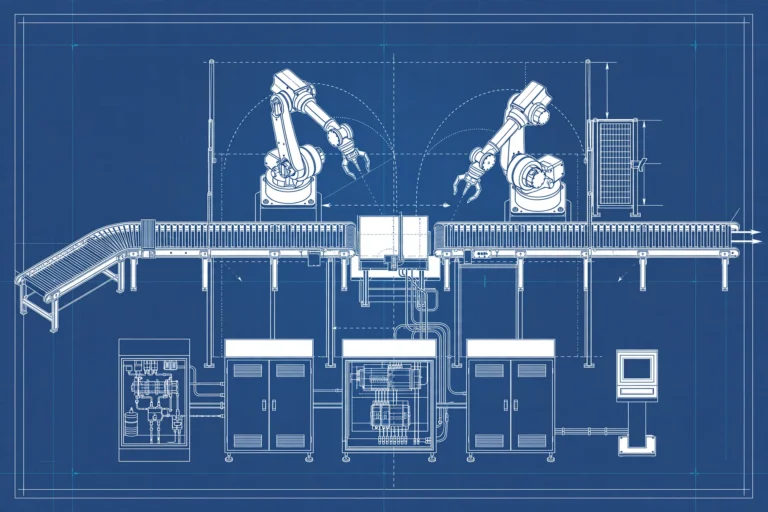
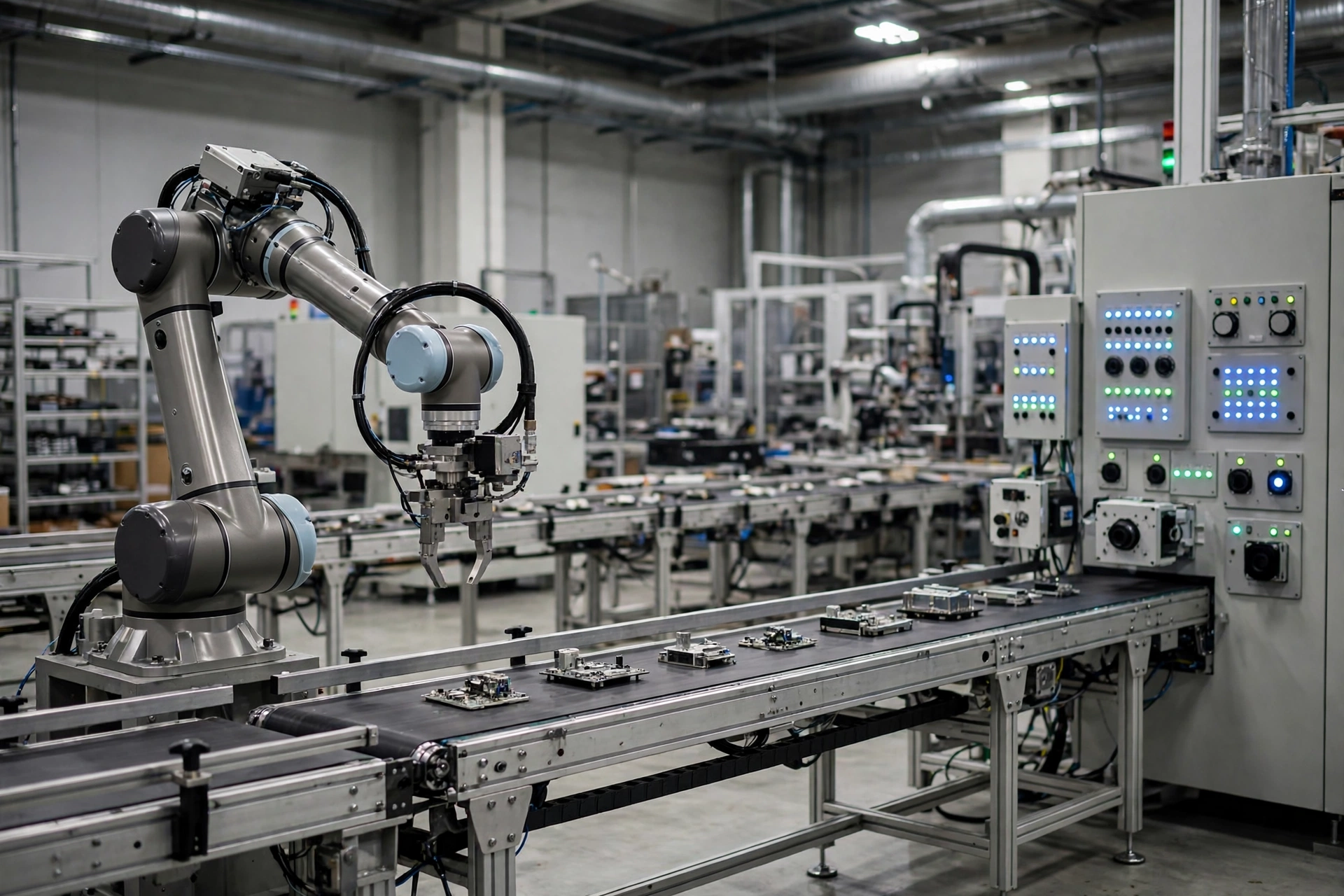
Walk onto a modern factory floor and the first thing you notice is how little hands-on handling is happening. Conveyor belts move parts, robotic arms weld and pack, and screens show the whole line’s status in real time. That is equipment automation: control systems, machinery, and software working together so production runs with minimal human intervention.
What Is Equipment Automation?
Equipment automation is the use of machines, control systems, sensors, and software to operate industrial equipment automatically or with limited human involvement. Sensors measure what is happening, controllers decide what to do next, actuators carry out the action, and supervisory software lets people monitor and manage the process. It covers everything from a single automated conveyor to a fully connected smart factory.
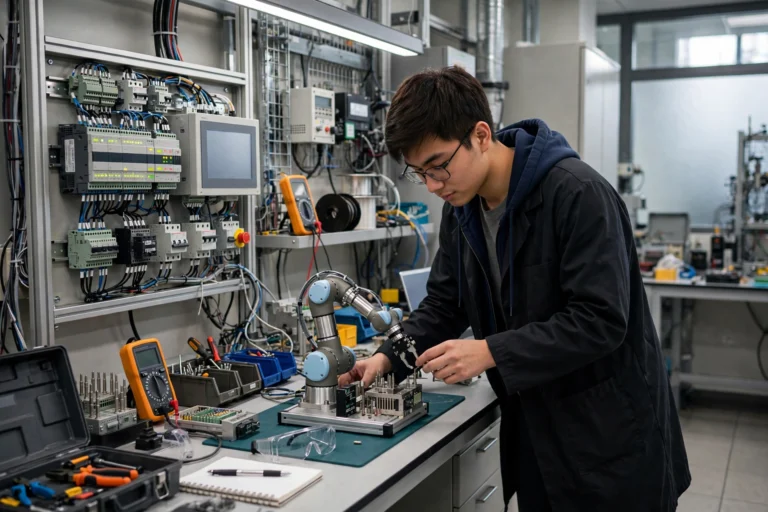
The building blocks are consistent across industries: programmable logic controllers (PLCs) that run machine logic, industrial robots that handle, weld, or assemble parts, human-machine interfaces (HMIs) that show operators what is happening, sensors, variable frequency drives, SCADA systems that supervise whole lines, machine vision cameras that inspect quality, and safety controllers that stop equipment when something goes wrong.
The market is large and still growing, though estimates vary a lot by what analysts count. Reports and Data put the global industrial automation market at $238.45 billion in 2025, while Fortune Business Insights valued the automation services segment alone at $186.89 billion in 2025. One widely reported anchor: annual industrial robot installations have exceeded 540,000 units globally, according to the International Federation of Robotics as cited by Reports and Data.
The Four Types of Equipment Automation
Automation is usually grouped by how easily the equipment adapts when the product changes. The four types are fixed, programmable, flexible, and integrated.
| Type | Best for | Typical examples | Trade-off |
|---|---|---|---|
| Fixed (hard) automation | Very high volumes of one identical product | Bottling lines, transfer machines, dedicated assembly lines | Fast and efficient, but hard to change |
| Programmable automation | Batch production with changing products | CNC machines, batch process systems, 3D printers | Flexible, but changeovers take time |
| Flexible automation | Frequent product changes, variable volumes | Robot cells, flexible manufacturing cells, autonomous mobile robots | Quick changeovers, but higher complexity and cost |
| Integrated automation | Whole-plant coordination | Connected lines with IIoT, MES, and AI-assisted inspection | Maximum visibility, but the biggest investment and skills demand |
Fixed automation uses specialized equipment for one task at high speed — automotive assembly lines or beverage bottling. Programmable automation can be reprogrammed for different batches, suiting food plants switching flavours or package sizes. Flexible automation switches products with little or no changeover time, using robot cells and autonomous mobile robots. Integrated automation connects machines, sensors, and production software into one digital network, sometimes called lights-out manufacturing when lines run without people on the floor.
Equipment Automation vs. Other Automation Approaches
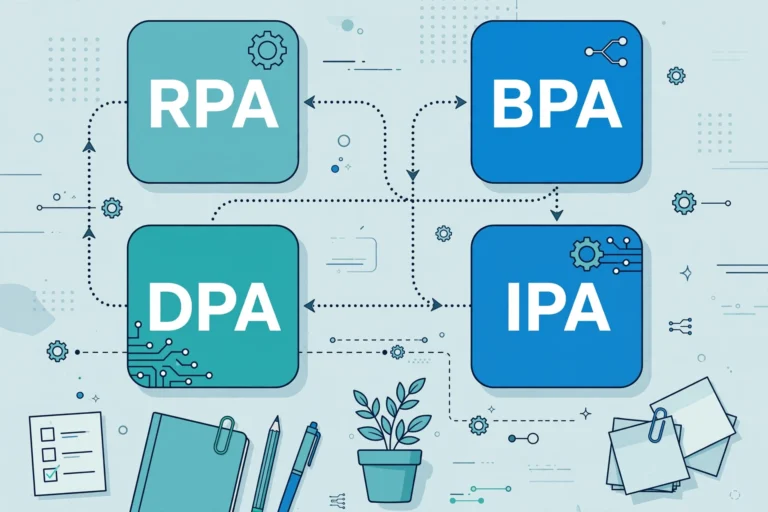
Equipment automation is the physical side of industrial automation: the machines and controllers themselves. It is not the same as business process automation (office workflows) or robotic process automation (software tasks on computers, not physical equipment). And a single robot is just one component — equipment automation is the whole system of robots, controllers, sensors, and software working together.
What Does Equipment Automation Cost?
There is no single price: a standalone conveyor or one collaborative robot cell can be a modest capital project, while an integrated line with robotics, vision, and plant-wide software is a major investment. Budget for three buckets: hardware, software and integration, and ongoing maintenance, cybersecurity, and training. Analysts consistently name high upfront cost and legacy-system integration as the main restraints, so a realistic budget must include integration and training, not just the machine’s sticker price.
The payback case rests on higher throughput, fewer defects, less unplanned downtime, and lower injury risk. One market analysis reported line productivity gains of 18% to 22% and downtime cuts of nearly 30% where predictive maintenance is in place — but treat analyst figures as estimates, not guarantees, and demand a pilot measured on your own line before committing at scale.
What You Need Before You Automate
Automation fails most often on prerequisites, not hardware. You need stable, documented processes — automating a chaotic process just produces defects faster. You need reliable power, networking, and data infrastructure, especially for integrated systems. You need people: controls engineers, robotics programmers, and maintenance staff are in short supply, a shortage Fortune Business Insights flags as a major industry challenge. And you need a safety plan, including risk assessments and safety controllers, before machines move faster than people can react.
Risks and Limits of Equipment Automation
Automation is not a cure-all. Fixed systems can become stranded assets if the product changes. Connected controllers create cybersecurity exposure, one reason vendors are investing heavily in industrial cybersecurity. Over-automation can reduce flexibility: a line built for one product at maximum speed may be the wrong answer for a market that rewards variety. Roles also shift from manual operation toward supervision, programming, and maintenance, so retraining must be part of the plan.
How to Choose the Right Equipment Automation
Start with two questions: how many units do you make, and how often does the product change? Very high volume, one product: fixed. Batches that change regularly: programmable. Frequent changes and variable volumes: flexible. Whole-plant visibility: integrated. Then pilot one cell, measure throughput, defect rate, downtime, and safety incidents against the manual baseline, and only then scale. Prefer open architectures where possible, so you can mix vendors without rebuilding control logic.
Analysis: Buy the System, Not the Robot
The most common buying mistake is shopping for a robot when you need a system. A robot arm is the visible part, but the value comes from the controllers, sensors, software, and integration around it — and from the process discipline underneath. The winning approach is boring on purpose: document the process, automate one bottleneck, measure honestly, then expand. Companies that skip the pilot and buy the biggest system first end up running a bad process faster.
Frequently Asked Questions
What is equipment automation in simple terms?
Equipment automation means machines, sensors, controllers, and software run industrial equipment with minimal human intervention. Sensors measure, controllers decide, actuators act, and supervisory software lets operators monitor production. It ranges from a single automated conveyor to a fully connected factory line.
What are the four types of equipment automation?
The four types are fixed, programmable, flexible, and integrated automation. Fixed suits high-volume identical products, programmable suits batch production, flexible suits frequent product changes, and integrated connects whole plants into one coordinated digital system. The right type depends on volume, product variety, and budget.
What equipment is used in industrial automation?
Common equipment includes programmable logic controllers (PLCs), industrial robots, human-machine interfaces (HMIs), industrial sensors, variable frequency drives, SCADA systems, machine vision cameras, automated conveyors, and safety controllers. Together they measure, control, move, inspect, and protect production processes.
How much does equipment automation cost?
Costs vary widely, from a single robot cell to a full integrated line. Budget for three buckets: hardware, software and integration, and ongoing maintenance, cybersecurity, and training. High upfront cost and legacy-system integration are the most commonly cited barriers, so a pilot measured on your own line is the safest way to validate payback.
Is equipment automation worth it for small manufacturers?
It can be, if scoped tightly. Small firms usually benefit most from one programmable or flexible cell aimed at a clear bottleneck — a packaging, inspection, or material-handling step — rather than a plant-wide system. Stable processes, basic networking, and staff training matter more than the size of the first purchase.
Related Reading
If you are planning a wider automation programme, see our guides to office automation systems, business process testing automation, the automation manager role, and application service automation.
Sources
Balluff — Breaking Down Industrial Automation: 4 Key Types
Universal Technical Institute — Types of Automation
oTechWorld — Industrial Automation Systems: Types & Real Examples
Fortune Business Insights — Industrial Automation Services Market
Reports and Data — Industrial Automation Market, 2025–2035