Automation Engineering Solutions Explained: What They Are, How They Work, and When to Use Them
Key takeaway: Automation engineering solutions are the designed systems — PLCs, sensors, robots, SCADA and MES software — that let factories and plants run with minimal human intervention. An engineering firm designs, builds and commissions the whole loop: sense, decide, act. The global industrial automation market is worth about $261 billion in 2026.
Automation engineering solutions sit behind almost everything manufactured today, from car parts to packaged food. They are not a single product: they combine hardware, software and engineering services that design, build and maintain systems which run industrial processes on their own.
What Are Automation Engineering Solutions?
An automation engineering solution is a complete, engineered system that replaces manual work in an industrial process with control systems, machines and software. It covers design, integration, programming, commissioning and ongoing support — not just the sale of a robot or a controller.
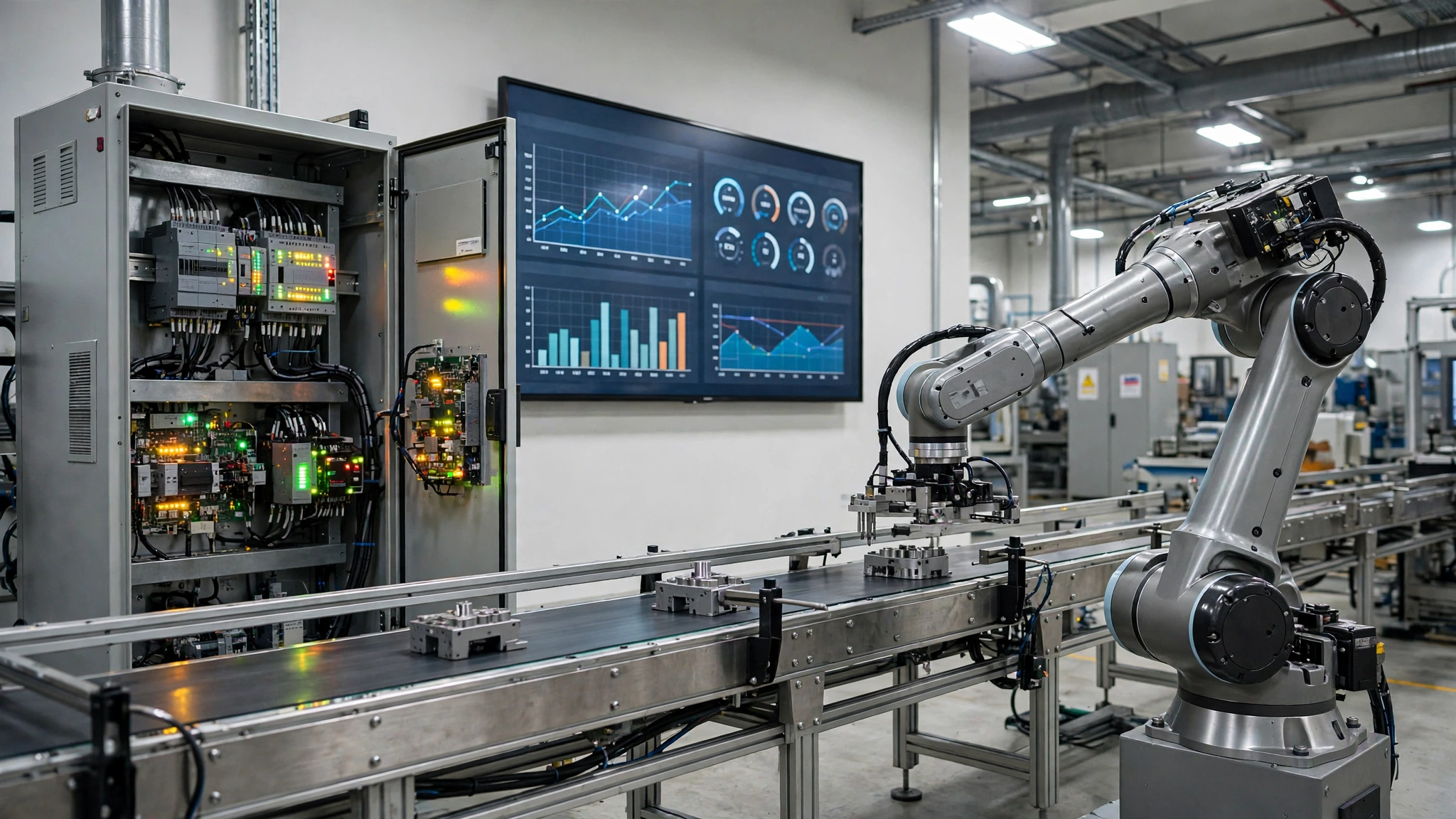
Industrial automation engineering designs, develops, integrates and maintains these systems, combining electrical, mechanical, software and data engineering. The goal is consistent output, higher accuracy, safer operation and real-time visibility into equipment performance. Every automated station runs the same loop — measure, decide, act, record: a sensor detects a condition, a controller (usually a PLC) runs the programmed logic, and an actuator moves or adjusts the machine. Sciotex’s engineering guide and Pacific Blue Engineering describe the same core idea: sensors, controllers and software working together so a process follows predefined rules instead of relying on human hands at every step.
The Four Types of Industrial Automation Compared
Engineers group automation by how easily it changes to a new product. Most plants run more than one type.
| Type | How it works | Best for | Changing products |
|---|---|---|---|
| Fixed (hard) automation | Sequence built into the machine’s mechanics | One product at very high volume | Impractical; usually means rebuilding |
| Programmable automation | Equipment reprogrammed between batches | Batch production, medium volume | Downtime to load a new program |
| Flexible (soft) automation | Switches variants with little downtime | Multiple variants, medium volume | Fast; program change only |
| Integrated automation | Machines, data and business systems linked | Whole lines or plants | Managed centrally from MES and ERP |
Fixed automation is the cheapest per unit at huge volumes but the least adaptable. Integrated automation is the most capable — and the most expensive to build and maintain.
Core Components: PLC, SCADA, Robots and MES
Most systems share the same building blocks. PLCs are rugged industrial computers that run machine sequences and safety interlocks reliably for years; they are the largest single technology segment, with about 40.6% of the market in 2026, according to Coherent Market Insights. SCADA gives operators a live view of the process from one screen. DCS handles continuous processes such as oil, gas and chemicals. Industrial robots do repetitive, precise or hazardous work such as welding and inspection. MES sits above the machines, tracking orders, quality and output.
That report puts the global market at about $261.23 billion in 2026, growing to $455.26 billion by 2033 at a 9.7% compound annual rate. Other firms estimate differently — Research and Markets puts 2026 at $131–225 billion — so treat any single figure as an estimate.
What Does an Automation Engineering Solution Cost?
Cost varies far more than most buyers expect, because the price is mostly engineering hours, not hardware. A single PLC-controlled machine cell can cost tens of thousands of dollars; a full line with robots, vision inspection and MES integration runs into hundreds of thousands. According to Mordor Intelligence, integrated MES–SCADA deployments often require $2–8 million per site, with paybacks exceeding three years in thin-margin sectors such as food processing. Ask for the total cost of ownership — programming changes, spare parts and operator training — not just the installation quote.
How to Choose an Automation Engineering Solution
Start with the problem, not the technology. Match the automation type to your volume; ask for past projects in your industry and with your PLC or SCADA brands; demand open standards so the system is cheaper to extend; budget for maintenance, updates and spare parts; and start with a pilot on one cell or line, measure the payback, then scale. This staged approach is the same one that works for automation implementation projects generally. Related reading: industrial automation and IoT, automation tooling and equipment, and motor drives in automated systems.
Risks and Limits to Know Before You Buy
Automation is not a guaranteed win. Upfront costs are high, payback can stretch past three years, and a poorly specified system can lock a plant into one product or one vendor. Cybersecurity is a real risk: connecting machines to networks exposes control systems never designed to face the internet. And automation changes jobs — it removes repetitive manual roles while creating demand for technicians, programmers and maintenance engineers.
Analysis: The Real Value Is Integration, Not Robots
Analysis: The hardware gets the attention, but the engineering is where the value sits. A robot on its own is a commodity; a system where sensors, PLCs, SCADA and MES share data — and where the line can switch products without a rebuild — is what actually cuts cost per part. If a proposal spends more pages on the machines than on integration, data flow and support, it is selling equipment, not a solution.
Frequently Asked Questions
What is an automation engineering solution?
It is a complete engineered system — hardware, software and services — that designs, builds and maintains automated control of an industrial process. It typically includes PLCs, sensors, actuators, robots, SCADA or MES software, and the integration and support work that connects them.
What are the four types of industrial automation?
Fixed, programmable, flexible and integrated automation. Fixed suits one product at very high volume, programmable suits batches, flexible suits multiple variants with fast changeovers, and integrated automation links whole lines or plants under computer control through MES and ERP systems.
How much does an automation engineering solution cost?
A single automated cell can cost tens of thousands of dollars, a full robotic line hundreds of thousands, and an integrated MES–SCADA deployment often $2–8 million per site, according to Mordor Intelligence. Engineering, integration and support are usually a larger share of the total than the hardware itself.
What is the difference between PLC, SCADA and MES?
A PLC runs a machine’s logic in real time. SCADA is the supervisory software operators use to monitor and control a process from screens. MES sits above both, managing production orders, quality data and schedules across a plant and connecting shop-floor data to business systems.
When should a business invest in automation engineering?
When volumes are stable enough to justify the upfront cost, when quality or safety depends on consistency humans cannot sustain, or when labour shortages limit output. Start with a pilot on one cell or line, measure the payback, and scale only after the numbers work.
Sources
- Sciotex — Industrial Automation: A Manufacturing Automation Guide
- Pacific Blue Engineering — Decoding Industrial Automation Solutions
- Coherent Market Insights — Industrial Automation Market Size and Forecast, 2026–2033
- Mordor Intelligence — Factory Automation and Industrial Controls Market Size & Growth Trends 2031