
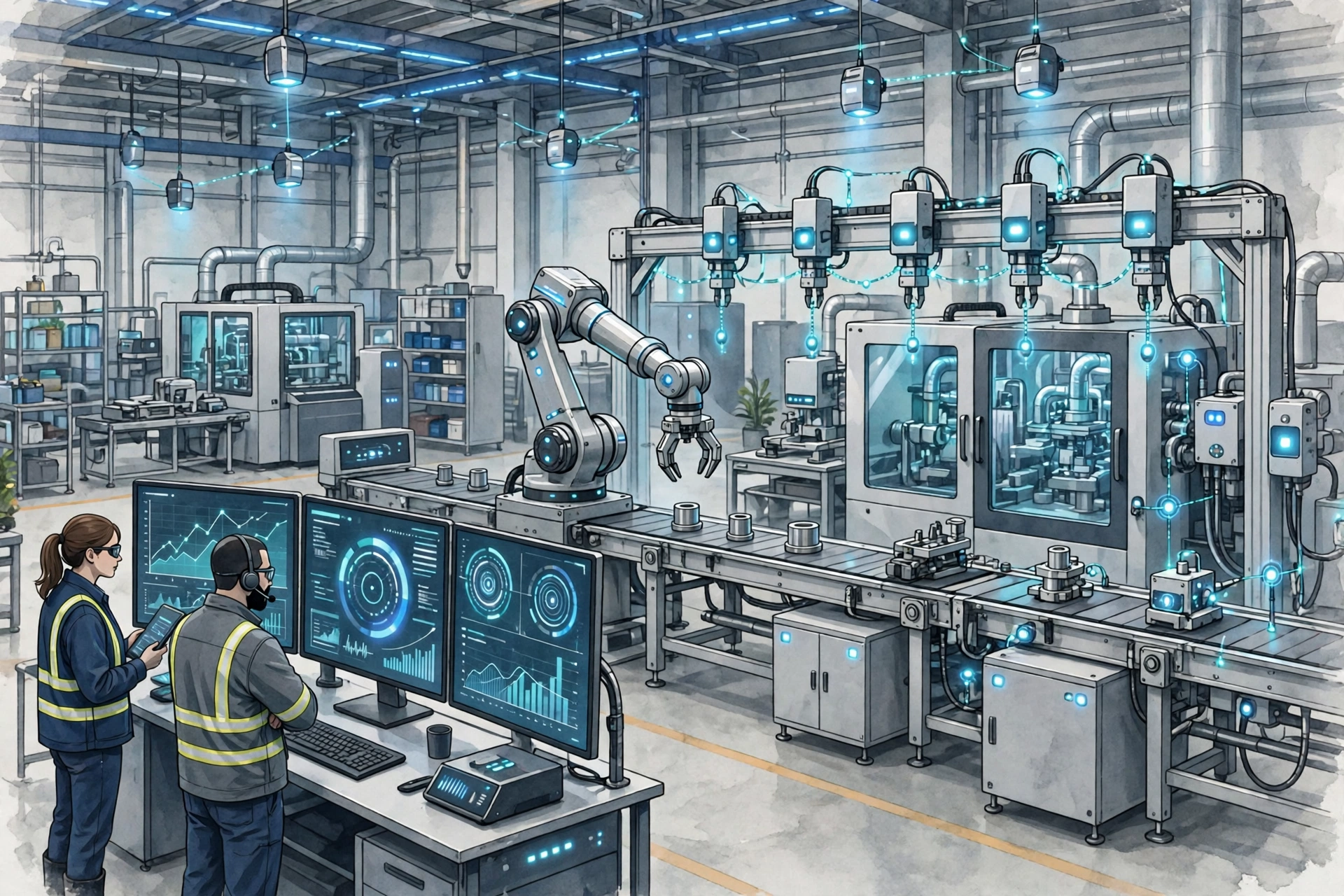
IoT-Enabled Industrial Automation Explained: How Connected Machines Run Modern Factories
Key takeaway: IoT-enabled industrial automation connects factory sensors, controllers and analytics software so machines report their own condition in real time. Instead of waiting for a breakdown, teams spot wear, heat or vibration changes early, plan maintenance during scheduled downtime, and run production with far less guesswork.
IoT-enabled industrial automation — often shortened to IIoT, the Industrial Internet of Things — turns a traditional automated factory into a connected one. Factories have used programmable logic controllers (PLCs), sensors and supervisory control systems for decades. What changes is that their data no longer stays locked on a local screen: it flows, securely and selectively, to dashboards where people can act on it.
What Is IoT-Enabled Industrial Automation?
IoT-enabled industrial automation is the use of connected sensors, edge computing and analytics to monitor, analyse and optimise industrial processes. Sensors measure what is happening, a controller keeps the process running safely, and a connected layer adds visibility, history and prediction on top. Tractian defines IIoT as the industrial subset of the Internet of Things, built for harsher conditions, higher reliability and direct links to operational technology such as SCADA, DCS and PLCs.
Control versus visibility is the key distinction. Safety-critical control stays local, on the PLC or distributed control system. The IoT layer does not replace it; it reads from it, usually through a gateway, and turns readings into alerts and trends. A network outage should therefore pause only the remote view — never the production line itself.
How IoT-Enabled Industrial Automation Works
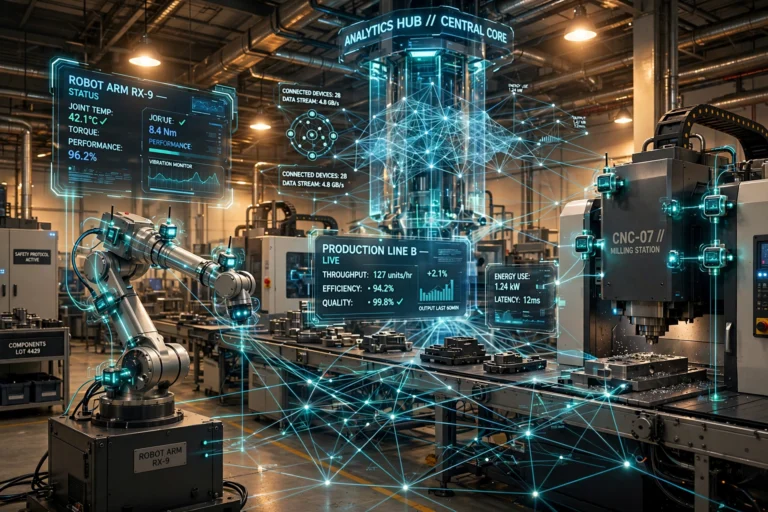
A typical system has five layers. Sensors and actuators measure temperature, pressure, vibration, flow and current, and act on the process through valves, motors and robotic arms. Controllers — PLCs and DCS units — run the control logic locally. Connectivity (MQTT, OPC-UA, Modbus, industrial Ethernet, Wi-Fi or 5G) carries data onward. Edge computing filters and analyses data close to the machine, so local alerts fire even if the cloud link drops. Finally, a platform stores the data and builds dashboards, analytics and maintenance alerts.
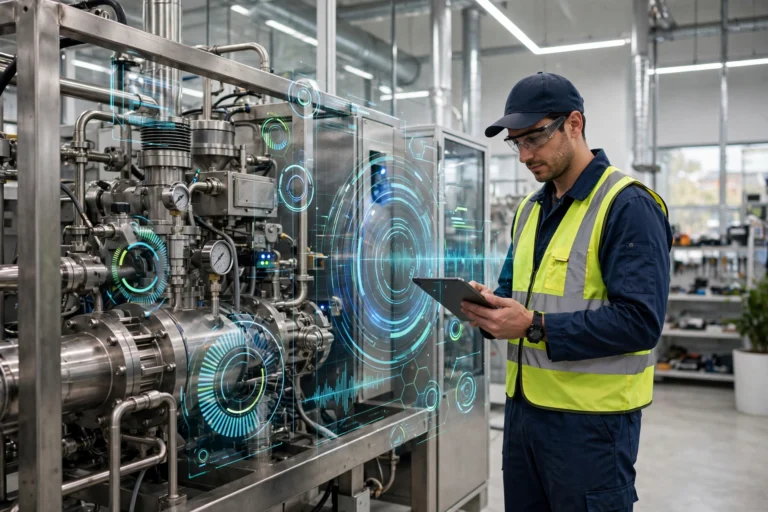
In practice, a vibration sensor on a pump can trigger a work order before a bearing fails, an energy dashboard can expose a machine drawing power overnight, and a quality team can trace a defect to the exact shift, line and sensor reading behind it.
IoT-Enabled Automation vs Traditional Automation vs Consumer IoT
IoT-enabled automation is neither old-style factory automation nor a smart home device on a factory floor. The table below makes the difference concrete.
| Feature | Traditional automation | IoT-enabled industrial automation | Consumer IoT |
|---|---|---|---|
| Main job | Control a machine locally | Control locally, plus monitor, predict and optimise across the plant | Convenience at home |
| Data use | Mostly live, on a local screen | Live plus trends, alerts and analytics | Live status, simple history |
| Cost of downtime | High | High — which is why prediction matters | Low |
| Security stakes | High, but isolated | Critical, as connectivity adds entry points | Important, not safety-critical |
Where IoT-Enabled Industrial Automation Pays Off
The strongest use cases are where an unplanned stop is expensive or a small drift ruins quality. Predictive maintenance leads the list: analytics learn a machine’s normal vibration, temperature and current pattern, then flag a deviation while there is still time to plan a repair. TeamViewer notes the same pattern across efficiency, safety and sustainability — fewer manual checks, faster decisions, and energy tracked machine by machine.
Other proven uses include energy monitoring, quality monitoring that catches drift before a batch is scrapped, and remote monitoring of pumps, compressors and sites that are costly to visit. For the wider automation picture, see general industries automation, manufacturing automation integration and electronics assembly automation.
How Much Does IoT-Enabled Industrial Automation Cost?
IoT-enabled industrial automation costs vary so widely that any single price would mislead, so start from the cost drivers. Sensors and gateways are usually the cheapest part; the real costs are integration with legacy equipment, the platform subscription, cybersecurity hardening, and the staff time needed to act on the data. A single-line pilot is a modest project; a plant-wide rollout is a capital programme, judged on avoided downtime and scrap rather than hardware alone.
Market estimates underline the scale of spend but measure different things, so compare them carefully. MarketsandMarkets puts the IIoT platform market alone at $12.55 billion in 2026, rising to $29.40 billion by 2032 at a 12.8% compound annual growth rate. Broader industrial IoT estimates that include hardware and services run far higher. Price your own pilot — hardware, integration, platform and support — rather than anchoring on a market total.
What Do You Need Before You Start?
IoT-enabled industrial automation needs four prerequisites. First, a clear problem: one machine, line or cost worth measuring. Second, a network plan that keeps operational technology separate from office IT, with the gateway as a controlled bridge. Third, a data owner who will check alerts and close the loop with maintenance. Fourth, a baseline: without a few weeks of normal readings, analytics cannot tell a fault from normal variation.
Start small on purpose. Pick one asset with a known failure mode, prove the alert arrives early and the saving is real, then expand. This avoids the most common failure: a wall of dashboards nobody trusts and nobody acts on.
What Are the Risks and Limits?
IoT-enabled industrial automation carries real risks, led by cybersecurity. Connecting previously isolated control systems to IP networks creates entry points that did not exist before, so segmentation, device authentication, encryption and patching are essential. Legacy integration is the second limit: older machines may need gateways or retrofits. Data overload is the third: without edge filtering and clear alert rules, teams drown in noise and start ignoring the system. None of these is a reason to avoid the technology — each is a reason to pilot carefully rather than connect everything at once.
Analysis: Why This Matters Now
Analysis: IIoT is moving from pilots to standard practice not only because sensors got cheaper, but because the cost of surprise — an unplanned stop, a scrapped batch, an unexplained energy bill — now outweighs the cost of visibility. The factories that benefit most are not those with the most sensors, but those with the clearest problem and the tightest loop between alert and action, keeping control local while letting insight travel. On the software side, our guide to robotic process automation architecture covers the office-process equivalent: automate routine work, but keep a human in charge of the decision.
Frequently Asked Questions
What is IoT-enabled industrial automation?
IoT-enabled industrial automation connects industrial sensors, controllers and analytics software so factory equipment reports its condition in real time. Control stays local on PLCs and similar systems, while the connected layer adds monitoring, alerts, trends and predictive maintenance on top of that control.
How is IIoT different from consumer IoT?
Consumer IoT covers smart home and wearable devices where convenience is the goal and downtime is a nuisance. IIoT covers factories, energy plants and utilities, where reliability and security are critical, data volumes are far larger, and a failure can stop production or endanger workers.
What equipment do you need to start with IoT-enabled industrial automation?
You need sensors for the measurements that matter, a gateway or edge device to collect and filter the data, connectivity such as industrial Ethernet or 5G, and a platform to store, visualise and analyse it. Most factories also keep their existing PLCs and SCADA systems, adding the IoT layer rather than replacing the control layer.
How much does IoT-enabled industrial automation cost?
Costs vary widely because integration, platform fees, cybersecurity and internal time usually outweigh sensor hardware. A single-line pilot is a modest project, while a plant-wide rollout is a capital programme. Judge the investment on avoided downtime, scrap and energy waste from your own pilot, not on a headline market figure.
Is connecting factory machines to the internet safe?
It can be done safely, but only with deliberate design: keep operational technology segmented from office IT, use authenticated and encrypted connections, patch devices, and treat the gateway as a controlled bridge. The risk comes from connecting equipment without those controls, not from connectivity itself.
Sources
- Tractian — IIoT (Industrial Internet of Things): Definition
- TeamViewer — IIoT: What Is Industrial IoT?
- MarketsandMarkets — IIoT Platform Market
- 6Wresearch — Industrial IoT Market Size


One Comment
Comments are closed.