Claims Workflow Automation Explained: How Insurance Claims Move From Filing to Payment
Key takeaway: Claims workflow automation uses AI, rules engines, and robotic process automation to move an insurance claim from first notice of loss to payment with far less manual handling. Simple claims can be settled in hours instead of days, while complex or suspicious claims are routed to human adjusters with the file already assembled.
When you file an insurance claim, a surprising amount of work happens before anyone decides whether you get paid. Someone has to read your forms, pull your policy, check your coverage, verify the damage, look for fraud signals, and arrange payment. Claims workflow automation hands those repetitive steps to software, so the claim moves through a defined workflow instead of sitting in an inbox waiting for a person.
It matters because claims are where insurers keep or lose customers. A slow, opaque process frustrates people at their worst moment, while a fast, transparent one builds loyalty. For insurers, claims handling is also one of the largest operating costs, which is why automation has moved from experiment to standard practice across property, auto, health, and life lines.
What claims workflow automation actually covers
Claims workflow automation is not one tool. It is a chain of technologies applied to the full claims lifecycle, from initial intake to final settlement, as described in guides from Kognitos and AI21. The pieces typically include:
- Digital intake: claims reported through apps, portals, or email instead of paper forms and phone queues.
- Intelligent document processing: optical character recognition and language models extract data from claim forms, medical reports, photos, and repair estimates.
- Rules engines: software checks the claim against policy terms, coverage limits, and deductibles.
- Fraud and severity scoring: machine learning models compare the claim against patterns across thousands of past claims.
- Workflow routing: the system sends each claim to the right place — automatic payment, a specialist adjuster, or a fraud team.
- Payment and communication: approved claims trigger payment, and the policyholder gets status updates without calling.
How a claim moves through an automated workflow
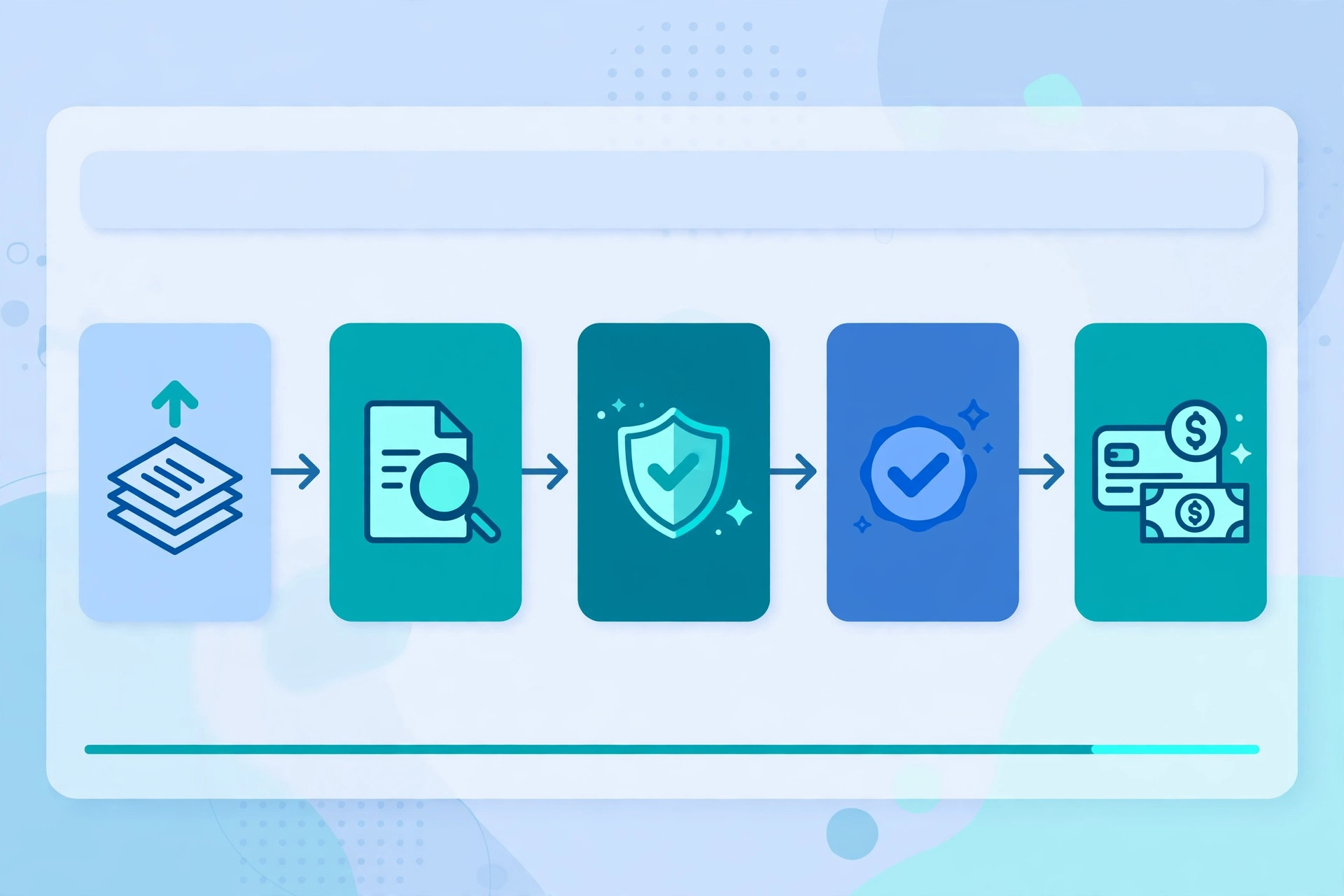
The journey usually follows the same six stages, whether the claim is for a dented car or a flooded kitchen:
- First notice of loss (FNOL). The policyholder reports the incident, often with photos or a short video. Getting this step right matters, because errors here are hard to correct later.
- Data extraction and validation. Software pulls the key facts from documents and checks them against the policy, coverage limits, and historical records to confirm eligibility.
- Triage. The claim is scored for complexity, value, and fraud risk, then routed accordingly.
- Assessment. For property and auto claims, image-based tools can estimate damage from photos; for other lines, rules and models check the numbers.
- Decision. Simple claims that pass every check are approved through straight-through processing, with no human touch. Anything flagged goes to an adjuster, with the evidence already gathered.
- Settlement and audit. Payment is issued, the customer is notified, and every step is logged in an audit trail that supports regulatory compliance.
Manual claims vs automated claims
| Stage | Manual process | Automated workflow |
|---|---|---|
| Intake | Phone call or paper form, retyped by staff | App or portal submission, data extracted automatically |
| Document handling | Filed and read by hand, prone to missing pages | Documents classified and checked for completeness on arrival |
| Triage | An adjuster reads the file and decides priority | Rules and models score and route the claim instantly |
| Fraud check | Relies on one handler’s experience | Compared against patterns across the whole book of claims |
| Simple-claim settlement | Days to weeks, depending on backlog | Hours, or minutes for the simplest cases |
| Audit trail | Reconstructed from notes and emails | Logged automatically at every step |
What the numbers say — and what to be careful about
Vendor and industry reports paint a consistent picture, but the exact figures vary by source, so treat them as reported ranges rather than promises. CoinLaw’s 2026 claims statistics roundup reports handling-cost reductions of 25 to 40 percent for end-to-end automation and cycle-time cuts of 40 to 60 percent, while ScienceSoft’s automation guide cites around a 30 percent drop in processing costs and straight-through processing for more than half of cases. The most famous real-world example is Lemonade: its claims bot, AI Jim, approved a stolen-coat claim in just 3 seconds in December 2016, after cross-referencing the policy and running 18 anti-fraud algorithms, according to Lemonade’s own account. Lemonade has since reported that 55 percent of its claims are fully automated end to end.
Fraud detection is the other headline benefit. The FBI estimates that 5 to 10 percent of non-health insurance claims are fraudulent, costing US insurers more than $40 billion a year, a figure cited in ScienceSoft’s guide. Automated systems can compare a new claim against patterns across an insurer’s entire history, something no single handler can do from memory.
Claims workflow automation vs related automation
It helps to place claims automation beside its neighbours, because vendors often blur the lines. IT process automation (ITPA) is the broader discipline of automating IT operations, while robotic process automation copies human screen actions for fixed, repetitive steps. Claims workflow automation combines both with AI: RPA moves data between systems, AI reads documents and scores risk, and workflow software orchestrates the whole chain. Dynamic AI agents are the newest layer, able to plan multi-step claim tasks and adapt when a case does not fit the script. And the same pattern — automate the routine, keep humans for judgment — shows up in other back offices too, as in automation of HR compliance workflows.
Cost: what an insurer actually pays for
There is no standard price. A small carrier buying an off-the-shelf claims platform pays a subscription plus implementation, while a large insurer building on its own systems faces integration work that often costs more than the software itself. The honest budget includes data cleanup, connecting legacy policy systems, staff training, and ongoing model monitoring. Deployments can go live in weeks for standard setups or take months for heavily customised ones. The return comes from lower handling costs and faster settlement — but only if enough simple claims qualify for straight-through processing.
Prerequisites: what has to be true before it works
Automation amplifies whatever data it is fed. Insurers need clean, structured policy and claims data, a single view of the customer across systems, and clear rules for what qualifies for automatic approval. Legacy systems are the usual blocker: if policy data lives in three disconnected databases, the workflow cannot validate a claim without human help. Someone must also own the rules and update thresholds as fraud patterns change.
Risks and limits
Automation is not a fit for every claim. Catastrophe claims, disputed liability, and high-value losses still need experienced adjusters, and regulators expect insurers to explain automated decisions and offer a fair appeals route. There is also a customer-trust risk: a claim denied or delayed by an opaque system feels worse than the same outcome explained by a person. The carriers that do this well keep a visible human escalation path and use automation to speed up approvals, not to quietly reject claims. Analysis: the realistic end state is hybrid — machines clear the routine majority, humans handle the exceptions.
What to watch next
Expect claims automation to push further into photo and video assessment, where damage is priced from images, and into sensor-driven claims, where connected cars and homes report incidents automatically. The open question is regulation: as more decisions are made by models, expect stricter requirements on explainability, bias testing, and human oversight. For policyholders, the practical advice is simple — report claims promptly, keep photos and receipts, and use the insurer’s app or portal, since digital-first claims are the ones automation handles fastest.
Sources
- Kognitos — What Is Insurance Claims Automation? A Complete Guide
- AI21 — What is Insurance Claims Automation?
- Lemonade — Lemonade Sets a New World Record (AI Jim’s 3-second claim)
- CoinLaw — AI in Insurance Claims Statistics 2026
- ScienceSoft — Automated Claims Processing in Insurance (2026 Guide)
Frequently asked questions
What is claims workflow automation?
Claims workflow automation is the use of software, including AI, machine learning, and robotic process automation, to handle the repetitive steps of an insurance claim: intake, document handling, triage, coverage checks, fraud screening, decision-making, and payment. Simple claims can move through the whole workflow without human touch, while complex or flagged claims are routed to a human adjuster.
How does claims workflow automation work step by step?
It starts with first notice of loss, when the policyholder reports the claim through an app, portal, or phone call. Software extracts data from forms, photos, and documents, checks it against the policy and coverage limits, and scores the claim for fraud risk and complexity. Straightforward claims are approved and paid automatically, a process called straight-through processing, while anything unusual goes to an adjuster with the file already assembled.
How much does claims workflow automation cost, and what does it save?
Costs vary widely by insurer size, claim volume, and whether the system is bought off the shelf or built in-house, so there is no single price tag. Industry surveys and vendor reports commonly put handling-cost reductions in the 25 to 40 percent range and cycle-time cuts of 40 to 60 percent, but these are reported ranges from vendors and surveys, not guaranteed results, and legacy-system integration is usually the biggest hidden cost.
Will claims workflow automation replace claims adjusters?
No, it changes what adjusters spend their day on rather than removing them. Automation takes over data entry, document sorting, and simple triage, while adjusters still make judgment calls on complex, high-value, or disputed claims, negotiate settlements, and handle customers in difficult moments. Insurers that automate approvals generally still route denials and exceptions to people.
What are the risks and limits of claims workflow automation?
The main risks are bad data, over-automation, and weak oversight. If the incoming documents are incomplete or the rules are wrong, the system can approve claims it should not or delay valid ones. Automated decisions also need audit trails and human review routes to satisfy regulators and to handle appeals fairly, which is why most carriers keep a human in the loop for anything unusual.