What Are the New 2026 Federal Regulations for Workplace Heat Safety?
The 2026 OSHA Heat Safety Enforcement Framework
As of June 13, 2026, the federal landscape for workplace heat safety is governed by a revised National Emphasis Program (NEP) and the General Duty Clause of the OSH Act. While the specific “Heat Injury and Illness Prevention” rule remains in the final stages of review, OSHA Directive CPL 03-00-024, effective April 10, 2026, provides the active enforcement mandate. This directive targets 55 high-risk industries, including construction, warehousing, and delivery services, authorizing proactive inspections whenever the local heat index reaches 80°F.
To ensure accurate monitoring of these environmental triggers, many industrial facilities are now partnering with thermal and infrared metrology companies to install calibrated heat-sensing arrays. These systems allow employers to track the heat index in real-time, ensuring compliance with the two-tier trigger system that defines modern federal safety expectations. Failure to maintain a safe environment under these conditions is currently cited under the General Duty Clause, which requires employers to protect workers from recognized hazards that are likely to cause death or serious physical harm.
Step-by-Step Compliance for the 80°F Initial Heat Trigger
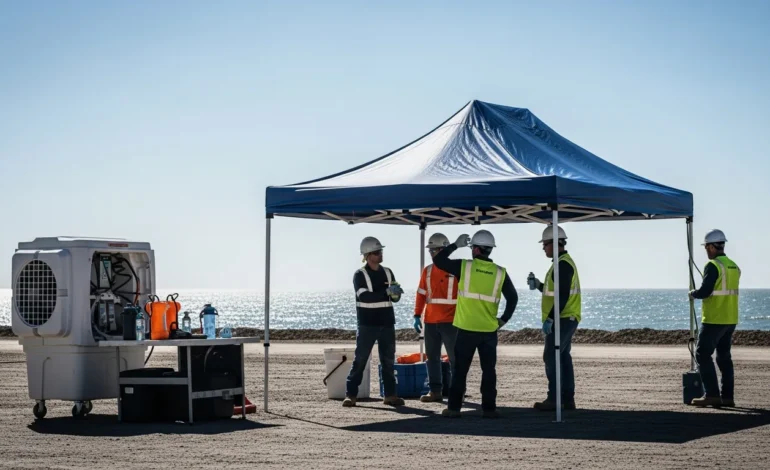
When the heat index reaches the 80°F Initial Heat Trigger, federal guidelines require immediate implementation of basic protective measures. Employers must provide at least one quart of cool drinking water per employee per hour, free of charge. This water must be located as close as practicable to the work area to encourage frequent hydration. Additionally, employers must provide access to shaded areas or climate-controlled break rooms that are large enough to accommodate all employees on break without crowding.
- Water Access: Provide 32 ounces of water per hour per worker.
- Shade Requirements: Shade must be present when temperatures exceed 80°F and available upon request below that threshold.
- Acclimatization: New and returning workers must follow a 14-day gradual workload increase, typically starting at 20% of normal duration on Day 1.
- Communication: Establish a two-way system (radio or phone) to monitor workers in isolated areas.
Mandatory Protocols for the 90°F High Heat Trigger
The 90°F High Heat Trigger activates enhanced safety protocols that are strictly enforced during the 2026 summer season. At this threshold, employers must implement mandatory rest breaks of at least 15 minutes every two hours. These breaks must occur in a designated “cool-down” area, which can include air-conditioned trailers or shaded areas equipped with misting fans. Employers are also required to implement a “buddy system” or regular observation to identify early signs of heat exhaustion or heat stroke among the crew.
Compliance with these rest cycles is as critical to business operations as adhering to the federal mileage rate for corporate travel. Documentation is key; OSHA inspectors in 2026 specifically look for written Heat Injury and Illness Prevention Plans (HIIPP) that detail these 90°F protocols. The plan must name a designated Heat Safety Coordinator responsible for monitoring site conditions and ensuring that no worker is left unobserved for extended periods during high-heat events.
Exceptions and What is NOT Allowed
The 2026 federal heat safety standards include specific limitations and prohibited practices that employers must recognize to avoid heavy citations. Most notably, employers are strictly prohibited from charging employees for water or required personal protective equipment (PPE) such as cooling vests. Furthermore, using electric fans in environments where the ambient temperature exceeds 95°F is generally discouraged by NIOSH and OSHA, as fans can actually increase the heat load on the body by blowing air that is hotter than the skin’s surface.
- Indoor Exceptions: Regulations do not apply to indoor work areas that are consistently maintained below 80°F via air conditioning.
- Short-Duration Tasks: Tasks lasting less than 15 minutes in any 60-minute period are generally exempt from the mandatory rest break requirements.
- Remote Work: Employees working from home or in telework environments are not covered under the employer’s site-specific heat plan.
- Sedentary Work: Office-based roles with minimal physical exertion are typically exempt unless the indoor heat index exceeds 80°F due to HVAC failure.
Penalties and Enforcement Timelines in 2026
OSHA updated its maximum penalty amounts on January 15, 2026, to account for inflation. For “Serious” or “Other-than-Serious” violations related to heat safety, the maximum fine is now $16,550 per violation. If an employer is found to have a “Willful” or “Repeated” violation—such as failing to provide water after a previous warning—the penalty can soar to $165,514 per violation. These fines are assessed per instance, meaning a single job site with multiple infractions can face six-figure liabilities in a single inspection.
The current enforcement timeline is immediate. The revised Heat NEP, which replaced the 2022 version on April 10, 2026, is scheduled to remain in effect until April 2031. This five-year window signals a long-term federal commitment to heat safety. Small businesses with 25 or fewer employees may be eligible for a 70% penalty reduction for first-time, non-willful offenses, but they must still demonstrate a good-faith effort to implement a written heat safety plan and provide basic necessities like water and shade.
Frequently Asked Questions
Does the 2026 heat rule apply to indoor warehouses?
Yes. The 2026 federal enforcement focus specifically includes indoor environments such as warehouses, commercial kitchens, and manufacturing plants. If the indoor heat index reaches 80°F, employers must provide water and shade/cool-down areas. At 90°F, mandatory rest breaks and active monitoring protocols apply. Indoor facilities without adequate ventilation or air conditioning are high-priority targets for OSHA inspections under the current National Emphasis Program.
What is the “Buddy System” required at 90°F?
The buddy system is a mandatory observation protocol where workers are paired up to monitor each other for signs of heat-related illness, such as confusion, excessive sweating, or dizziness. In 2026, OSHA requires this system to be active whenever the heat index hits 90°F. For solo workers, employers must maintain regular communication via phone or radio at least every two hours to ensure the employee is safe and hydrated.
How do I calculate the Heat Index for my job site?
Employers should use the OSHA-NIOSH Heat Safety Tool app or a calibrated wet-bulb globe temperature (WBGT) meter. The heat index is a measure of how hot it really feels when relative humidity is factored in with the actual air temperature. Because humidity significantly hinders the body’s ability to cool itself through sweat, the heat index is the only metric OSHA recognizes for triggering mandatory safety interventions in 2026.
Are there specific training requirements for 2026?
Yes. All employees and supervisors in high-risk industries must receive annual training on heat illness prevention. This training must cover how to recognize symptoms of heat exhaustion and heat stroke, the importance of acclimatization, and the company’s specific emergency response procedures. Documentation of this training is a primary requirement during an OSHA inspection; failure to provide training logs can result in a “Serious” violation citation and associated fines.